


Quick Answer
Acrylic polymer emulsion and latex are not two opposing material classes. In waterborne coatings, “latex” usually describes a dispersion of polymer particles in water. An acrylic polymer emulsion is a dispersion of acrylic or acrylic-copolymer particles in water, so it is often also called an acrylic latex.
The term “latex paint” is widely used for waterborne paint, but it does not identify one exact binder chemistry. A latex paint may be based on an all-acrylic, styrene-acrylic, vinyl-acrylic, vinyl acetate ethylene, styrene-butadiene, or another polymer system.
The practical question is not simply “acrylic emulsion or latex?” It is: what polymer chemistry, film-formation conditions, formulation, and tested performance does the product provide?
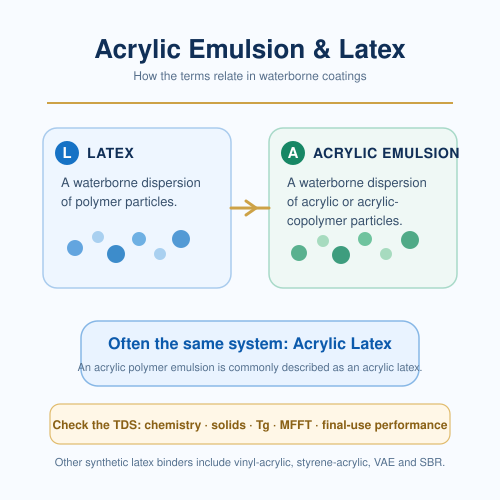
Acrylic Polymer Emulsion and Latex Are Often Overlapping Terms
In technical language, a latex is a stable dispersion of polymer particles in water. The particles remain separate while the product is stored and applied.
An acrylic polymer emulsion contains acrylic or acrylic-copolymer particles dispersed in water. Because it is a particle dispersion, it can also be described as an acrylic latex.
This means the terms often overlap:
Latex describes the waterborne particle-dispersion form.
Acrylic polymer emulsion identifies the polymer chemistry as acrylic-based.
Acrylic latex combines both descriptions.
The wording on a product label can vary by manufacturer, region, and application. For this reason, the technical data sheet is more useful than the marketing name alone.
The Most Useful Way to Read the Names
Term | What It Usually Means | What It Does Not Confirm |
|---|---|---|
Latex | A waterborne dispersion of polymer particles | The exact polymer chemistry |
Acrylic polymer emulsion | An aqueous dispersion of acrylic or acrylic-copolymer particles | Whether it is an all-acrylic formulation |
Acrylic latex | A latex binder with acrylic-based polymer chemistry | The final coating performance in every application |
Latex paint | A waterborne paint using a dispersed polymer binder | That it contains natural rubber or only acrylic polymer |
100% acrylic | A binder identified as acrylic-based | That the paint will meet every service condition without formulation and testing |
Common Waterborne Binder Families
Waterborne coatings use several polymer families. Each family can be designed for different film hardness, flexibility, adhesion, water resistance, gloss, cost, and application conditions.
Binder Family | Typical Positioning |
|---|---|
All-acrylic | Often selected when weatherability, adhesion, color retention, and exterior durability are important |
Styrene-acrylic | Used where a balance of cost, hardness, adhesion, and performance is required |
Vinyl-acrylic | Common in many interior and general-purpose waterborne systems |
Vinyl acetate ethylene (VAE) | Used in selected paints, construction products, paper, textile, and adhesive formulations |
Styrene-butadiene rubber (SBR) | Used in industrial, paper, construction, and specialty applications where its properties fit the target use |
Natural rubber latex | A separate material class used in specialized applications; it should not be assumed when a coating is simply labeled “latex” |
These are general selection patterns, not universal performance guarantees. Polymer composition, additives, pigments, substrate, and application conditions all influence the final result.
How a Waterborne Binder Forms a Film
A coating binder works only when its dispersed particles can form a continuous film after application.
Water begins to evaporate.
The polymer particles become more concentrated on the substrate.Particles pack together.
As the water level decreases, the distance between particles becomes smaller.Particles deform and coalesce.
If the temperature and formulation are suitable, the particles join together and form a continuous polymer film.The film develops final properties.
Drying, curing, crosslinking, and aging determine adhesion, water resistance, flexibility, hardness, and block resistance.
The minimum film formation temperature, commonly called MFFT, is an important guide. If the application temperature is too low for the binder system, the particles may not form a uniform, continuous film.
Why Labels Alone Do Not Predict Performance
“Acrylic” and “latex” are useful starting words, but they do not replace technical evaluation.
A coating formulator should review:
Exact polymer family and monomer composition
Solids content
Glass-transition temperature, or Tg
Minimum film formation temperature
Particle size and particle morphology
pH and viscosity
Surfactant and protective-colloid system
Coalescent requirement
Crosslinking mechanism, if used
Pigment volume concentration and filler loading
Wet adhesion, scrub resistance, water resistance, stain resistance, or weathering data relevant to the final use
For example, two acrylic emulsions may both be described as “acrylic latex,” but they can behave very differently because of their Tg, particle design, solids content, or additive package.
How to Compare an Acrylic Emulsion and a Latex Product
When comparing two waterborne binders, request the same type of information for both products.
Comparison Item | Why It Matters |
|---|---|
Polymer chemistry | Identifies whether the binder is all-acrylic, styrene-acrylic, vinyl-acrylic, VAE, SBR, or another system |
Solids content | Affects drying, viscosity, transport cost, and formulation design |
Tg and MFFT | Help predict whether the particles can form a film under the intended conditions |
Viscosity and rheology | Affect mixing, pumping, coating application, leveling, and sag resistance |
Particle characteristics | Influence film formation, gloss, packing, and stability |
Adhesion data | Must match the target substrate and surface preparation method |
Water and chemical resistance | Must be evaluated under conditions relevant to the finished product |
Weathering data | Important for exterior or UV-exposed applications |
Compatibility | Confirms suitability with pigments, fillers, thickeners, defoamers, and other additives |
The best product is the one that meets the final performance requirement with a stable, reproducible formulation. It is not automatically the product with the most familiar label.
Selecting a System by Application
For exterior coatings, the key questions are usually weathering, color retention, wet adhesion, water management, cracking resistance, and durability on the intended substrate.
For interior coatings, scrub resistance, stain resistance, odor, gloss, touch-up, and application properties may be more important.
For adhesives and sealants, flexibility, cohesive strength, tack, water resistance, and compatibility with the substrate often control the selection.
For paper, textile, construction, and industrial formulations, the required balance may include hardness, flexibility, binder efficiency, processability, or compatibility with fillers and pigments.
A finished formulation should always be tested under realistic application and service conditions. Binder chemistry is important, but it is only one part of the complete system.
Do Not Confuse Coating Binders With Polymer Microspheres
A coating binder latex and a polymer microsphere suspension can both contain polymer particles dispersed in water, but they are designed for different purposes.
A coating binder is formulated to form a continuous film after drying. Its selection depends on film formation, adhesion, mechanical properties, and coating performance.
Polymer microspheres are discrete particles selected for controlled size, surface chemistry, color, optical properties, density, or suspension behavior. They may be used in diagnostics, calibration, research, photonic materials, spacing, tracing, or industrial formulations.
An aqueous particle suspension should not be treated as a coating binder unless its film-forming behavior and application performance have been confirmed.
Conclusion
Acrylic polymer emulsion and latex should be understood as related terms rather than competing materials. Acrylic polymer emulsion identifies an acrylic-based particle dispersion, while latex is the broader term for a waterborne polymer-particle system.
For coatings, select materials according to the exact polymer chemistry, solids content, Tg, MFFT, formulation compatibility, application temperature, and validated film-performance data.
Where a project uses discrete particles rather than a finished coating binder, Polymer & Latex Microspheres and Latex Particle are separate particle product routes. For a coating formulation, review the binder chemistry and the conditions required for water-based latex polymer coalescence before promising final performance.
FAQ
Is acrylic polymer emulsion the same as acrylic latex?
Usually, yes. Both terms commonly describe acrylic or acrylic-copolymer particles dispersed in water. Naming can vary by supplier and market, so the technical data sheet should confirm the exact chemistry.
Are all latex paints acrylic?
No. “Latex paint” is a broad commercial term for waterborne paint. The binder may be all-acrylic, styrene-acrylic, vinyl-acrylic, VAE, SBR, or another polymer system.
Does 100% acrylic always mean the best choice?
Not automatically. An all-acrylic binder may be suitable for demanding applications, but the correct selection still depends on the substrate, film thickness, pigments, additives, application conditions, and required performance tests.
Why do Tg and MFFT matter?
They help indicate whether polymer particles can deform and coalesce into a continuous film at the intended application temperature. Poor film formation can reduce adhesion, durability, and water resistance.
Are polymer microspheres the same as a coating binder emulsion?
No. Polymer microspheres are discrete particles designed for controlled particle properties. A coating binder is designed to form a continuous film after drying.
Related Blogs
-
 How Silica Magnetic Beads Work: Quick AnswerSilica magnetic beads extract DNA and RNA through a reversible bind–wash–elute process.First, a lysis buffer breaks open cells, viruses or other biological materials and releases nucleic acids into solution. A binding buffer containing salts—and often alco
-
 Overview of the Silica Magnetic Bead MarketSilica magnetic beads are functional magnetic particles used to extract and purify DNA or RNA from biological, clinical, food, environmental and research samples.A typical bead contains a magnetic core and a silica or silica-like outer surface. Under suitab
-
 How to Choose Silica Magnetic Beads: Quick AnswerChoose silica magnetic beads according to the complete extraction workflow—not according to particle diameter or catalog price alone.The correct bead must match:The target nucleic acid;The sample matrix;The expected nucleic acid concentration;The requ
-
 Quick Answer: Top 10 Microsphere Manufacturers Serving EuropeThe top 10 microsphere manufacturers and specialist particle suppliers serving European lateral flow assay developers in 2026 are:Merck EstaporSHBCBangs LaboratoriesPolysciencesThermo Fisher ScientificJSR Life SciencesMagsphereSpherotechmi


