


Quick Answer
Amino-functionalized silica particles are silicon dioxide microspheres carrying surface primary amine groups (–NH₂). These amino groups provide defined chemical handles for coupling compatible molecules, including activated carboxyl-containing ligands, NHS ester-modified molecules, aldehyde-containing molecules and selected linker systems.
They are useful in biomolecule conjugation, immunoassay reagent development, particle-based detection and surface-modification research. However, an amino-functionalized silica particle is a raw-material platform, not a ready-to-use assay reagent. Final performance depends on the ligand, coupling chemistry, particle format, blocking, washing conditions and sample matrix.
A native carboxyl group does not automatically form a stable covalent bond with a surface amine. The carboxyl group must first be activated, for example through an EDC/NHS-based workflow or by using a pre-activated ester.
What Are Amino-Functionalized Silica Particles?
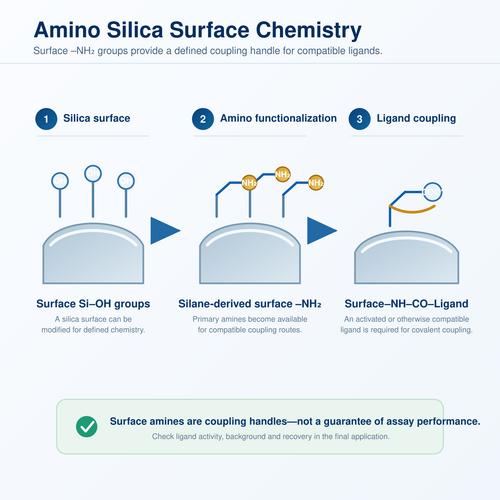
Amino-functionalized silica particles combine a silicon dioxide matrix with surface primary amine groups. The silica surface can contain hydroxyl groups that support silane-derived surface modification, allowing amino groups to be introduced as coupling sites.
The amino surface is useful when the intended ligand has a complementary reactive group or can be converted into an amine-reactive form. This enables more controlled immobilization than relying only on nonspecific adsorption.
Not every silica particle has the same structure, particle size, surface-area profile, dispersion medium or amino-group availability. A silica microsphere should therefore be selected according to the required chemistry and assay workflow rather than by the word “silica” alone.
How Amino Groups Are Introduced onto Silica Surfaces
Silica surfaces can be modified using silane-derived chemistry to introduce primary amines. In a finished amino silica microsphere product, the relevant feature for the user is the resulting surface –NH₂ group rather than the manufacturing route itself.
The surface amines can serve as sites for subsequent coupling of compatible molecules. Their practical value depends on:
Accessibility of the surface amino groups
Particle diameter and particle number
Dispersion medium and stabilizers
Ligand functional group
Coupling chemistry
Final sample matrix and detection method
Amino functionalization does not mean that every molecule will bind directly or that every coupled ligand will retain full activity. The ligand and reaction route must be matched carefully.
Amino Silica Microspheres vs. Carboxyl Silica Microspheres
Amino and carboxyl silica microspheres support different coupling directions.
Particle Surface | Main Reactive Group | Typical Coupling Direction |
|---|---|---|
Amino silica microspheres | Primary amine, –NH₂ | Couples with activated carboxyl groups, NHS esters, aldehydes or other amine-reactive ligands |
Carboxyl silica microspheres | Carboxyl group, –COOH | Activated before coupling to primary amines on antibodies, proteins or peptides |
Plain silica microspheres | No deliberately introduced coupling group | Used when passive adsorption or material research is sufficient |
Neither amino nor carboxyl chemistry is universally better. The right choice depends on the functional groups available on the target molecule and on the desired immobilization strategy.
How Surface Amines Are Used in Coupling
Activated Carboxyl-to-Amine Coupling
A protein, peptide, biotin derivative or other molecule containing a carboxyl group can be activated before reaction with the amino silica surface. EDC/NHS-based chemistry is commonly used to create an amine-reactive intermediate.
The activated ligand can then form an amide bond with the primary amines on the silica particle surface.
NHS Ester Coupling
NHS ester- or Sulfo-NHS ester-modified ligands can react directly with surface primary amines. This route may be used with compatible dyes, biotin derivatives, linkers and modified biomolecules.
Activated esters can hydrolyze in aqueous systems, so the workflow should be designed and validated for the actual ligand.
Aldehyde-to-Amine Coupling
Aldehyde-containing molecules can react with surface amines through a validated aldehyde–amine coupling route. Depending on the application, the linkage may require a stabilization step.
This route should be evaluated carefully when the orientation or activity of an antibody, enzyme or other sensitive biomolecule is important.
Other Linker Systems
Heterobifunctional linkers and other amine-reactive chemistries can be considered when the target molecule contains thiols, carbohydrates or another specific functional group.
The selection should begin with the ligand chemistry, not with a generic coupling recipe.
A Practical Amino Silica Coupling Workflow
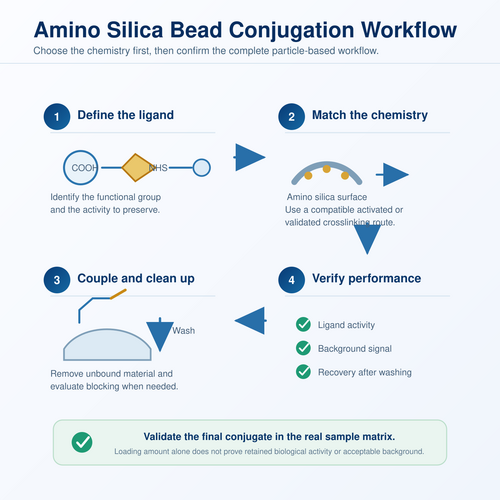
A typical development workflow includes the following steps:
Identify the target molecule and its available reactive group.
Select a compatible coupling route, such as activated carboxyl-to-amine, NHS ester-to-amine or a validated aldehyde-to-amine route.
Confirm that the supplied particle suspension, buffer and additives are compatible with the selected chemistry.
Fully resuspend the amino silica microspheres before sampling and coupling.
Perform the coupling reaction under conditions validated for the target ligand.
Remove unbound material and evaluate blocking when residual reactive sites or nonspecific adsorption may affect the application.
Verify ligand activity, background signal, particle recovery after washing and final performance in the real sample matrix.
There is no universal reaction time, ligand loading or buffer condition for every amino silica particle application. Conditions must be optimized using the intended particle, biomolecule and assay format.
Where Amino-Functionalized Silica Particles Fit
Amino silica microspheres can be evaluated for research and reagent-development workflows requiring a chemically modifiable silica carrier.
Typical application directions include:
Antibody, antigen and protein immobilization
Peptide, hapten and modified oligonucleotide coupling
Particle-based immunoassay reagent development
Particle capture and binding research
Surface-chemistry comparison studies
Biosensor and biomolecule-conjugation research
Particle-based optical or fluorescent detection development when a suitable particle format is selected
Affinity ligand immobilization for research capture workflows
The microsphere itself does not provide analyte specificity. Specificity comes from the immobilized antibody, antigen, receptor, peptide or other validated ligand.
How to Select Amino Silica Microspheres
Selection Factor | Why It Matters |
|---|---|
Particle diameter | Influences surface area, particle number, sedimentation, recovery and optical response |
Surface amino availability | Determines whether enough accessible groups are available for the intended coupling route |
Dispersion medium | Surfactants, stabilizers or preservatives may affect conjugation and downstream use |
Ligand functional group | Determines whether activation, a pre-activated ester or another linker is required |
Detection format | Assay reader, microscopy, flow analysis and visible-particle methods may require different particle formats |
Final sample matrix | Complex samples may require optimized blocking and washing conditions |
Scale requirement | Development work and production-scale formulation may require different package sizes and batch planning |
Do not select a particle only by nominal diameter. Surface chemistry, ligand compatibility and the final application are equally important.
Common Problems During Amino Silica Coupling
Low Coupling Efficiency
Low coupling can result from incomplete ligand activation, hydrolysis of an activated group, an incompatible buffer, insufficient access to the reactive site or a low effective ligand concentration.
For a carboxyl-containing ligand, verify that activation occurs before it contacts the amino silica surface.
High Background Signal
Background may result from nonspecific interaction, incomplete blocking, excess ligand, insufficient washing or interference from the real sample matrix.
A good coupling result in buffer alone does not guarantee low background in serum, lysate or another complex sample.
Particle Aggregation
Aggregation may occur when particles are exposed to incompatible solvents, excessive ionic strength, unsuitable pH conditions or harsh handling.
Confirm the compatibility of all reagents introduced during the coupling and washing workflow.
Loss of Biological Activity
A high amount of attached biomolecule does not necessarily mean high activity. Activity can be reduced when a ligand is coupled through a critical binding site, attached in an unfavorable orientation or crowded on the particle surface.
Evaluate retained functional activity together with attachment amount.
Handling and Storage Considerations
Follow the storage and handling instructions supplied for the specific product batch.
Before sampling, resuspend settled particles thoroughly but gently. Avoid allowing the microspheres to dry during routine handling. Use clean, low-binding laboratory containers when the workflow is sensitive to particle loss or biomolecule adsorption.
Do not assume that an amino silica microsphere suspension is compatible with freezing, repeated freeze-thaw cycles, high-temperature treatment, autoclaving or aggressive solvents. Confirm compatibility against the applicable product specification before use.
Frequently Asked Questions
Are amino-functionalized silica particles the same as amine-reactive particles?
No. Amino-functionalized silica particles carry primary amines on the surface. Amine-reactive particles carry activated groups designed to react with primary amines on the ligand.
Do amino silica microspheres directly react with carboxyl groups?
Not under a typical aqueous coupling workflow. The carboxyl group should first be activated, for example by an EDC/NHS-based method or by using a pre-activated ester.
Are amino silica microspheres the same as amino magnetic silica beads?
No. Both may have surface amino groups, but magnetic silica beads include a magnetic core and can be separated with a magnet. Non-magnetic amino silica microspheres require a non-magnetic particle-handling workflow.
Can amino silica microspheres be used directly as a diagnostic reagent?
They are particle raw materials for research and reagent development. A final assay requires ligand selection, coupling optimization, blocking, performance testing and application-specific validation.
Does silica automatically mean a porous high-surface-area particle?
No. Particle morphology and porosity depend on the individual product design. Confirm the applicable product specification rather than assuming a general silica structure.
Conclusion
Amino-functionalized silica particles are most useful when the particle surface, ligand chemistry and assay workflow are selected together. Start with the ligand’s functional group, choose a compatible coupling route, then verify activity, background and recovery in the final application.
For immunoassay reagent development and biomolecule conjugation projects, SANYU GROUP supplies ASi1UM-10 amino silica microspheres: 1 µm silica particles with surface amino groups, supplied as a 5% aqueous suspension. The product can be evaluated as a silica carrier for defined coupling workflows and particle-based assay development.
Related Blogs
-
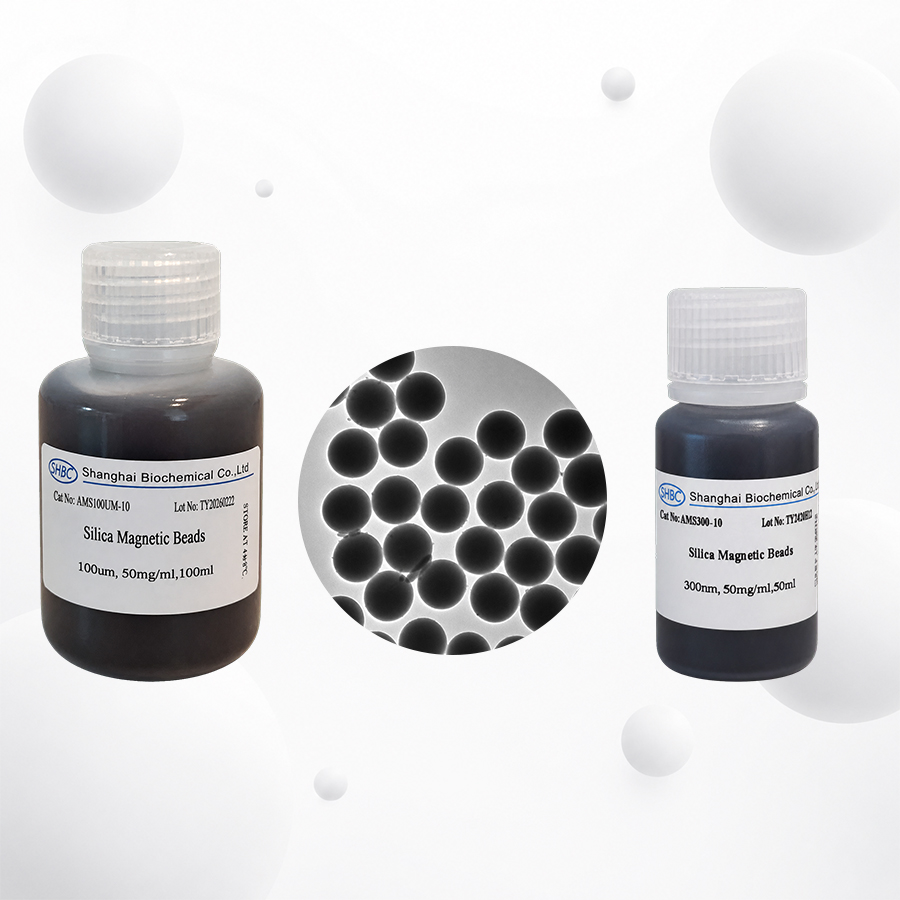 How Silica Magnetic Beads Work: Quick AnswerSilica magnetic beads extract DNA and RNA through a reversible bind–wash–elute process.First, a lysis buffer breaks open cells, viruses or other biological materials and releases nucleic acids into solution. A binding buffer containing salts—and often alco
-
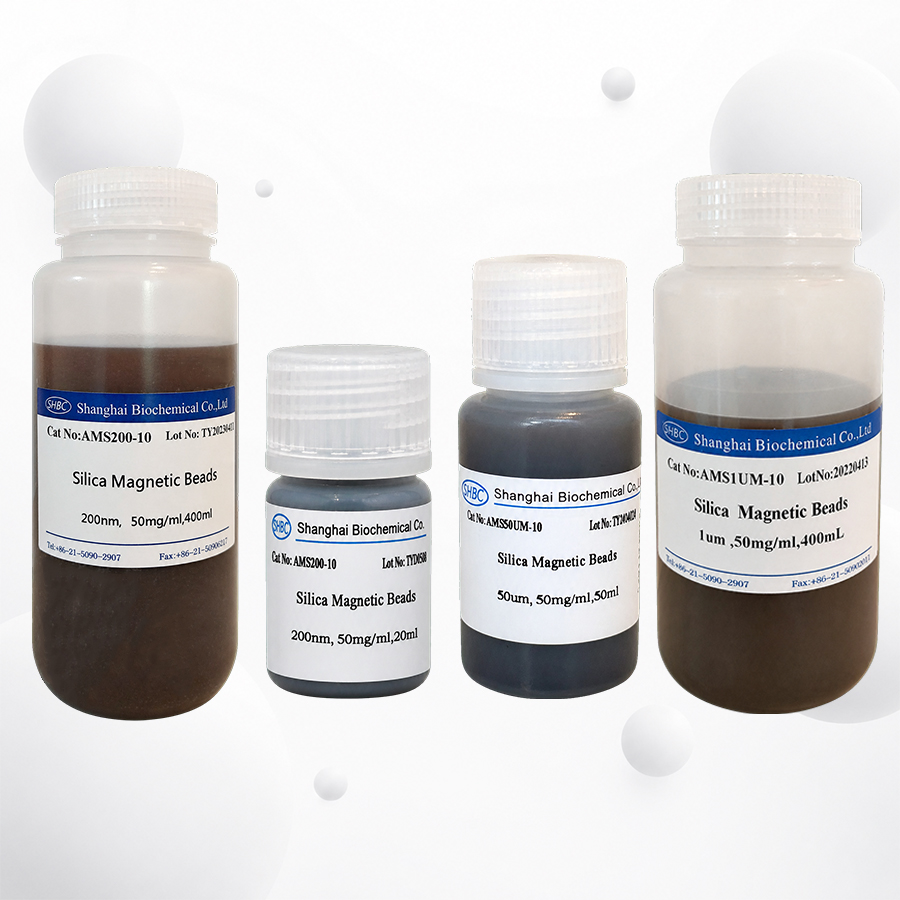 Overview of the Silica Magnetic Bead MarketSilica magnetic beads are functional magnetic particles used to extract and purify DNA or RNA from biological, clinical, food, environmental and research samples.A typical bead contains a magnetic core and a silica or silica-like outer surface. Under suitab
-
 How to Choose Silica Magnetic Beads: Quick AnswerChoose silica magnetic beads according to the complete extraction workflow—not according to particle diameter or catalog price alone.The correct bead must match:The target nucleic acid;The sample matrix;The expected nucleic acid concentration;The requ
-
 Quick Answer: Top 10 Microsphere Manufacturers Serving EuropeThe top 10 microsphere manufacturers and specialist particle suppliers serving European lateral flow assay developers in 2026 are:Merck EstaporSHBCBangs LaboratoriesPolysciencesThermo Fisher ScientificJSR Life SciencesMagsphereSpherotechmi


