


What Is Carboxylated SBR Latex?
Carboxylated SBR latex, often abbreviated as XSBR latex, is an aqueous dispersion of styrene–butadiene copolymer particles containing carboxyl functionality. It is commonly used as a binder in paper coatings, carpet backing, textiles, nonwovens and selected adhesive or construction formulations.
The word “latex” describes the dispersed form of the material. The polymer particles are suspended in water rather than dissolved in it. “SBR” identifies the styrene–butadiene chemistry, while “carboxylated” indicates the incorporation of carboxylic acid groups.
These groups provide additional polar interactions and potential reaction sites. Their effect depends on polymer composition, particle structure, stabilizers, formulation ingredients and drying or curing conditions.
XSBR therefore represents a family of grades with different properties. A soft carpet binder, a paper-coating latex and a cement-compatible dispersion should not be treated as interchangeable simply because they share the same polymer name.
What Do Styrene, Butadiene and Carboxyl Groups Contribute?
Styrene generally increases hardness and glass transition temperature when its proportion increases in an otherwise comparable copolymer. Butadiene contributes flexibility and rubber-like behavior. Manufacturers adjust their balance to obtain the stiffness, elasticity and processing characteristics required for a particular application.
Carboxyl functionality is commonly introduced through copolymerization with an unsaturated acid monomer, such as acrylic acid, methacrylic acid or itaconic acid. The acid selection, amount and distribution influence the resulting material.
In the aqueous dispersion, carboxyl groups may exist as protonated –COOH groups or ionized –COO− groups. Their ionization depends on pH and the local chemical environment. Changing pH can consequently affect particle interactions and formulation behavior.
Carboxyl groups can improve interactions with suitable polar substrates and fillers. They can also participate in deliberately designed crosslinking systems. For example, zinc-containing compounds can form ionic associations with carboxylate groups under appropriate conditions.
However, carboxylation does not establish a universal crosslink density or guarantee better performance in every test. Increasing functionality can also change water sensitivity, viscosity and electrolyte response. The useful balance must be established for the actual grade and finished formulation.
How Does Carboxylated SBR Latex Form a Film?
A film-forming XSBR binder develops a polymer layer as water leaves the applied coating. Film formation is a physical process that depends on the particles being sufficiently deformable under the application conditions.
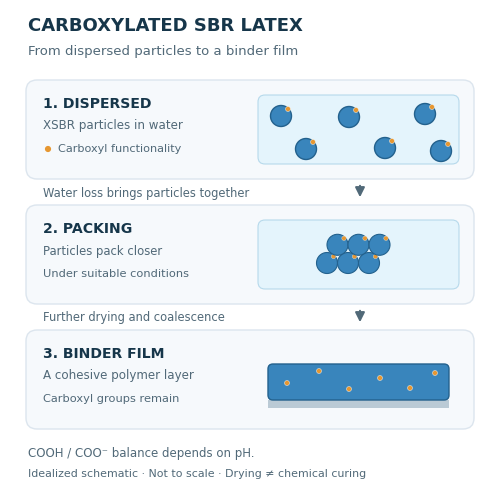
The main stages are:
Dispersion: Polymer particles remain separated in the aqueous phase.
Packing and deformation: Water loss brings the particles closer together, and sufficiently soft particles deform as the coating consolidates.
Coalescence: Particle boundaries become less distinct as polymer chains interdiffuse where their mobility and particle structure permit, producing a cohesive binder film.
The minimum film-forming temperature, or MFFT, describes the lowest temperature at which a dispersion forms a continuous film under the specified test conditions. It is related to glass transition temperature, or Tg, but the two values are not identical.
A grade may require suitable substrate temperature, drying time or formulation aids to form an acceptable film. Low temperature, excessive drying speed or poor compatibility can leave a weak, porous or cracked coating.
Film formation and chemical curing should be evaluated separately. Water evaporation can produce a film without creating a new covalent network. Any additional crosslinking depends on the binder chemistry, crosslinker and curing conditions.
The illustration shows a simplified progression from dispersed XSBR particles to a continuous binder film under suitable film-forming conditions. It does not represent measured particle sizes or a guaranteed drying rate, and it does not imply that every XSBR grade automatically crosslinks during drying.
Key Properties and Their Practical Limits
The most useful description of an XSBR grade connects each property to a measurable requirement.
Property | Potential benefit | What must be checked |
|---|---|---|
Adhesion | Binding fibers, pigments or suitable substrates | Substrate condition, formulation and wet or dry bond strength |
Flexibility | Allowing bending or deformation without cracking | Tg, temperature, filler loading and cure |
Cohesion | Helping a coating or backing hold together | Film formation, polymer architecture and crosslinking |
Water resistance | Maintaining performance after specified moisture exposure | Water uptake, swelling and retained adhesion |
Dispersion stability | Supporting mixing, pumping and application | Shear, pH, electrolytes and additive compatibility |
Processing behavior | Controlling coating flow and penetration | Solids, viscosity, foam and drying conditions |
Water resistance is a property of the tested film or finished system. A latex that disperses in water may still form a water-resistant coating, but the result depends on film continuity and composition.
XSBR should not be described as universally resistant to oils, fuels, solvents or aggressive chemicals. Carboxylation does not remove the limitations of the underlying styrene–butadiene chemistry. Test the exact chemical, concentration, temperature and exposure time.
Weathering also requires qualification. Butadiene-derived unsaturation can be vulnerable to oxidative and ozone aging. Outdoor suitability may require protective formulation measures or a different binder chemistry.
Likewise, heat resistance cannot be inferred from flexibility or adhesion alone. Evaluate the finished material at its intended service temperature and under the expected load.
Carboxylated SBR Latex vs Other Polymer Dispersions
Similar names can conceal important differences in composition and intended use.
Material | Main distinction | Typical selection purpose |
|---|---|---|
Non-carboxylated SBR latex | Styrene–butadiene dispersion without deliberate carboxyl modification | Applications matched to its specific flexibility, stability and bonding behavior |
Carboxylated SBR latex | Styrene–butadiene dispersion with carboxyl functionality | Industrial binder formulations requiring a suitable balance of adhesion and mechanical properties |
Carboxylated nitrile latex, or XNBR | Acrylonitrile–butadiene chemistry with carboxyl functionality | Selected dipped-glove and other nitrile applications |
Acrylic latex | Dispersion based on acrylic monomers | Coatings, adhesives or construction systems matched to the acrylic grade |
Carboxyl polystyrene microspheres | Functionalized polystyrene particles designed to remain discrete during their intended use | Particle-based assays, bioconjugation and other microsphere applications |
XNBR and XSBR are different materials. The acrylonitrile component in nitrile polymers is important to their oil and chemical resistance profile. Performance still varies with grade and formulation.
Medical or examination glove claims cannot be transferred from nitrile latex to a general-purpose XSBR binder. Likewise, being synthetic does not establish that a material is hypoallergenic, biocompatible or suitable for a medical device.
The correct comparison begins with the intended function and verified specifications, rather than the shared word “latex.”
How Is Carboxylated SBR Latex Manufactured?
Industrial XSBR production generally uses free-radical emulsion polymerization. Manufacturers control composition and particle development to produce a specified dispersion.
A typical manufacturing sequence includes:
Selecting the polymer design: Styrene, butadiene and acid comonomers are chosen to meet the target properties.
Preparing and feeding ingredients: Water, stabilizers, initiators and monomer feeds are managed within the selected production process.
Controlling polymerization: Reaction conditions and feed strategy govern conversion, particle development and polymer structure.
Reducing residual monomers: Appropriate post-polymerization treatment and physical stripping or devolatilization reduce unreacted volatile material.
Finishing and quality control: pH and solids are adjusted as required, coagulum is filtered out, and the dispersion is tested before packaging.
These operations have different purposes. Filtration removes coagulated polymer and other particulate material; it is not a substitute for removing dissolved residual monomers.
The polymerization route may include a chemical treatment that converts remaining monomer, physical removal of volatile components, or a combination. The sequence depends on the product and manufacturing design.
There is no single reaction temperature, final pH or solids content that defines all commercial XSBR latexes. Different production routes also manage reaction termination differently.
Because butadiene is volatile and polymerization generates heat, production requires appropriate industrial reactor, pressure-control and process-safety systems. A general process description is not a manufacturing recipe.
Applications in Paper and Paperboard Coatings
In pigment-coated paper, an XSBR binder helps hold mineral pigments together and attach the coating to the paper substrate. Grade selection affects coating integrity, surface finish and printing behavior.
Useful evaluation criteria include:
Dry and wet pick resistance.
Compatibility with the pigment, dispersant and thickener package.
Coating rheology at the intended application speed.
Binder distribution during drying.
Surface properties after finishing or calendering.
A harder binder may support a different surface response from a softer grade, but increasing hardness can also affect flexibility and film formation.
Paper and packaging applications must distinguish coating strength from barrier performance. A binder that improves pigment bonding does not automatically create a complete waterproof or water-vapor barrier.
Any food-contact suitability must be established for the specific grade, formulation and intended use. The polymer family name alone does not establish compliance.
Applications in Carpet Backing
Carboxylated SBR latex is an established binder option for carpet precoats and secondary backing formulations. Its role includes securing tufts, binding components and contributing to backing integrity.
Carpet compounds often contain substantial filler levels. The latex must remain compatible with those fillers and with the thickener, dispersant, defoamer or foaming package used in production.
Important checks include tuft bind, backing adhesion, flexibility, drying behavior and performance after moisture exposure. Odor and emission requirements may also influence grade selection.
A change in filler level or drying profile can affect backing performance even when the latex grade remains the same. Compare complete compounds at representative application weights rather than judging the binder only from an unfilled film.
Applications in Textiles and Nonwovens
Selected XSBR grades bind fibers in nonwoven fabrics and support textile coating, finishing or lamination.
The target may be a soft hand, improved tensile integrity, greater stiffness or better resistance to abrasion. These goals require different polymer and formulation choices.
Evaluate binder penetration, distribution, fiber compatibility and the balance between strength and flexibility. Excessive binder pickup can make a fabric too stiff; inadequate pickup can leave weak fiber bonding.
Nonwovens intended for demanding exposure conditions also require wet strength and aging tests. A binder used successfully in an industrial fabric should not automatically be assigned to a skin-contact or medical application without the relevant assessment.
Applications in Adhesives and Construction Materials
Suitable XSBR grades can be formulated into laminating adhesives, flooring-related binders and other bonding systems. Adhesive performance depends on wetting, drying, substrate compatibility and the balance between tack and cohesive strength.
Pressure-sensitive adhesion is a specific requirement. It should not be assumed for every XSBR grade simply because the material functions as a binder.
In construction, specially designed dispersions may be used in polymer-modified mortar, cementitious bonding systems or coatings. Cement compatibility is particularly important because the mixture contains an alkaline, ion-rich aqueous phase.
An unsuitable dispersion may coagulate, change workability or interfere with application. Evaluate the intended cement, aggregate, admixtures, water content and curing schedule together.
Polymer modification can improve selected properties, but compressive strength, flexural behavior, adhesion and permeability need separate measurements. More latex does not automatically improve every result.
Waterproofing or exterior service claims should refer to the tested finished system. They cannot be inferred solely from the presence of carboxyl groups.
Which Specifications Matter When Selecting an XSBR Grade?
Start with the application, then use technical data to narrow the candidate grades.
Specification | Why it matters | Information to request |
|---|---|---|
Total solids | Controls dry-material delivery and water contribution | Test method, typical value and specification limits |
pH | Influences ionization and formulation compatibility | Recommended operating range and adjustment guidance |
Viscosity | Affects pumping, mixing and coating | Temperature, instrument, spindle and speed |
Tg and MFFT | Relate to mechanical behavior and film formation | Separate values and test conditions where available |
Particle size | Influences dispersion behavior and coating development | Measurement method, reported average and distribution |
Carboxyl functionality | Provides polar and reactive sites | Relevant functional-content information and intended crosslinking system |
Stability | Determines tolerance of processing and additives | Mechanical, electrolyte and application-specific stability |
Residual monomers and emissions | Affect odor and product requirements | Grade-specific results, methods and applicable documentation |
Typical data describe a representative product; they are not necessarily guaranteed release limits. Use the agreed specification and certificate of analysis to assess a delivered batch.
Compare viscosity results only when their measurement conditions are compatible. A single viscosity number without temperature and instrument settings provides an incomplete comparison.
Particle-size methods also need context. An intensity-weighted light-scattering result and a number-based microscopy result may describe the same dispersion differently.
Finally, confirm compatibility in the complete formulation. A promising technical data sheet cannot predict every interaction with the user's fillers, salts, pigments or processing equipment.
How to Calculate Dry Latex Solids
Formulation comparisons should use a consistent dry-material basis. Wet latex quantities can be misleading when two grades have different solids contents.
The basic calculation is:
Dry latex solids = wet latex mass × total solids mass fraction
For example, 100 kg of latex at 50% total solids provides 50 kg of dry latex solids.
To supply the same 50 kg of dry solids using a 45% latex:
Required wet latex = 50 kg ÷ 0.45 = 111.1 kg
The lower-solids latex therefore requires about 11.1 kg more wet material for the same dry-solids delivery.
Total solids can include nonvolatile stabilizers and other ingredients as well as polymer. If a recipe specifies pure polymer content, confirm the appropriate polymer fraction instead of assuming that measured total solids are entirely polymer.
The liquid contribution matters too. In cementitious or coating formulations, adjusting latex quantity without accounting for its accompanying aqueous phase can change water content, viscosity and drying behavior.
These calculations illustrate mass balance. They do not establish a recommended binder dosage for a particular application.
Formulation Problems and What to Check
Troubleshooting works best when each symptom is connected to plausible causes and a controlled comparison.
Symptom | Possible contributors | Useful checks |
|---|---|---|
Coagulum or grit after mixing | Incompatible additives, electrolyte shock or excessive shear | Addition sequence, diluted compatibility trials and process conditions |
Weak or cracked film | Unsuitable film-forming conditions or insufficient binder | Substrate temperature, MFFT, coat weight and drying profile |
Poor wet adhesion | Incomplete film development or unsuitable formulation | Water exposure conditions, cure and retained bond strength |
Excessive foam or pinholes | Air entrainment or incompatible foam control | Mixing, application method and defoamer compatibility |
Large viscosity drift | pH change, thickener interaction or storage instability | pH, temperature and viscosity measured under consistent conditions |
Avoid making several formulation changes at once. Compare one controlled change against the existing formulation so the result is interpretable.
Use representative substrates and application conditions. A binder can perform well in a laboratory film while behaving differently in a filled coating or porous textile.
When evaluating aging or chemical exposure, record the exposure conditions and the property measured afterward. Appearance alone may miss a loss of adhesion or strength.
Storage and Handling
Follow the specific product's technical and safety data sheets for storage temperature, shelf life and handling.
Many latex dispersions require protection from freezing, excessive heat, evaporation and contamination. Freeze–thaw stability should be confirmed rather than assumed.
Keep containers appropriately closed and use clean equipment. Restore uniformity by the supplier's recommended mixing procedure before sampling or use.
Do not assume that a visibly separated or frozen latex can be recovered simply by vigorous stirring. Assess its condition against the supplier's guidance and the required application properties.
Document storage history when investigating unexplained viscosity changes, coagulum or inconsistent coating performance.
Is XSBR Latex the Same as Carboxyl Polystyrene Microspheres?
No. Both materials can contain carboxyl groups and be supplied in water, but their polymer composition and intended behavior differ.
A film-forming XSBR binder is selected to develop a cohesive polymer phase during application and drying. Carboxyl polystyrene microspheres used in assays are selected to retain their particle identity during the intended workflow.
For binder selection, film formation, adhesion and mechanical performance are central. For diagnostic microspheres, particle size distribution, surface functionality, colloidal stability and biomolecule-coupling behavior are more relevant.
Carboxyl groups on suitable assay particles can be used in coupling workflows, including appropriately developed EDC/NHS chemistry. This does not make an industrial XSBR binder a substitute for validated assay microspheres.
Match the material to the task: creating a coating and developing a particle-based immunoassay require different specifications and performance tests.
Frequently Asked Questions
What does XSBR stand for?
XSBR commonly denotes carboxylated styrene–butadiene rubber. In XSBR latex, the functionalized copolymer particles are dispersed in an aqueous phase.
Does carboxylated SBR latex always require zinc oxide?
No. Zinc-containing compounds can participate in certain ionic crosslinking systems, but the appropriate curing package depends on the grade and application. Some uses rely primarily on film formation.
Is carboxylated SBR latex waterproof?
The name does not guarantee waterproof performance. Evaluate the finished coating or composite for its intended water exposure, film thickness, curing conditions and acceptance criteria.
Is XSBR the same as nitrile latex?
No. XSBR is based on styrene and butadiene. Carboxylated nitrile latex is based on acrylonitrile and butadiene with carboxyl functionality. Their application and resistance profiles differ.
Is a higher-solids latex always better?
No. Higher solids can reduce the amount of aqueous phase delivered per unit of dry material, but viscosity, stability, coating behavior and film development must still suit the process.
Can filtration remove residual styrene from latex?
Ordinary particulate filtration does not replace residual-monomer reduction. Manufacturers use suitable post-polymerization treatment and stripping or devolatilization processes for that purpose.
Can one XSBR grade serve paper coating, carpet backing and cement modification?
A grade may support multiple applications, but compatibility and performance must be verified in each system. Matching chemistry alone is insufficient.
Can industrial XSBR latex replace diagnostic latex beads?
It should not be substituted on the basis of the word “latex.” Diagnostic particles require suitable size distribution, surface chemistry and stability within the validated assay workflow.
Conclusion
Carboxylated SBR latex is a versatile industrial binder platform whose performance depends on grade selection, formulation and application conditions. Useful evaluation connects composition and technical data with measured film formation, adhesion, stability and durability in the finished product.
For further reading on polymer chemistry and dispersion terminology, see our guide to acrylic polymer vs latex. If your project requires functional particles for diagnostic development, explore carboxyl polystyrene microspheres from SANYU GROUP and contact our technical team to discuss particle specifications and coupling requirements.
Related Blogs
-
 How Silica Magnetic Beads Work: Quick AnswerSilica magnetic beads extract DNA and RNA through a reversible bind–wash–elute process.First, a lysis buffer breaks open cells, viruses or other biological materials and releases nucleic acids into solution. A binding buffer containing salts—and often alco
-
 Overview of the Silica Magnetic Bead MarketSilica magnetic beads are functional magnetic particles used to extract and purify DNA or RNA from biological, clinical, food, environmental and research samples.A typical bead contains a magnetic core and a silica or silica-like outer surface. Under suitab
-
 How to Choose Silica Magnetic Beads: Quick AnswerChoose silica magnetic beads according to the complete extraction workflow—not according to particle diameter or catalog price alone.The correct bead must match:The target nucleic acid;The sample matrix;The expected nucleic acid concentration;The requ
-
 Quick Answer: Top 10 Microsphere Manufacturers Serving EuropeThe top 10 microsphere manufacturers and specialist particle suppliers serving European lateral flow assay developers in 2026 are:Merck EstaporSHBCBangs LaboratoriesPolysciencesThermo Fisher ScientificJSR Life SciencesMagsphereSpherotechmi


