


Quick Answer
A floating magnetic sphere is not defying gravity. It is held at a controlled position when magnetic force counteracts its weight and the system prevents small movements from becoming unstable.
A stable floating magnetic sphere usually requires active feedback, a superconducting or diamagnetic material, rotation, or another dynamic stabilization method. Simply placing two ordinary permanent magnets with like poles facing each other may create a momentary balance, but it does not provide stable free levitation in all directions.
This is different from magnetic bead separation. Magnetic beads are designed to disperse in liquid, capture a target molecule or cell, and then move toward an external magnet for separation. They are not designed to hover in air like a display sphere.
What Is a Floating Magnetic Sphere?
A floating magnetic sphere is a macroscopic sphere that appears to hover above or below a magnetic base. The visual effect is created by carefully controlled magnetic forces rather than by anti-gravity.
In a typical magnetic levitation display, the sphere contains a magnet or magnetic component. An electromagnet inside the base or upper support applies an attractive or repulsive force. When the magnetic force is correctly balanced against gravity, the sphere can remain at a selected height.
The difficult part is not producing magnetic force. The difficult part is maintaining stability. A sphere that moves slightly upward, downward, or sideways must be guided back toward its intended position before it falls or attaches to the magnet.
Why Simple Magnet Repulsion Is Not Enough
Two magnets can repel each other, but repulsion alone does not create a stable three-dimensional hovering position for an ordinary magnetic sphere.
At one point, the upward magnetic force may equal the downward force of gravity. However, this only describes force balance at that exact position. If the sphere moves a few millimeters away, the magnetic force may increase or decrease in a way that makes the movement worse instead of correcting it.
For stable levitation, the system needs a restoring response. When the sphere rises too high, the magnetic force must change so that it moves back down. When it drops too low, the field must change so that it moves back up. Side-to-side motion must also be controlled.
This is why a floating magnetic sphere should be understood as a stability-control problem, not simply a strong-magnet problem.
How an Actively Controlled Magnetic Levitation System Works
Many practical floating magnetic sphere devices use an electromagnet, a position sensor, and a control circuit.
The sensor continuously measures the position of the sphere. The controller compares the real position with the target position and adjusts the current supplied to the electromagnet. This changes the magnetic force quickly enough to correct small movements.
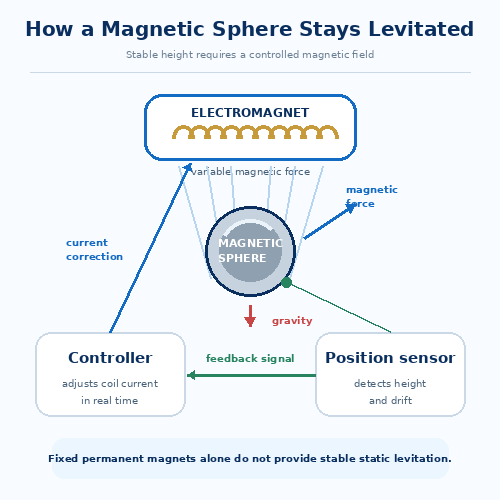
A controlled levitation system normally includes:
A magnetic sphere or object
An electromagnet
A position sensor
A feedback controller
A stable power supply
Mechanical protection against sudden loss of power
The controller may increase current when the sphere falls and reduce current when the sphere moves too close to the electromagnet. This continuous adjustment is what makes stable levitation possible.
Other Stability Strategies for Magnetic Levitation
Active electromagnetic feedback is common, but it is not the only way to create magnetic levitation.
Superconducting and Diamagnetic Levitation
Superconductors can strongly exclude magnetic fields under appropriate conditions. This can create a stable levitation effect and is often used in scientific demonstrations and advanced engineering research.
Certain diamagnetic materials can also be repelled by a strong magnetic field. However, the effect is usually weak and may require specialized equipment.
Rotational Stabilization
A spinning magnetic top can remain suspended above a magnetic base within a narrow operating range. Rotation adds gyroscopic stability, helping prevent the object from tipping or drifting sideways.
This method is visually impressive but sensitive to sphere position, rotation speed, magnet geometry, vibration, and air movement.
Dynamic Electromagnetic Fields
Some systems use changing electromagnetic fields or induced currents to generate lift and stability. These methods are used in specialized industrial and transportation technologies where contact-free motion can reduce friction.
What Controls Levitation Height and Stability?
The height and stability of a floating magnetic sphere depend on several variables working together.
Mass of the Sphere
A heavier sphere requires greater upward magnetic force. The system must generate sufficient force while still allowing precise control.
Magnetic Strength and Orientation
The magnetic material, magnetization direction, and magnetic geometry all influence how the sphere interacts with the field.
Magnetic Field Gradient
A magnetic field gradient is often more important than magnetic-field strength alone. The gradient determines how strongly the magnetic force changes as the sphere moves.
Sensor Accuracy and Control Speed
The sensor must detect small position changes accurately. The controller must respond quickly enough to correct the movement before the sphere becomes unstable.
External Disturbances
Vibration, air movement, nearby ferromagnetic objects, temperature changes, and power fluctuations can all disturb a levitation system.
Magnetic Levitation Is Not Magnetic Bead Separation
A floating magnetic sphere in air and a magnetic bead in liquid involve magnetic forces, but they serve very different purposes.
A levitation display aims to hold one visible object at a controlled position in air. It needs continuous stability control.
Magnetic bead separation aims to move dispersed particles through a liquid toward a magnet. The magnet creates a nonuniform magnetic field that collects the particles against the wall of a tube, plate well, or processing vessel.
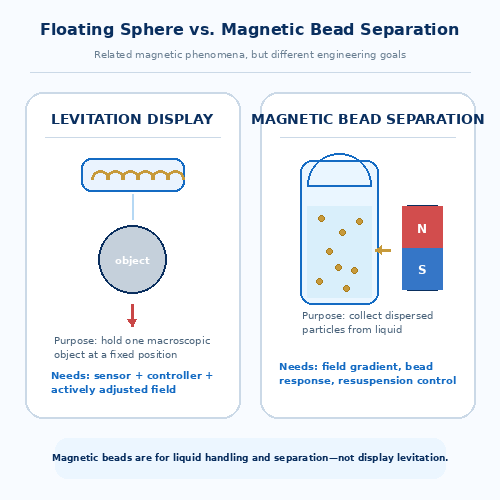
For liquid-phase magnetic bead workflows, key performance factors include:
Magnetic response under the selected separation device
Collection time and recovery
Particle size distribution
Dispersion and resuspension behavior
Surface chemistry
Binding capacity for the target molecule
Compatibility with sample buffer and automation format
A magnetic bead does not need to float in air. It needs to remain sufficiently dispersed during the reaction, respond efficiently to a magnetic separator, and resuspend reproducibly for the next process step.
Why Suspension Stability Matters for Magnetic Beads
In liquid workflows, the word “floating” is sometimes used loosely. A magnetic bead suspension is not magnetic levitation.
Particles in a liquid are affected by gravity, buoyancy, viscosity, particle size, density, surface chemistry, and mixing conditions. Smaller particles may remain dispersed for longer, while larger or denser particles may settle more quickly when no mixing is applied.
When an external magnet is introduced, the goal is controlled migration and collection. After the magnet is removed, the particles should be able to resuspend without excessive aggregation.
For this reason, a magnetic bead should be selected according to its intended workflow rather than according to a levitation demonstration. A material that works well in a decorative floating sphere is not automatically suitable for nucleic acid extraction, antibody coupling, protein purification, or cell separation.
Choosing Magnetic Particles for a Liquid Workflow
The correct magnetic particle starts with the application.
For nucleic acid purification, the surface chemistry must support DNA or RNA binding under the chosen buffer conditions. For antibody or protein immobilization, the surface must support the intended coupling method. For affinity capture, the ligand and target molecule must be compatible.
Particle size also matters, but it should not be considered alone. A larger particle is not automatically better or faster. Magnetic separation performance depends on particle architecture, magnetic content, field gradient, liquid volume, viscosity, mixing conditions, and the separation hardware.
Before selecting a magnetic bead, define:
Target molecule, cell, or nucleic acid
Sample type and sample volume
Binding or coupling chemistry
Required recovery and purity
Magnetic rack, plate magnet, or automated instrument
Buffer composition and wash conditions
Resuspension requirements
Required particle size and solids concentration
Common Misconceptions About Floating Magnetic Spheres
A Stronger Magnet Always Creates Better Levitation
Not necessarily. Stability depends on the full magnetic design, sensor feedback, force gradient, sphere mass, and mechanical alignment.
A Floating Sphere Uses Only Permanent Magnets
Some rotating-top demonstrations use permanent magnets, but many stable display systems use electromagnets and active feedback control.
Magnetic Beads Float Like a Display Sphere
No. Magnetic beads are usually dispersed in liquid and collected by a magnetic field gradient. Their purpose is separation, purification, immobilization, or capture.
A Uniform Magnetic Field Pulls Every Magnetic Particle Toward a Magnet
A magnetic particle generally needs a nonuniform field to experience a net translational force. This is why magnetic separators are designed to create strong local field gradients.
Conclusion
A floating magnetic sphere is an example of controlled magnetic levitation. It requires a designed stability mechanism, not simply a pair of strong magnets.
Magnetic bead workflows are different. In life-science and diagnostic applications, magnetic particles are engineered for liquid handling, target capture, magnetic collection, washing, and resuspension.
For bioseparation and assay development, SANYU GROUP provides a magnetic bead portfolio for liquid-phase workflows, including silica magnetic beads for nucleic acid extraction, carboxyl magnetic beads for EDC/NHS coupling, streptavidin magnetic beads for biotinylated target capture, and NHS magnetic beads for rapid primary-amine coupling.
Select the bead according to the target, binding principle, sample matrix, separation hardware, and required workflow performance—not according to a magnetic levitation display.
FAQs
Can a floating magnetic sphere remain stable without electricity?
Some specialized demonstrations use superconductors, diamagnetic materials, or rotational stabilization. However, many commercial floating magnetic sphere displays require electricity for sensing and active electromagnetic control.
Why does a floating magnetic sphere suddenly fall?
The sphere may fall if the sensor loses position detection, the controller cannot correct a disturbance quickly enough, the power supply is interrupted, or the sphere moves outside its stable operating range.
Can two permanent magnets create a stable floating sphere?
Two permanent magnets can create attraction or repulsion, but a normal magnetic sphere cannot remain in a stable free position using only a static permanent-magnet arrangement. Additional stabilization is needed.
Do magnetic beads float in a sample tube?
Magnetic beads do not levitate like a display sphere. They may remain dispersed, settle gradually, or resuspend depending on particle properties and the liquid conditions. During magnetic separation, they migrate toward the magnet.
What should be evaluated when selecting magnetic beads?
Evaluate the target application, surface chemistry, magnetic response, separation time, particle size distribution, binding capacity, buffer compatibility, recovery, and resuspension performance.
Related Blogs
-
 How Silica Magnetic Beads Work: Quick AnswerSilica magnetic beads extract DNA and RNA through a reversible bind–wash–elute process.First, a lysis buffer breaks open cells, viruses or other biological materials and releases nucleic acids into solution. A binding buffer containing salts—and often alco
-
 Overview of the Silica Magnetic Bead MarketSilica magnetic beads are functional magnetic particles used to extract and purify DNA or RNA from biological, clinical, food, environmental and research samples.A typical bead contains a magnetic core and a silica or silica-like outer surface. Under suitab
-
 How to Choose Silica Magnetic Beads: Quick AnswerChoose silica magnetic beads according to the complete extraction workflow—not according to particle diameter or catalog price alone.The correct bead must match:The target nucleic acid;The sample matrix;The expected nucleic acid concentration;The requ
-
 Quick Answer: Top 10 Microsphere Manufacturers Serving EuropeThe top 10 microsphere manufacturers and specialist particle suppliers serving European lateral flow assay developers in 2026 are:Merck EstaporSHBCBangs LaboratoriesPolysciencesThermo Fisher ScientificJSR Life SciencesMagsphereSpherotechmi


