


Quick Answer
An ideal hollow sphere with constant magnetization has three different magnetic-field regions. The self-generated magnetic field is zero only inside the central cavity. The magnetic field within the shell material is not zero and is generally nonuniform. Outside the sphere, the field is equivalent to that of a magnetic dipole.
This result applies to an ideal model: the shell is perfectly spherical, the magnetization vector M has the same magnitude and direction throughout the magnetic material, and no free currents are present. It should not be interpreted as a general magnetic-shielding result or as a direct description of every hollow magnetic particle.
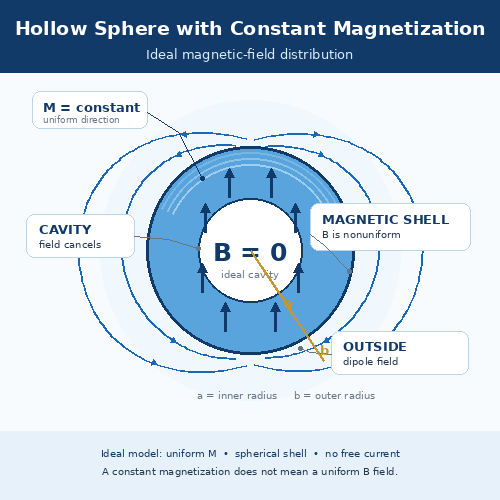
The Idealized Hollow-Sphere Model
Consider a spherical magnetic shell with:
Inner radius: a
Outer radius: b
Uniform magnetization: M
“Constant magnetization” means that the magnetization vector has the same direction and magnitude at every point in the shell material. It does not mean that the magnetic flux density B is uniform everywhere.
A useful way to analyze the shell is by superposition. Treat it as:
A uniformly magnetized solid sphere with radius b and magnetization M
Minus a uniformly magnetized solid sphere with radius a and the same magnetization M
This approach makes the field distribution easier to understand.
Why the Magnetic Field in the Cavity Is Zero
For an isolated, uniformly magnetized solid sphere in a nonmagnetic surrounding medium, the magnetic flux density inside the sphere is uniform:
B = (2/3)μ0M
For the hollow shell, the outer sphere produces this field throughout the cavity. The removed inner sphere produces the same field in the opposite direction. The two contributions cancel:
B_cavity = (2/3)μ0M − (2/3)μ0M = 0
Therefore, the ideal shell produces zero self-field in the cavity where r < a.
This cancellation refers only to the field generated by the shell itself. If an external magnet, current-carrying coil, or nearby magnetic object is present, its field can still contribute inside the cavity.
Magnetic Field Distribution in Three Regions
Inside the cavity: r < a
The self-generated magnetic field is zero.
This is a consequence of the exact spherical geometry and uniform magnetization assumption. It does not mean that every hollow magnetic particle has a zero internal field in practice.
Inside the magnetic shell: a < r < b
The magnetic field is not zero. It varies with position inside the shell and is affected by the inner and outer spherical boundaries.
A constant magnetization M does not create a constant B field in this region. The internal field distribution is more complex than in a solid uniformly magnetized sphere.
Outside the sphere: r > b
Outside the shell, the field is equivalent to a dipole field with magnetic dipole moment:
m = (4π/3)(b³ − a³)M
The external magnetic field decreases rapidly with distance, approximately following a 1/r³ dependence. A thicker shell or a larger outer radius increases the magnetic material volume and therefore increases the magnetic dipole moment when M remains unchanged.
Magnetization, Magnetic Field Strength, and Flux Density
It is important to distinguish three related quantities:
Magnetization M describes the magnetic moment per unit volume of the material.
Magnetic field strength H describes the magnetic field generated by currents and magnetization.
Magnetic flux density B is the field quantity commonly measured in tesla.
A material can have a constant magnetization while its B field changes from one region to another. That is why the cavity can have zero self-field, the shell can have a nonuniform field, and the exterior can show a dipole field.
What Changes in Real Hollow Magnetic Particles?
Real hollow magnetic particles rarely satisfy all assumptions of the ideal model. Their behavior can be influenced by:
Nonuniform magnetic material distribution
Magnetic nanoparticle aggregation
Porosity, voids, or shell-thickness variation
Finite magnetic susceptibility
Remanence and hysteresis
Surface coatings and polymer or silica matrices
External magnetic fields
Interactions with nearby particles
For this reason, the hollow-sphere model is useful for teaching, preliminary calculations, and simulation setup, but it should not replace magnetic characterization or separation testing for a real product.
Why Magnetic Bead Separation Requires a Field Gradient
A uniform magnetic field can magnetize or orient a magnetic particle, but it does not normally produce a net translational force on the particle.
Magnetic collection requires a nonuniform field, meaning a magnetic-field gradient. For a small particle with approximately linear magnetic behavior, a common engineering approximation is:
F_m ≈ (VΔχ / 2μ0)∇B²
Where V is the effective magnetic volume and Δχ is the magnetic susceptibility contrast between the particle and the surrounding medium.
In practical magnetic separation, performance depends on more than magnetization alone. Important factors include magnetic material loading, particle size, magnetic core structure, bead aggregation, liquid viscosity, distance from the magnet, and the field gradient generated by the separator.
From an Ideal Shell Model to Practical Magnetic Bead Design
The ideal hollow shell demonstrates an important principle: particle geometry changes magnetic-field distribution.
For practical magnetic beads, the relevant design questions are usually:
How much magnetic material is present in each bead?
Is the magnetic phase evenly distributed or concentrated in a core?
What particle size is needed for the assay or separation workflow?
Does the surface chemistry support the required coupling or capture method?
Does the magnetic separator provide sufficient field gradient for rapid collection?
A bead with high magnetic material loading may still perform poorly if its surface chemistry, dispersion stability, or separation hardware is not suitable for the intended application.
Frequently Asked Questions
Is the magnetic field always zero inside a hollow magnetized sphere?
No. Zero field applies only to the cavity of an ideal uniformly magnetized spherical shell and only to the shell’s self-generated field.
Is the magnetic field zero within the shell material?
No. The magnetic field inside the shell material is generally nonuniform.
Does constant magnetization mean constant magnetic flux density?
No. Constant magnetization M does not mean that B has the same value in the cavity, shell, and exterior regions.
What happens when the inner radius is zero?
When a = 0, the hollow shell becomes a solid uniformly magnetized sphere. Its internal magnetic flux density is uniform and nonzero under the ideal model.
Does this model describe ordinary magnetic beads?
Not directly. Most magnetic beads are composite particles containing magnetic nanoparticles in a polymer, silica, or other matrix rather than perfectly uniform hollow magnetic shells.
Why do magnetic beads need a magnetic-field gradient?
A field gradient generates the force that moves magnetic beads toward a magnet or magnetic separator. A perfectly uniform magnetic field does not normally collect particles into one location.
Conclusion
A hollow sphere with constant magnetization is an ideal magnetostatic model with a zero self-field in the cavity, a nonuniform field in the magnetic shell, and a dipole field outside the particle. The model is useful for understanding how geometry influences magnetic fields, but it should not be confused with universal magnetic shielding or the behavior of every hollow magnetic particle.
For real separation and assay development, magnetic response must be evaluated together with particle size, magnetic material loading, surface chemistry, sample composition, and separator design. SANYU GROUP provides Magnetic Beads and Magnetic Grate options for magnetic separation workflows. Where surface functionalization or nucleic-acid processing is required, Carboxyl Magnetic Beads and Silica Magnetic Beads can be selected according to the application. To evaluate a suitable bead and magnetic-separation configuration, contact our technical team.
Related Blogs
-
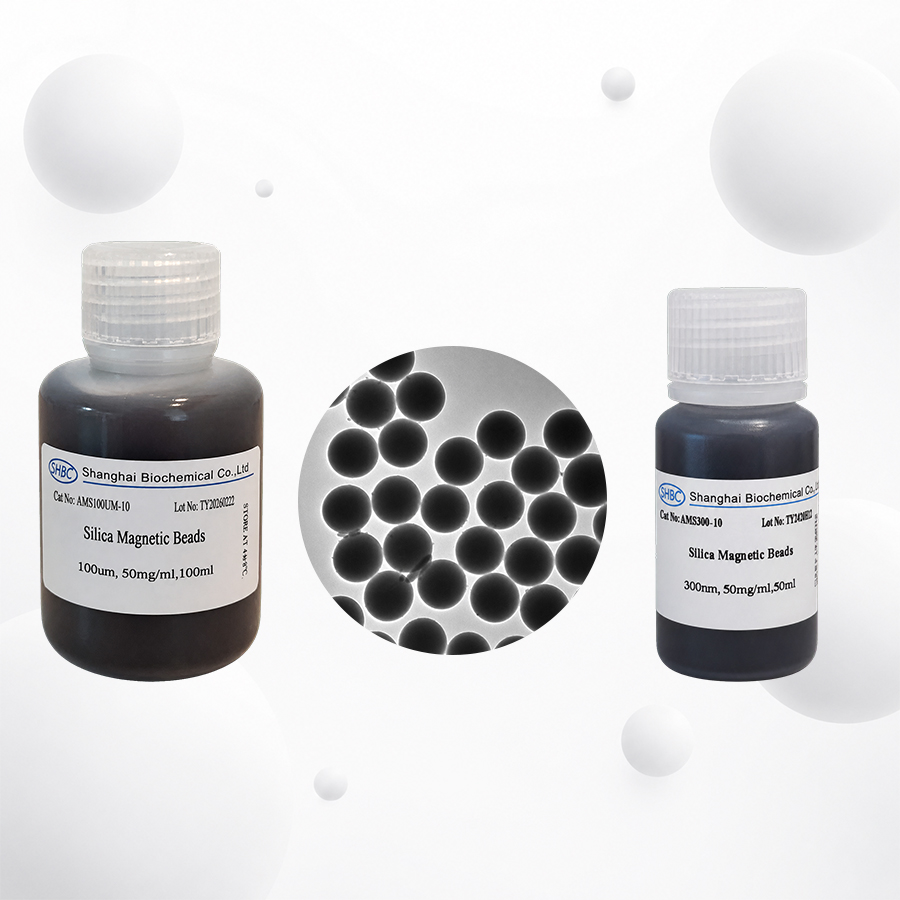 How Silica Magnetic Beads Work: Quick AnswerSilica magnetic beads extract DNA and RNA through a reversible bind–wash–elute process.First, a lysis buffer breaks open cells, viruses or other biological materials and releases nucleic acids into solution. A binding buffer containing salts—and often alco
-
 Overview of the Silica Magnetic Bead MarketSilica magnetic beads are functional magnetic particles used to extract and purify DNA or RNA from biological, clinical, food, environmental and research samples.A typical bead contains a magnetic core and a silica or silica-like outer surface. Under suitab
-
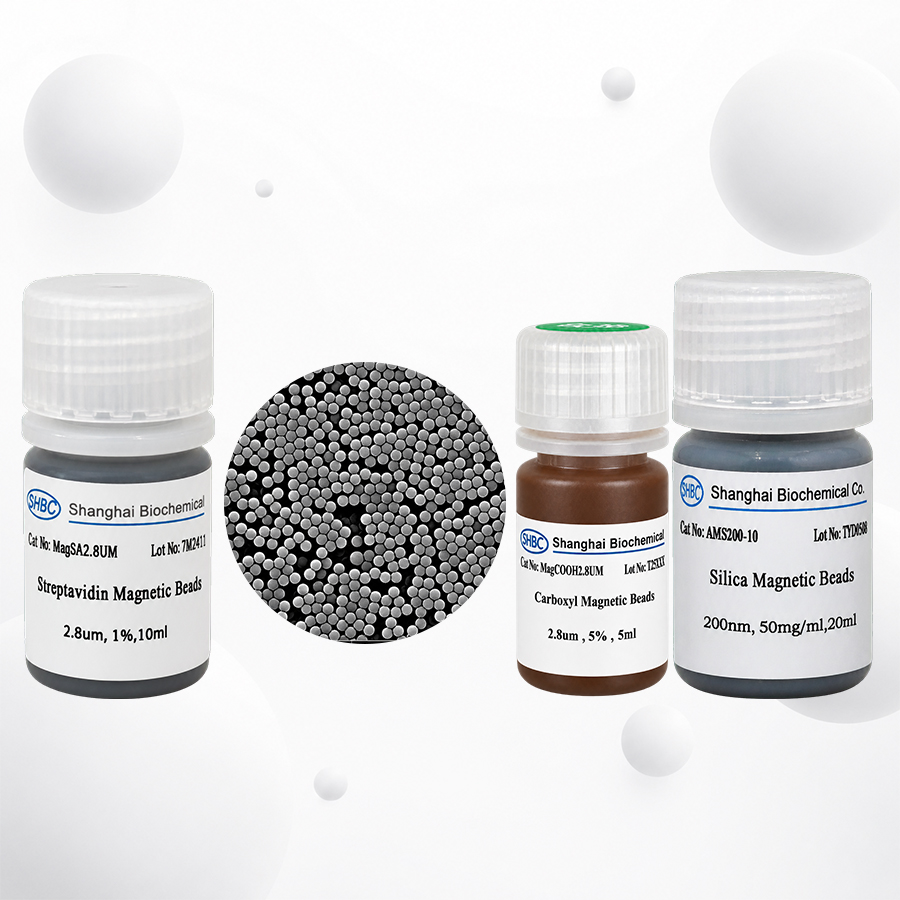 How to Choose Silica Magnetic Beads: Quick AnswerChoose silica magnetic beads according to the complete extraction workflow—not according to particle diameter or catalog price alone.The correct bead must match:The target nucleic acid;The sample matrix;The expected nucleic acid concentration;The requ
-
 Quick Answer: Top 10 Microsphere Manufacturers Serving EuropeThe top 10 microsphere manufacturers and specialist particle suppliers serving European lateral flow assay developers in 2026 are:Merck EstaporSHBCBangs LaboratoriesPolysciencesThermo Fisher ScientificJSR Life SciencesMagsphereSpherotechmi


