


Quick Answer
Magnetic fields do not deflect every particle in the same way.
A moving charged particle, such as an electron or ion, is deflected by the Lorentz force:
F = q(v × B)
This force requires a velocity component perpendicular to the magnetic field. A uniform magnetic field can bend the path of a charged particle.
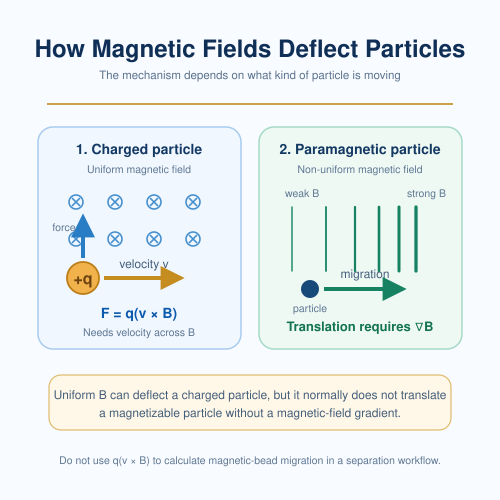
A magnetic particle or magnetic bead follows a different mechanism. It responds to magnetization and usually requires a magnetic-field gradient to produce net translational motion. A uniform magnetic field may align a magnetic particle, but it does not normally pull the particle across the solution.
Before calculating particle motion, first identify whether the particle is electrically charged, magnetically responsive, or neither.
First Identify the Particle Type
Particle Type | Main Magnetic Mechanism | Does a Uniform Magnetic Field Cause Deflection? |
|---|---|---|
Electron, ion, or other charged particle | Lorentz force, q(v × B) | Yes, when velocity has a component perpendicular to B |
Paramagnetic or superparamagnetic particle | Magnetic moment and field gradient | Usually no net translation without a gradient |
Diamagnetic particle | Magnetic response relative to the surrounding medium | Depends on susceptibility contrast and field gradient |
Neutral, nonmagnetic particle | No direct magnetic-force mechanism | No direct magnetic deflection |
The word “particle” is too broad by itself. A charged ion in a vacuum and a magnetic bead in an aqueous suspension should not be analyzed with the same equation.
How a Uniform Magnetic Field Deflects a Charged Particle
For a charged particle moving through a magnetic field, the magnetic force is:
F = q(v × B)
Its magnitude is:
|F| = |q|vB sin θ
Where:
q is the charge
v is particle velocity
B is magnetic-field strength
θ is the angle between v and B
The force is maximum when the particle moves perpendicular to the field.
When θ = 90°:
|F| = |q|vB
The force is zero when the particle moves parallel or anti-parallel to the magnetic field.
When θ = 0° or 180°:
|F| = 0
Why Charged Particles Follow Curved Paths
The Lorentz force is perpendicular to both the velocity direction and the magnetic-field direction.
For a positively charged particle, the right-hand rule can be used to determine force direction. For a negatively charged particle, the force direction is opposite.
In a uniform magnetic field:
A particle moving perpendicular to B follows a circular path.
A particle moving partly parallel and partly perpendicular to B follows a helical path.
A particle moving exactly parallel to B is not magnetically deflected.
A magnetic field alone changes the direction of a charged particle but does not change its speed or kinetic energy.
Magnetic Particles Need a Field Gradient for Net Migration
Magnetic particles are not deflected because they carry a free electric charge moving through a magnetic field.
Instead, a magnetically responsive particle develops or contains a magnetic moment. A useful general expression is:
F_m ≈ ∇(m · B)
Where m is the magnetic moment and ∇B represents the magnetic-field gradient.
A magnetic-field gradient means that the field is stronger on one side of the particle than on the other. This difference creates a net translational force.
For a paramagnetic or superparamagnetic particle in a suitable medium, the particle typically moves toward the region with higher magnetic-field strength.
Uniform Field Versus Field Gradient
A strong magnetic field and a strong magnetic-field gradient are not the same thing.
Magnetic Condition | Charged Particle | Paramagnetic or Superparamagnetic Particle |
|---|---|---|
Uniform magnetic field | Can curve if velocity is perpendicular to B | Can align, but normally has no net translational force |
Non-uniform magnetic field | Can still deflect through the Lorentz force | Can experience a net force and migrate toward stronger field regions |
No magnetic field | No magnetic force | No magnetic response force |
For magnetic separation, the gradient near the magnet is especially important. The particle must experience a difference in field strength across its position to move toward the collection zone.
What Controls Magnetic Particle Migration?
For magnetic particles suspended in liquid, the actual movement depends on more than magnet strength.
Important factors include:
Magnetic-field gradient and magnet geometry
Particle magnetic response
Particle volume and size
Distance between the sample and the magnet
Suspension viscosity
Flow rate and mixing conditions
Particle concentration and aggregation
Temperature and incubation time
A stronger magnet does not automatically guarantee faster or better separation if the magnet position, tube geometry, particle properties, or liquid conditions are unsuitable.
Charged-Particle Deflection Versus Magnetic-Bead Separation
The two mechanisms should be kept separate.
Charged particle
A charged particle must be moving through a magnetic field. Its deflection depends on charge, velocity, magnetic-field strength, and the angle between velocity and field.
The relevant equation is:
F = q(v × B)
Magnetic particle or bead
A magnetic particle can migrate in a liquid toward a magnetic-field gradient even when it is not moving initially.
Its response depends on magnetic moment, magnetization, field gradient, liquid drag, and particle properties.
The relevant question is not “what is the particle charge?” It is “what magnetic force is generated in the local field gradient, and can that force overcome fluid drag?”
Common Mistakes
Using the Lorentz-force equation for magnetic beads
The equation q(v × B) describes moving electrically charged particles. It should not be used to calculate magnetic bead capture or separation speed.
Assuming a uniform magnetic field always pulls particles sideways
A uniform field can deflect a moving charged particle. However, it does not normally create net translational motion for a simple magnetic particle without a gradient.
Assuming every particle moves toward a magnet
A neutral, nonmagnetic particle has no direct magnetic response. Diamagnetic and paramagnetic materials can also respond differently depending on their susceptibility relative to the surrounding medium.
Ignoring liquid drag
Magnetic particles in a liquid do not move like ions in a vacuum. Viscosity, flow, particle size, and aggregation influence migration and collection.
Practical Examples
In a mass spectrometer, charged ions are deflected by a magnetic field according to their charge, mass, and velocity. This is a Lorentz-force application.
In magnetic separation, magnetically responsive particles move through a liquid toward a high-gradient region near a magnet. This is a magnetophoresis application.
In a laboratory suspension, a nonmagnetic polymer particle will not become magnetically collectable simply because a magnet is placed near the tube.
Choosing the Right Physical Model
Use the charged-particle model when the particle is an electron, ion, plasma particle, or another free moving electrical charge.
Use the magnetic-particle model when the particle contains magnetic material, has a magnetic moment, or is designed for magnetic collection in liquid.
Use a combined approach only when both electrical charge motion and magnetic particle response are genuinely relevant to the system.
Conclusion
Magnetic fields deflect particles through different mechanisms.
Charged particles are deflected by the Lorentz force when their motion has a component perpendicular to the magnetic field. Magnetic particles require a magnetic-field gradient for net migration through a liquid.
For bioseparation workflows, Magnetic Beads should be selected according to magnetic response, particle size, surface chemistry, buffer compatibility, target molecule, and the separation format rather than the charged-particle Lorentz-force equation.
FAQ
Do magnetic fields deflect all particles?
No. Charged particles, magnetic particles, and nonmagnetic particles respond differently. The particle type determines the correct physical model.
Can a uniform magnetic field move a magnetic bead across a liquid?
A uniform field can align a magnetic particle, but net translational motion normally requires a magnetic-field gradient.
Why does a charged particle curve in a magnetic field?
The Lorentz force acts perpendicular to the particle velocity and bends its path. The force can create circular or helical motion.
Does a charged particle moving parallel to a magnetic field deflect?
No. When velocity is parallel or anti-parallel to the magnetic field, the magnetic force is zero.
Why do magnetic beads collect near a magnet?
The field is non-uniform near the magnet. The field gradient creates a net magnetic force that pulls magnetically responsive particles toward the collection area.
Related Blogs
-
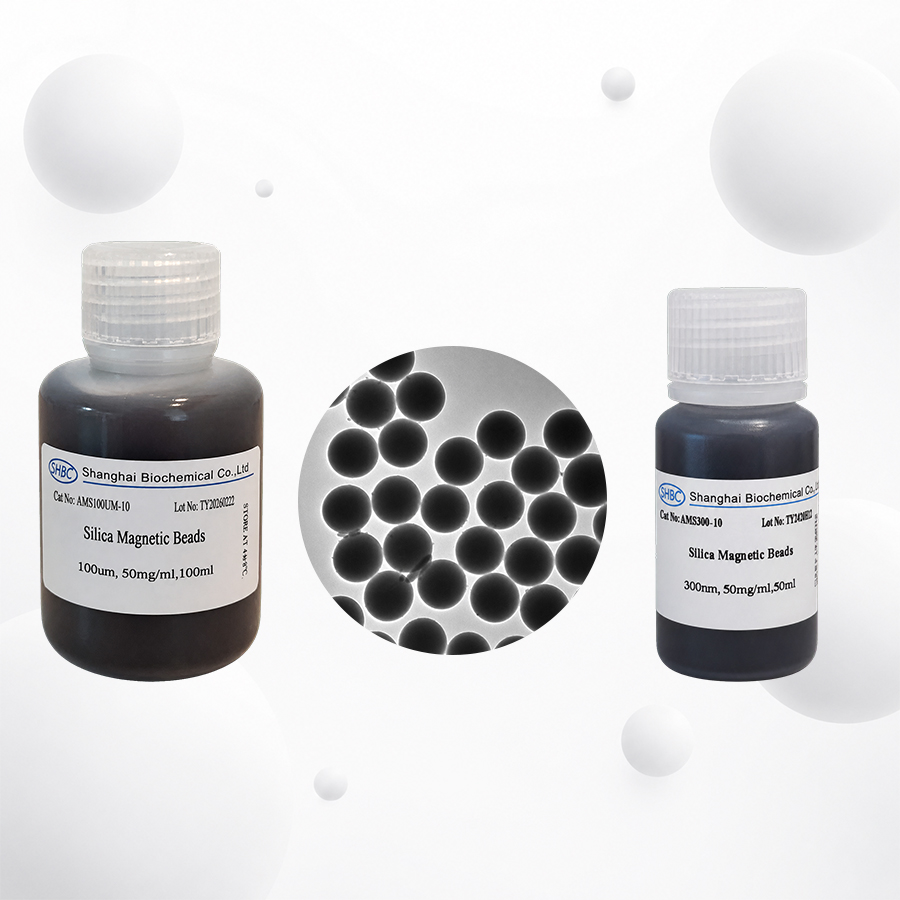 How Silica Magnetic Beads Work: Quick AnswerSilica magnetic beads extract DNA and RNA through a reversible bind–wash–elute process.First, a lysis buffer breaks open cells, viruses or other biological materials and releases nucleic acids into solution. A binding buffer containing salts—and often alco
-
 Overview of the Silica Magnetic Bead MarketSilica magnetic beads are functional magnetic particles used to extract and purify DNA or RNA from biological, clinical, food, environmental and research samples.A typical bead contains a magnetic core and a silica or silica-like outer surface. Under suitab
-
 How to Choose Silica Magnetic Beads: Quick AnswerChoose silica magnetic beads according to the complete extraction workflow—not according to particle diameter or catalog price alone.The correct bead must match:The target nucleic acid;The sample matrix;The expected nucleic acid concentration;The requ
-
 Quick Answer: Top 10 Microsphere Manufacturers Serving EuropeThe top 10 microsphere manufacturers and specialist particle suppliers serving European lateral flow assay developers in 2026 are:Merck EstaporSHBCBangs LaboratoriesPolysciencesThermo Fisher ScientificJSR Life SciencesMagsphereSpherotechmi


