


Quick Answer
Sphere magnets work through retained magnetization in a ball-shaped magnetic material. A typical sphere magnet has a north pole and a south pole on opposite sides, creating a magnetic field around it.
Their attraction, repulsion and rotation depend on pole orientation, distance and surrounding materials. The spherical shape allows easy changes in orientation, but it does not produce equal magnetic strength in every direction.
Sphere magnets are also different from the functionalized magnetic beads used in laboratory separation workflows.
What Is a Sphere Magnet?
A sphere magnet is a permanent magnet manufactured in the shape of a ball. Common examples are made from neodymium iron boron, usually abbreviated as NdFeB.
During magnetization, a strong applied field establishes a preferred magnetic direction within the material. The resulting permanent magnet retains substantial magnetization after that applied field is removed.
For a conventional sphere magnet magnetized along one diameter, the two poles lie at opposite ends of that magnetic axis. Its smooth surface does not remove the poles or make every surface position magnetically equivalent.
Why Do Sphere Magnets Attract, Repel and Rotate?
Attraction and Repulsion
When opposite poles face each other, two magnets attract. When like poles face each other, they repel.
The result depends on how the magnets are positioned. A sphere that can move freely may rotate before settling into an attracting arrangement. This helps explain why magnetic balls can form chains even when their poles are not visibly marked.
Rotation
An external magnetic field can exert a turning effect, called torque, on a sphere magnet. This tends to align its magnetic moment with the applied field.
Rotation and translation are different effects. A perfectly uniform external field can turn an ideal magnetic dipole without producing a net pulling force. A field that changes with position can also produce translational force.
Attraction to Steel
A sphere magnet can induce magnetization in nearby ferromagnetic steel, producing attraction.
The steel does not need to be another permanent magnet. However, the response depends on the material: different steel grades can behave differently, and not every metal is strongly attracted to a magnet.
Is the Magnetic Field Uniform Around a Sphere Magnet?
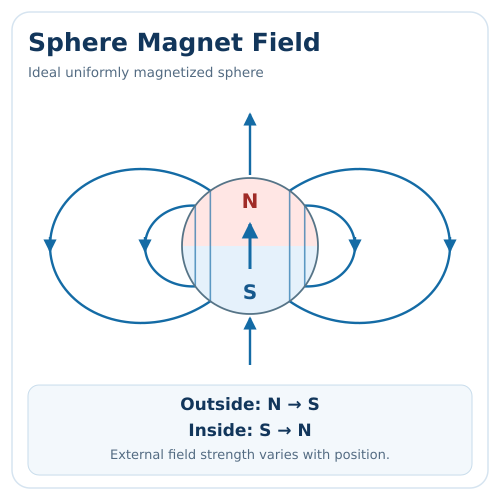
No. The external magnetic field changes in both strength and direction around the sphere.
For an ideal uniformly magnetized sphere, the external field has the pattern of a magnetic dipole. Outside the magnet, field lines leave the north region and return to the south region. Inside, they continue from south to north, forming closed paths.
“Uniform magnetization” describes the magnetization within the material. It does not mean that the surrounding field is uniform. Even when the ideal internal field is uniform, the external field remains position-dependent.
What Determines Sphere Magnet Strength?
Diameter alone does not fully describe magnetic performance.
Factor | Why it matters |
|---|---|
Magnetic material and grade | Determine the material’s magnetic properties and resistance to demagnetization |
Sphere diameter | Changes the magnet’s volume and overall magnetic moment |
Magnetization direction | Determines where the poles lie and how the sphere interacts with another object |
Distance | Strongly affects the field reaching the target |
Target material and geometry | Influence attraction and the magnetic flux path |
Coating, mounting and gaps | Change the separation and contact conditions |
Operating temperature | Must remain within the limits specified for the selected material and grade |
A measured surface field and a measured holding force describe different properties. A useful specification should state the measurement position or test arrangement.
How Does Distance Affect Sphere Magnets?
The magnetic effect becomes weaker as the distance increases.
For an ideal dipole, field strength along a fixed direction decreases with the inverse cube of the distance from its center. Doubling that center-to-measurement distance reduces the field to one-eighth of its previous value.
This is a field relationship, not a universal holding-force formula. Pulling force also depends on orientation, target geometry and how the field changes with position.
When comparing measurements, record whether the distance is measured from the sphere’s center or its surface.
Where Are Sphere Magnets Used?
Sphere magnets are useful when a rounded shape and changing orientation are part of the design. Examples include:
Demonstrations of magnetic poles, alignment and dipole interactions.
Magnetic chains and assemblies with movable connections.
Research fixtures for studying magnetic forces and rotation.
Positioning or sensing arrangements designed around a rotating magnetic element.
Performance should be assessed in the actual assembly. A sphere’s ability to rotate does not automatically establish a specified holding force or positioning accuracy.
Handling Small Strong Magnets
Strong sphere magnets can snap together and pinch fingers. Small high-powered magnets must be kept away from children because swallowing multiple magnets can cause serious internal injury.
If magnet ingestion is suspected, seek immediate medical attention.
Sphere Magnets Versus Laboratory Magnetic Beads
Laboratory magnetic beads serve a different purpose from solid sphere magnets.
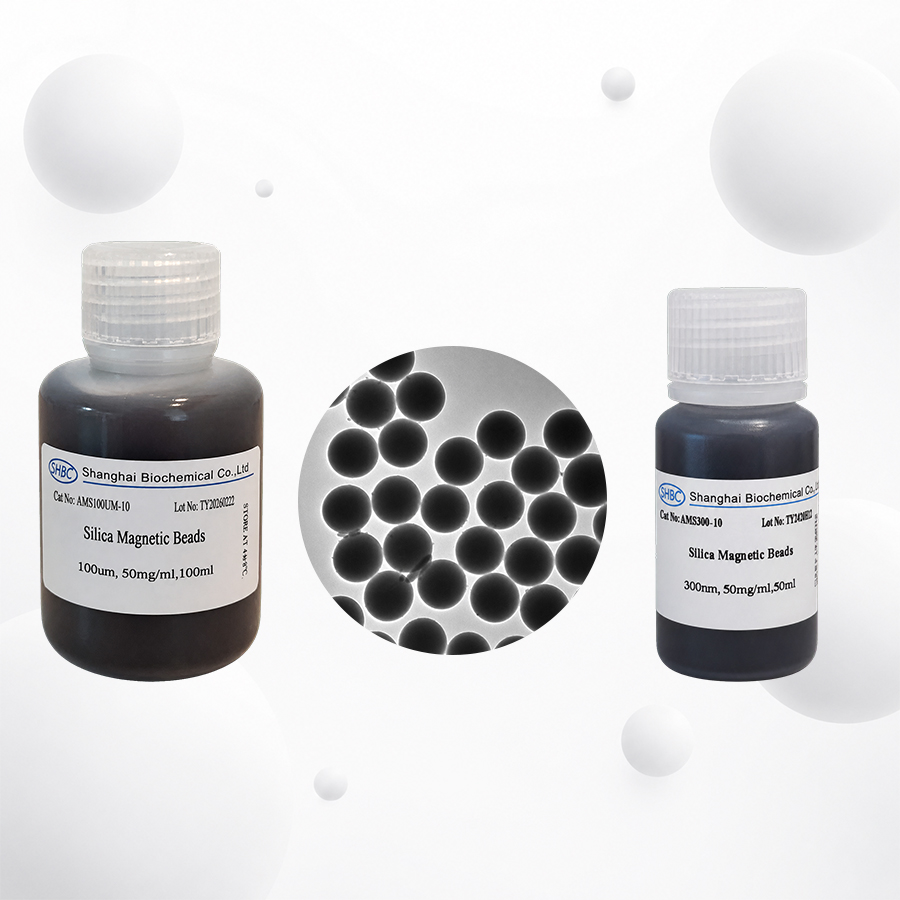
Many bead formulations contain magnetic iron oxide combined with a polymer or silica structure. Superparamagnetic formulations develop a magnetic response in an applied field and have little or no residual magnetization after its removal.
Their ability to redisperse also depends on surface chemistry, buffer conditions and interactions with the sample.
Feature | Sphere permanent magnet | Laboratory magnetic bead |
|---|---|---|
Physical form | Solid magnetic ball | Functionalized particles, commonly supplied as a suspension |
Magnetic behavior | Retains magnetization | Product-dependent; many formulations are superparamagnetic |
Main function | Produces a field and interacts mechanically with magnetic materials | Supports target capture and magnetic separation |
Surface purpose | Often protection against damage or corrosion | Binding, coupling or adsorption chemistry |
In a laboratory separation workflow, an external magnet or magnetic rack provides the field gradient that collects the beads. The bead surface determines how the target is captured.
Selecting a bead therefore requires consideration of particle size, surface chemistry, binding conditions, dispersion and separation performance.

Frequently Asked Questions
Do Sphere Magnets Have Poles Even Without Markings?
Yes. A conventionally magnetized sphere has north and south poles even when its coating does not identify them. A suitable pole detector can help locate the magnetic axis.
Why Do Magnetic Balls Form Chains?
Freely moving spheres can rotate into arrangements where opposite poles face neighboring magnets. The balance between magnetic interactions and mechanical constraints determines the final structure.
Is a Larger Sphere Magnet Always Better?
No. A larger sphere made from the same material generally has a larger magnetic moment, but suitability also depends on the required force, available space, distance and mounting arrangement.
Does a Steel Ball Attracted to a Magnet Become a Permanent Magnet?
Not necessarily. Attraction demonstrates a magnetic response, but the amount of magnetization retained afterward depends on the steel and its magnetic history.
Can Laboratory Magnetic Beads Replace Solid Sphere Magnets?
They serve different functions. Magnetic beads are selected for particle-based capture and separation, while solid sphere magnets are selected for field generation and mechanical magnetic interactions.
Conclusion
Sphere magnets work through retained magnetization, producing north and south poles and a position-dependent magnetic field. Attraction, repulsion and rotation depend on orientation, distance and the surrounding materials.
For laboratories using magnetic separation, particle selection also requires a surface chemistry suited to the target. SANYU GROUP supplies Magnetic Beads, including Carboxyl Magnetic Beads for biomolecule coupling and Silica Magnetic Beads for nucleic acid purification.
To discuss particle size, surface chemistry and separation requirements, contact our technical team with your intended application.
Related Blogs
-
 How Silica Magnetic Beads Work: Quick AnswerSilica magnetic beads extract DNA and RNA through a reversible bind–wash–elute process.First, a lysis buffer breaks open cells, viruses or other biological materials and releases nucleic acids into solution. A binding buffer containing salts—and often alco
-
 Overview of the Silica Magnetic Bead MarketSilica magnetic beads are functional magnetic particles used to extract and purify DNA or RNA from biological, clinical, food, environmental and research samples.A typical bead contains a magnetic core and a silica or silica-like outer surface. Under suitab
-
 How to Choose Silica Magnetic Beads: Quick AnswerChoose silica magnetic beads according to the complete extraction workflow—not according to particle diameter or catalog price alone.The correct bead must match:The target nucleic acid;The sample matrix;The expected nucleic acid concentration;The requ
-
 Quick Answer: Top 10 Microsphere Manufacturers Serving EuropeThe top 10 microsphere manufacturers and specialist particle suppliers serving European lateral flow assay developers in 2026 are:Merck EstaporSHBCBangs LaboratoriesPolysciencesThermo Fisher ScientificJSR Life SciencesMagsphereSpherotechmi


