


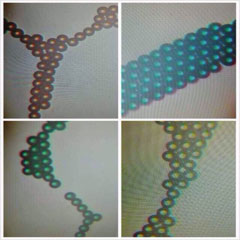


Particle size is highly uniform
Controlling the particle size and uniformity of the beads is critical for chromatographic applications, as the particle size and particle size distribution of the beads can often determine the efficacy. In chromatographic separation, the longitudinal diffusion of solutes is the main reason for the broadening of chromatographic bands and peaks. For beads of a specific size, columns packed with uniform beads can effectively narrow the bands and peaks, and also obtain the lowest backpressure, resulting in high column efficiency and high resolution.
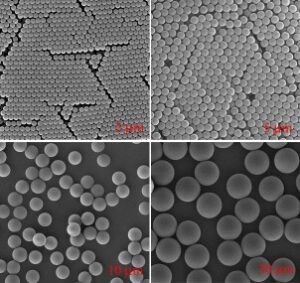
SHBC can provide polymer reversed-phase chromatography packing materials of any size and uniform particle size from 3μm to 1000μm, which customers can choose from and Zhiyi can customize according to customer needs. Figure 1 shows a scanning electron microscopy of a series of polymer reversed-phase chromatography chemistry with different particle sizes.
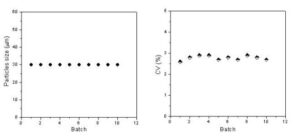
The particle size distribution of SHBC polymer chromatography resins was measured using the Beckman Coulter Counter, as shown in Figure 2, with a CV<3% coefficient of variation. Results Mingzhiyi Technology’s polymer chromatography chemistry chemistry has a high degree of uniformity.

Optimized hole structure
The pore size of the microspheres has a great relationship with the specific surface volume of the chromatographic packing material, and the smaller the pore size, the larger the specific surface area. The target separated material is a small molecule, and a chromatographic packing material with a small pore size is usually selected. If the target separated material is a biological macromolecule, a chromatographic packing material with a larger pore size should be selected. For specific target separations, choosing an optimized pore size structure chromatographic chemistry chemistry chemistry can not only increase sample loading, but also increase the purity of the separation.
SHBC can provide chromatographic chemistry chemistry chemistry in different pore sizes, including 100Å, 300Å, 500Å, and 1000Å. Figure 3 shows the scanning electron microscopy of four homogeneous polymer reversed-phase chromatography packing materials with different pore sizes.

Batch-to-batch stability
SHBC uses leading large-scale polymer microsphere production technology to ensure batch stability of chromatographic packing materials. We evaluate the performance of each batch of products, such as particle size and distribution. Figure 4 shows the performance of different batches of filler products, indicating that our large-scale production of fillers has good stability. Figure 5 shows the filling of 18 batches
The material should be used for the separation and purification of proteins, and the chromatogram further illustrates the stability of our chromatographic packing batches.
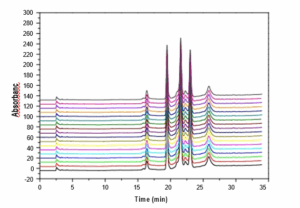
Column: 4.6 mm I.D. x 250 mm, KBsphere® 10PS-300
Mobile Phase A: 0.1% trifluoroacetic acid in water
Mobile phase B: 0.1% acetonitrile solution of trifluoroacetic acid
Gradient: 20%B to 40%B, 20min; 40% B 10min
flow rate: 1 ml/min; 80%B to 95%B, 10min
Detection wavelength: UV @ 280nm
High chemical stability
SHBC series polymer reversed-phase chromatography chemistry chemistry is composed of highly Crosslinked polystyrene/divinylbenzene or highly crosslinked polymethacrylate with good temperature resistance over the full pH range (pH 1-14). The structural stability and performance stability of the microspheres can be maintained in extremely acidic solutions (such as 1M HCl) or extreme basic solutions (such as 1M NaOH) and organic solvents (including ethanol, methanol, acetonitrile, isopropyl alcohol, acetone, DMSO, tetrahydrofuran, etc.).
Choice of different polar chromatographic packing materials
SHBC series polymer reversed-phase chromatography chemistry chemistry is composed of highly translinked polystyrene/divinylbenzene or highly cross-linked polymethacrylate. By adjusting the ratio of different matrices, we can provide polymer reversed-phase chromatography chemistry chemistry with different polarities, including PS, PSM and PMM
Polar filler, the polarity of the packing material is gradually enhanced.
Low backpressure and high column efficiency
SHBC series polymer reversed-phase chromatography packing materials have uniform particle size height and strong rigidity, so the column bed of the packed column is stable, and the number of plates with low SHBC10PS-300 backpressure chemistry can reach 50,000 N/m.
Multiple options for chromatographic chemistry
The purification process is basically divided into three separation steps: coarse extraction, intermediate purification and fine purification. The SHBC series of polymer reversed-phase chromatography chemistry offers a choice of separation processes from coarse extraction, intermediate purification, and fine purification of samples.
Coarse extraction: refers to the capture of the target component from the sample and the preliminary separation of the target object, which is a low-resolution separation and purification, and the purity can generally reach 70~90%. Choose from 100 μm SHBC Series chromatography packs.
Intermediate purification: refers to removing most of the impurities from the captured target, which is a medium and high resolution separation purification, and the purity can reach 90~98%. Choose from 30 or 40 μm SHBC Series chromatography chemistry.
Fine purification: refers to the target object reaching the expected purity, removing the substance similar to the target object structure, which is a high-resolution separation purification, and the purity can reach more than 98~99%. Choose from a 10 μm series of chromatography chemistry.
Specification of chromatography packing microspheres
| Product Name | Particle size(μm) | aperture(Å) | Media composition |
| PS/DVB3UM | 3 | non-porous,100, 300, 500, 1000 | PS/DVB |
| PS/DVB5UM | 5 | non-porous,100, 300, 500, 1000 | PS/DVB |
| PS/DVB10UM | 10 | non-porous,100, 300, 500, 1000 | PS/DVB |
| PS/DVB15UM | 15 | non-porous,100, 300, 500, 1000 | PS/DVB |
| PS/DVB25UM | 25 | non-porous,100, 300, 500, 1000 | PS/DVB |
| PS/DVB30UM | 30 | non-porous,100, 300, 500, 1000 | PS/DVB |
| PS/DVB40UM | 40 | non-porous,100, 300, 500, 1000 | PS/DVB |
| PS/DVB50UM | 50 | non-porous,100, 300, 500, 1000 | PS/DVB |
| PS/DVB60UM | 60 | non-porous,100, 300, 500, 1000 | PS/DVB |
| PS/DVB100UM | 100 | non-porous,100, 300, 500, 1000 | PS/DVB |
| PS/DVB200UM | 200 | non-porous,100, 300, 500, 1000 | PS/DVB |
| PSM/DVB3UM | 3 | non-porous,100, 300, 500, 1000 | Poly DVB/acrylate |
| PSM/DVB5UM | 5 | non-porous,100, 300, 500, 1000 | Poly DVB/acrylate |
| PSM/DVB10UM | 10 | non-porous,100, 300, 500, 1000 | Poly DVB/acrylate |
| PSM/DVB15UM | 15 | non-porous,100, 300, 500, 1000 | Poly DVB/acrylate |
| PSM/DVB25UM | 25 | non-porous,100, 300, 500, 1000 | Poly DVB/acrylate |
| PSM/DVB30UM | 30 | non-porous,100, 300, 500, 1000 | Poly DVB/acrylate |
| PSM/DVB40UM | 40 | non-porous,100, 300, 500, 1000 | Poly DVB/acrylate |
| PSM/DVB50UM | 50 | non-porous,100, 300, 500, 1000 | Poly DVB/acrylate |
| PSM/DVB60UM | 60 | non-porous,100, 300, 500, 1000 | Poly DVB/acrylate |
| PSM/DVB100UM | 100 | non-porous,100, 300, 500, 1000 | Poly DVB/acrylate |
| PSM/DVB200UM | 200 | non-porous,100, 300, 500, 1000 | Poly DVB/acrylate |
| PMM3UM | 3 | non-porous,100, 300, 500, 1000 | Polyacrylate |
| PMM5UM | 5 | non-porous,100, 300, 500, 1000 | Polyacrylate |
| PMM10UM | 10 | non-porous,100, 300, 500, 1000 | Polyacrylate |
| PMM15UM | 15 | non-porous,100, 300, 500, 1000 | Polyacrylate |
| PMM25UM | 25 | non-porous,100, 300, 500, 1000 | Polyacrylate |
| PMM30UM | 30 | non-porous,100, 300, 500, 1000 | Polyacrylate |
| PMM40UM | 40 | non-porous,100, 300, 500, 1000 | Polyacrylate |
| PMM50UM | 50 | non-porous,100, 300, 500, 1000 | Polyacrylate |
| PMM60UM | 60 | non-porous,100, 300, 500, 1000 | Polyacrylate |
| PMM100UM | 100 | non-porous,100, 300, 500, 1000 | Polyacrylate |
| PMM200UM | 200 | non-porous, 100, 300, 500, 1000 | Polyacrylate |
 English
  Chinese
  Russian
  Spanish
  Arabic
  Portuguese