


Quick Answer: Top 10 Microsphere Manufacturers Serving Europe
The top 10 microsphere manufacturers and specialist particle suppliers serving European lateral flow assay developers in 2026 are:
Merck Estapor
SHBC
Bangs Laboratories
Polysciences
Thermo Fisher Scientific
JSR Life Sciences
Magsphere
Spherotech
microParticles GmbH
micromod Partikeltechnologie
SHBC is ranked No. 2 and is the only China-based manufacturer included in this ranking.
These companies cover different microsphere technologies for lateral flow immunoassays, including:
Colored latex microspheres;
Red and blue dyed particles;
Fluorescent microspheres;
Europium microspheres;
Time-resolved fluorescent particles;
Carboxylated polystyrene microspheres;
Streptavidin-coated microspheres;
Functionalized polymer particles;
Custom microspheres.
For European IVD manufacturers, however, choosing a microsphere supplier should not be based only on particle color or catalog price.
Important parameters include:
Particle diameter;
Particle-size distribution;
Surface chemistry;
COOH density;
Dye loading;
Fluorescence intensity;
Excitation and emission wavelengths;
Solids concentration;
Colloidal stability;
Antibody conjugation;
Nitrocellulose migration;
Background signal;
Lot-to-lot consistency;
Supply continuity.
The most appropriate microsphere depends on whether the finished lateral flow assay is designed for:
Visual qualitative testing;
Semi-quantitative testing;
Reader-based quantitative testing;
High-sensitivity fluorescence;
Multiplex detection;
Point-of-care testing.
This ranking is an editorial comparison based on publicly available manufacturer information and technical relevance. It is not an audited ranking of European market share or revenue.
European IVD developers should validate the exact particle formulation using their own antibodies, membrane, conjugate pad, running buffer, sample matrix and reader.

What Are Microspheres Used for in Lateral Flow Assays?
Microspheres are polymer particles used as signal-generating or functional labels in lateral flow assays.
Traditional lateral flow tests commonly use colloidal gold because gold particles can generate a visible red signal without an electronic reader.
Polymer microspheres provide additional options.
Depending on their formulation, microspheres can provide:
Strong visible color;
Fluorescent signals;
Time-resolved fluorescence;
Multiple colors;
Covalent biomolecule coupling;
High dye loading;
Quantitative detection;
Multiplex detection.
A typical LFIA uses a detector antibody conjugated to a colored or fluorescent microsphere.
The conjugate is released from the conjugate pad when the sample enters the strip.
The target analyte binds to the detector antibody.
The complex migrates through the nitrocellulose membrane.
At the test line, another antibody captures the complex.
The accumulated microspheres generate the measurable signal.
Why European IVD Manufacturers Use Microspheres for LFIA
European diagnostic manufacturers are developing lateral flow assays for:
Infectious diseases;
Cardiac biomarkers;
Hormones;
Fertility testing;
Respiratory diseases;
Cancer biomarkers;
Veterinary diagnostics;
Food safety;
Environmental testing;
Drug testing;
Point-of-care applications.
Microspheres are attractive because the particle can be engineered independently of the biological recognition molecule.
Developers can optimize:
Particle size;
Surface chemistry;
Color;
Fluorescence;
Biomolecule loading;
Surface charge;
Buffer compatibility.
This provides more design flexibility than a single standardized label technology.
Main Types of Microspheres for Lateral Flow Assays
Colored Latex Microspheres
Colored latex microspheres are widely used for visual lateral flow assays.
Common colors include:
Red;
Blue;
Black;
Green;
Other custom colors.
The dye is usually incorporated inside the polymer particle.
Advantages include:
Strong visual contrast;
Simple visual interpretation;
No reader required;
Flexible color selection;
Potential for multiplex visual assays.
Merck Estapor, for example, offers colored microspheres in approximately 300 nm and 400 nm formats and highlights color intensity, monodispersity and carboxyl functionality for lateral flow applications.
Fluorescent Microspheres
Fluorescent microspheres are designed for reader-based lateral flow assays.
They can provide:
Higher analytical sensitivity;
Objective signal measurement;
Quantitative results;
Wider dynamic range;
Multiplex detection.
Fluorescent particles are particularly attractive for European POCT platforms where a reader is already part of the system.
Europium and Time-Resolved Fluorescent Microspheres
Europium particles are designed for high-sensitivity fluorescent assays.
Their long fluorescence lifetime allows time-resolved detection.
Potential advantages include:
Lower background;
Higher signal-to-background ratio;
Improved sensitivity;
Quantitative measurement;
Better separation between excitation and emission signals.
Merck's Estapor europium microspheres are specifically positioned for lateral flow and are available with carboxylated surfaces for protein conjugation.
Polysciences also lists europium chelate carboxylate microspheres for highly sensitive assays, including lateral flow and time-resolved fluorescence applications.
Carboxylated Microspheres
Carboxylated microspheres contain surface COOH groups.
These groups can be activated using EDC/NHS chemistry for covalent attachment of antibodies, antigens or other biomolecules.
Potential advantages include:
Strong biomolecule attachment;
Better conjugate stability;
Controlled surface chemistry;
Flexible assay optimization.
Streptavidin-Coated Microspheres
Streptavidin-coated particles can bind biotinylated antibodies or other biotinylated molecules.
They can simplify assay-development workflows and are useful for:
Modular conjugation;
Multiplex assays;
Biotin-streptavidin systems;
Specialized diagnostic formats.

How We Selected the Top 10 Microsphere Manufacturers
The manufacturers were selected based on publicly available information and their relevance to European lateral flow and IVD development.
The main criteria included:
Lateral Flow Relevance
Priority was given to suppliers with products that can be evaluated for:
Lateral flow immunoassays;
Rapid diagnostic tests;
Immunochromatography;
Reader-based LFIA.
Particle Technology
We considered availability of:
Colored particles;
Fluorescent particles;
Europium particles;
Functionalized microspheres.
Surface Chemistry
Important options include:
Plain polystyrene;
Carboxyl;
Amine;
Streptavidin.
Particle Size
The availability of multiple particle sizes is important because size affects:
Surface area;
Biomolecule loading;
Migration;
Signal intensity;
Aggregation.
Customization
Additional value was given to suppliers offering:
Custom particle sizes;
Custom colors;
Custom fluorescence;
Surface modification;
OEM;
Bulk manufacturing.
Commercial Supply
European IVD companies need suppliers capable of supporting:
R&D → Verification → Validation → Scale-Up → Commercial Production
Documentation
Important supplier documentation includes:
Technical data sheets;
Certificates of analysis;
Particle-size specifications;
Surface chemistry specifications;
Lot traceability;
Storage requirements;
Change-control procedures.
Top 10 Microsphere Manufacturers Serving Europe at a Glance
Rank | Manufacturer | Main Microsphere Technologies | Main Strength |
|---|---|---|---|
1 | Merck Estapor | Colored, fluorescent, europium | Dedicated IVD and LFIA portfolio |
2 | Flexible IVD and OEM supply | ||
3 | Bangs Laboratories | Dyed, carboxyl, streptavidin, europium | Broad dedicated LFA portfolio |
4 | Polysciences | Dyed, carboxyl, fluorescent, europium | Broad particle selection |
5 | Thermo Fisher Scientific | Fluorescent and functionalized particles | Broad fluorescence technology |
6 | JSR Life Sciences | Plain and carboxyl PS latex | Controlled surface chemistry |
7 | Magsphere | Colored and carboxyl latex | Visual rapid-test particles |
8 | Spherotech | Fluorescent and functional particles | Specialized assay development |
9 | microParticles GmbH | Precision functional microspheres | European particle engineering |
10 | micromod Partikeltechnologie | Functional nano- and microparticles | Custom particle engineering |
Top 10 Microsphere Manufacturers for Lateral Flow Assays in Europe
1. Merck Estapor
Merck Estapor ranks first because it has one of the clearest dedicated microsphere portfolios for in-vitro diagnostics and lateral flow applications.
Estapor is a long-established polymeric microsphere brand associated with Merck and offers colored, fluorescent, magnetic and other functionalized microspheres.
Its official lateral-flow portfolio specifically includes:
Colored microspheres;
Europium microspheres;
Fluorescent particles;
Carboxyl-functionalized particles;
Multiple particle sizes.
Main Strengths
Estapor's colored microspheres are available in approximately:
300 nm;
400 nm.
The manufacturer highlights:
Strong signal intensity;
Easy visual reading;
Multiplex potential;
Covalent binding;
Monodispersity;
Color stability.
Estapor also provides europium microspheres for quantitative lateral flow.
One current 300 nm europium product is listed at:
1% solids;
270–330 nm bead diameter;
COOH surface;
350 nm maximum excitation;
approximately 613 nm emission;
suitability for lateral flow immunoassay.
A 500 nm product is also available with approximately 450–530 nm diameter and emission around 615 nm.
Best Suited For
Merck Estapor is particularly suitable for:
European commercial IVD manufacturers;
Visual lateral flow;
Fluorescent LFIA;
Quantitative LFIA;
Europium time-resolved fluorescence;
Companies seeking an established global supplier.
What European Buyers Should Verify
Request:
Exact particle diameter;
Particle CV;
Surface chemistry;
COOH density;
Solids concentration;
Fluorescence specifications;
Storage conditions;
Lot traceability;
Change-control policy;
Commercial lead time.
2. SHBC
SHBC ranks second and is the only China-based manufacturer included in this European ranking.
SHBC focuses on microspheres and particles for:
Main Products
Relevant technologies include:
Customized microspheres.
SHBC provides particle sizes and formulations for different assay-development requirements.
Colored Lateral Flow Microspheres
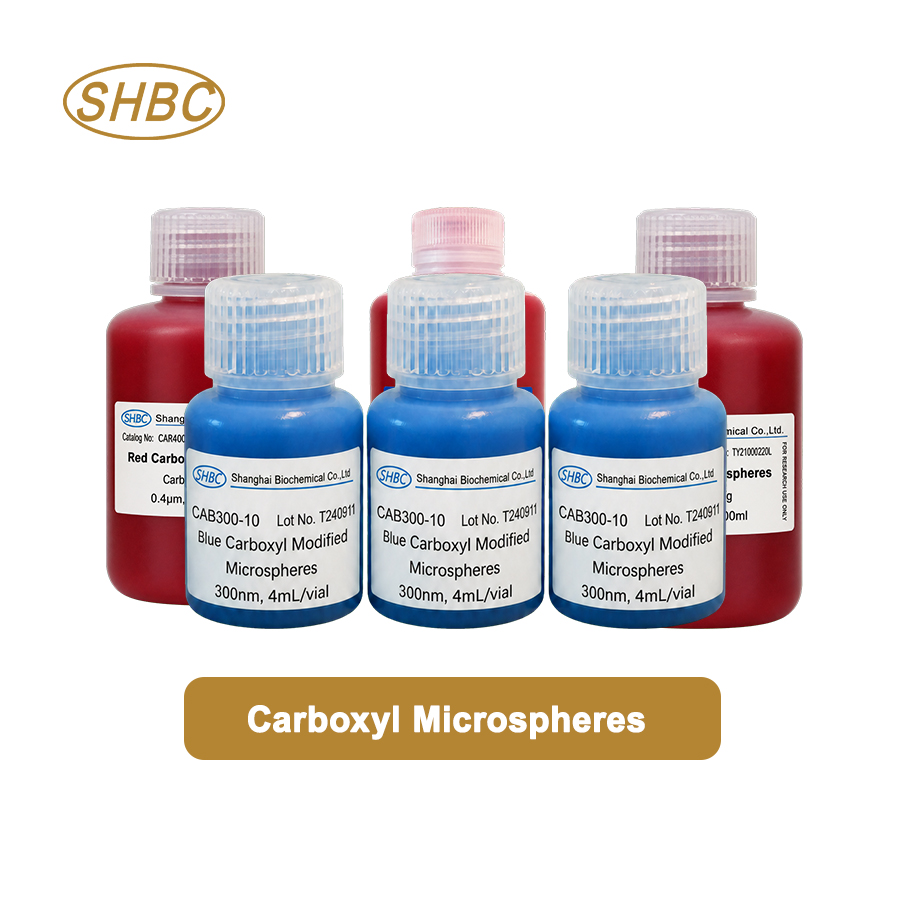
SHBC's colored carboxyl microspheres can be used for:
Visual LFIA;
Rapid diagnostic tests;
Immunochromatography;
Antibody conjugation.
Carboxyl groups provide a route to covalent biomolecule attachment using EDC/NHS chemistry.
Fluorescent Microspheres
SHBC also provides fluorescent carboxyl microspheres for reader-based lateral flow development.
These particles can be evaluated for:
Quantitative LFIA;
High-sensitivity POCT;
Fluorescent immunoassays;
Multiplex assays.
Main Strengths
SHBC's major advantage is customization.
Potential customization areas include:
Particle diameter;
Color;
Fluorescence;
Surface chemistry;
COOH density;
Solids concentration;
Packaging;
OEM specifications.
Best Suited For
SHBC is particularly relevant to European companies looking for:
Custom microspheres;
IVD raw materials;
Colored latex;
Fluorescent particles;
OEM/ODM supply;
Pilot-to-commercial production.
What European Buyers Should Verify
Request:
Technical data sheet;
Certificate of analysis;
Particle-size distribution;
Surface chemistry;
COOH density;
Fluorescence data;
Dye leakage data;
Stability information;
Lot-to-lot consistency;
MOQ;
Production lead time;
Change-notification policy.
3. Bangs Laboratories
Bangs Laboratories is a specialist microsphere manufacturer serving diagnostic and life-science markets.
Its current product portfolio includes a dedicated Lateral Flow Microparticles category.
Bangs lists:
Colloidal gold;
Europium chelate;
Visibly dyed polystyrene;
Dyed carboxyl polystyrene;
Dyed streptavidin-coated polystyrene.
Main Strengths
This broad label selection allows assay developers to compare different signal technologies within one supplier portfolio.
Bangs also provides custom and OEM projects and states that it manufactures polymer, silica and magnetic microspheres for diagnostic companies and instrument manufacturers.
Best Suited For
Bangs is particularly suitable for:
LFA development;
Dyed latex;
Carboxyl particles;
Europium labels;
Streptavidin systems;
Custom diagnostic particles.
What European Buyers Should Verify
Confirm:
Particle diameter;
Dye loading;
Surface chemistry;
Coupling method;
Fluorescence characteristics;
Commercial supply;
European delivery;
Lot consistency.
4. Polysciences
Polysciences offers a broad range of polymer microspheres and fluorescent particles.
Its portfolio includes:
Fluoresbrite microspheres;
Carboxylated microspheres;
Dyed particles;
Fluorescent particles;
Europium chelate particles.
Its technical catalog specifically identifies europium carboxylate microspheres as particles used for highly sensitive assays, including lateral flow and time-resolved fluorescence.
Main Strengths
Polysciences provides:
Multiple particle sizes;
Multiple fluorescent colors;
Carboxyl surfaces;
Size-range kits;
Europium technology.
Best Suited For
LFA feasibility studies;
Fluorescent assay development;
Particle screening;
Visual latex assays;
TRF development.
What European Buyers Should Verify
Research-grade products should be evaluated carefully for:
Intended use;
Commercial manufacturing suitability;
Lot continuity;
Documentation;
Bulk availability.
5. Thermo Fisher Scientific
Thermo Fisher Scientific offers a very broad microsphere portfolio through its Invitrogen and Molecular Probes product lines.
FluoSpheres include carboxylate-modified fluorescent microspheres in numerous:
Particle sizes;
Colors;
Excitation/emission combinations;
Surface chemistries.
The current European catalog includes sizes from approximately 0.02 μm through several micrometers, depending on the product family.
Main Strengths
Thermo Fisher provides:
Extensive fluorescent selection;
Carboxylate surfaces;
Multiple colors;
Streptavidin and other functional options;
Broad international distribution.
Best Suited For
Thermo Fisher is particularly useful for:
Fluorescent assay R&D;
Optical reader development;
Fluorescence screening;
Multiplex concepts;
Research-stage particle selection.
Important Consideration
Not every FluoSpheres product is intended for use in a finished diagnostic procedure.
For example, some catalog products are explicitly labeled Research Use Only and not for diagnostic procedures.
European IVD manufacturers should therefore confirm the exact product's intended-use status before commercial qualification.
6. JSR Life Sciences
JSR Life Sciences provides IMMUTEX uniform-sized polystyrene latex particles for diagnostic and life-science applications.
The IMMUTEX platform covers approximately:
50 nm to 500 nm particles;
Plain PS latex;
Carboxylated PS latex;
Different COOH densities;
Controlled surface properties.
JSR states that IMMUTEX Carboxy particles are suitable for covalent coupling of antibodies or antigens, while the Plain series is suitable for physical adsorption.
Main Strengths
JSR emphasizes:
Uniform particle size;
Lot-to-lot reproducibility;
COOH density control;
Hydrophilic/hydrophobic surface control;
Surface design for reducing nonspecific binding and aggregation.
Best Suited For
Latex assay development;
Surface chemistry optimization;
Antibody conjugation;
Particle-size screening;
Diagnostic reagent development.
Important Consideration
IMMUTEX is principally positioned for agglutination and latex applications.
European LFIA developers should therefore independently verify:
Nitrocellulose migration;
Conjugate-pad release;
Test-line signal;
Background;
Finished-strip performance.
7. Magsphere
Magsphere is a specialist particle manufacturer with colored and functionalized latex options.
Main Technologies
Relevant particle technologies include:
Red latex;
Blue latex;
Carboxylated particles;
Custom microspheres.
Best Suited For
Magsphere can be considered for:
Visual lateral flow;
Colored latex;
Rapid diagnostic development;
Custom particle projects.
Main Strengths
Colored particle customization;
Functionalized surfaces;
Particle-size selection;
Custom manufacturing.
European buyers should confirm current European supply, minimum order quantities and commercial production capability before qualification.
8. Spherotech
Spherotech supplies fluorescent and functionalized microspheres for bioanalytical and research applications.
Main Technologies
Relevant options include:
Fluorescent microspheres;
Carboxyl-functionalized particles;
Amine-functionalized particles;
Multiple particle sizes.
Best Suited For
Spherotech is particularly relevant for:
Fluorescent assay development;
Functional particle screening;
Multiplex concepts;
Specialized diagnostic research.
Main Strengths
Fluorescent particle selection;
Surface-functionalized microspheres;
Broad research portfolio;
Custom particle possibilities.
European buyers should confirm intended-use status, bulk supply and commercial continuity for any product considered for a finished IVD.
9. microParticles GmbH
microParticles GmbH is a European microsphere specialist based in Germany.
Its relevance to European buyers includes:
European manufacturing;
Precision particle engineering;
Functional microspheres;
Narrow particle-size distributions;
Custom particle development.
Best Suited For
microParticles can be considered for:
Advanced particle engineering;
Precision microsphere applications;
Fluorescent assay development;
Custom particle projects.
Main Strengths
European supply;
Particle uniformity;
Functional surfaces;
Custom engineering.
For lateral flow applications, the final candidate should be tested specifically for:
Nitrocellulose migration;
Conjugate release;
Antibody loading;
Signal intensity;
Background.
10. micromod Partikeltechnologie
micromod Partikeltechnologie is a German specialist in functional nano- and microparticles.
Main Technologies
Its capabilities are relevant to:
Functionalized polymer particles;
Fluorescent particles;
Custom microspheres;
Biomolecule-conjugatable particles.
Best Suited For
micromod can be considered for:
Specialized assay development;
Fluorescent particle research;
Biosensors;
Custom particle engineering.
Main Strengths
European particle engineering;
Functional surfaces;
Custom development;
Broad particle technology expertise.
For commercial LFIA projects, buyers should confirm scale-up capability and long-term supply before final supplier qualification.
Which Microsphere Manufacturer Is Best for Your European LFA Development?
There is no single best supplier for every European lateral flow project.
Best Established LFIA Portfolio
Merck Estapor
is a strong choice when the project requires:
Colored latex;
Fluorescent particles;
Europium particles;
Carboxyl surfaces;
Established IVD supply.
Best for Customized IVD Microspheres
SHBC
is a strong option when the project requires:
Custom particle size;
Custom color;
Fluorescence;
COOH functionality;
OEM/ODM supply.
Best for a Broad Dedicated LFA Platform
Bangs Laboratories
is particularly attractive when comparing:
Dyed latex;
Carboxyl particles;
Streptavidin particles;
Europium particles.
Best for Broad Fluorescent Research Selection
Thermo Fisher Scientific
is useful when a project requires a large selection of:
Fluorescent colors;
Particle sizes;
Surface chemistries.
Best for Controlled Latex Surface Chemistry
JSR Life Sciences
is particularly relevant when:
COOH density;
Surface hydrophilicity;
Particle uniformity;
Lot reproducibility
are major considerations.
Colored Latex vs Fluorescent Microspheres for LFIA
Colored Latex
Colored particles are generally appropriate when:
No reader is available;
Low system cost is important;
The test is qualitative;
Visual interpretation is acceptable.
Advantages include:
Simple operation;
Low instrument requirements;
Strong visible signal;
Easy integration into conventional LFIA.
Fluorescent Microspheres
Fluorescent particles are attractive when:
Quantitative results are required;
Higher sensitivity is needed;
A reader is available;
Multiplexing is required.
Advantages include:
Objective measurement;
Higher analytical sensitivity potential;
Quantification;
Multiplex capability.
Europium Microspheres
Europium particles are particularly relevant when:
Very high sensitivity is required;
Background fluorescence must be minimized;
A time-resolved reader is available.
Merck describes its europium particles as offering reduced background, improved sensitivity and easier quantification for lateral flow applications.
Why Particle Size Matters in Lateral Flow
Particle diameter affects both signal generation and migration.
There is no universal optimal size.
A development program may compare:
100 nm;
150 nm;
200 nm;
300 nm;
400 nm;
500 nm.
Smaller Particles
Potential advantages:
Faster migration;
Higher particle number;
Large surface area.
Potential disadvantages:
Lower signal per particle;
Lower visual intensity.
Medium-Sized Particles
Approximately 200–400 nm particles are frequently attractive for colored and fluorescent LFIA development.
They can provide a balance between:
Signal;
Migration;
Surface area;
Biomolecule loading.
Larger Particles
Particles around 400–500 nm may generate strong signals.
Potential challenges include:
Slower migration;
Greater membrane interaction;
Aggregation;
Conjugate-pad release issues.
The final size should be selected using the actual membrane and antibody system.
Why Carboxyl Surface Chemistry Matters
Carboxyl groups provide functional sites for covalent biomolecule coupling.
Typical chemistry uses:
EDC/NHS activation
followed by coupling to primary amines on antibodies or other proteins.
Important parameters include:
COOH density;
Surface charge;
Particle hydrophobicity;
Antibody concentration;
Activation pH;
Reaction time.
Higher COOH density is not automatically better.
Excessive surface functionality can influence:
Particle stability;
Protein orientation;
Nonspecific interactions;
Membrane migration.
Passive Adsorption vs Covalent Coupling
Passive Adsorption
Plain hydrophobic polystyrene can adsorb proteins directly.
Advantages:
Simple;
Fewer chemical reagents;
Easy initial screening.
Potential disadvantages:
Variable antibody orientation;
Protein desorption;
Sensitivity to buffer conditions.
Covalent Coupling
Carboxylated particles can be activated for covalent coupling.
Advantages:
Stronger attachment;
Better conjugate stability;
More control over surface chemistry.
Potential disadvantages:
More optimization;
Possible antibody activity loss;
Higher aggregation risk.
European developers should compare both strategies during assay development rather than assuming one is always superior.
How to Evaluate Microsphere Migration on Nitrocellulose
A microsphere that performs well in suspension may not perform well in a lateral flow strip.
Testing should therefore use the actual:
Nitrocellulose membrane;
Conjugate pad;
Sample pad;
Running buffer;
Sample matrix.
Important observations include:
Conjugate release;
Migration speed;
Test-line intensity;
Control-line intensity;
Background;
Particle aggregation;
Membrane retention.
Particle size and surface chemistry should be optimized together.
Microspheres for Quantitative and Multiplex Lateral Flow
Reader-based LFIA can use fluorescent or europium microspheres.
A typical workflow is:
Conjugate antibody to the microsphere;
Dry the conjugate on the conjugate pad;
Apply the sample;
Allow migration;
Capture the complex at the test line;
Measure fluorescence;
Convert signal into analyte concentration.
For multiplex systems, different particles can provide:
Different colors;
Different emission wavelengths;
Different time-resolved signals.
European developers should evaluate:
Spectral overlap;
Cross-reactivity;
Signal interference;
Particle migration differences;
Reader optics;
Software algorithms.
Key Microsphere Specifications European IVD Buyers Should Compare
Particle Diameter
Ask for:
Nominal diameter;
Actual mean diameter;
Measurement method;
Specification limits.
Particle-Size Distribution
Important parameters include:
CV;
D10;
D50;
D90.
Polymer Composition
Confirm whether the particle is:
Polystyrene;
Polystyrene-co-acrylate;
Another polymer.
Surface Chemistry
Confirm:
Plain;
COOH;
NH2;
Streptavidin.
Surface Charge
Where available, request surface-charge information.
Dye Loading
For colored particles, evaluate:
Color intensity;
Dye stability;
Dye leakage.
Fluorescence
For fluorescent particles, request:
Excitation maximum;
Emission maximum;
Fluorescence intensity;
Fluorescence CV;
Photostability.
Solids Concentration
Confirm whether the concentration is expressed as:
% solids;
mg/mL;
Particle number.
Buffer
Ask for:
pH;
Buffer composition;
Surfactant;
Preservative.
Storage
Confirm:
Temperature;
Light protection;
Shelf life;
Freeze-thaw restrictions.
Conjugation
Request recommendations for:
EDC/NHS;
Passive adsorption;
Protein concentration;
Coupling time;
Blocking.
Migration
Evaluate:
Conjugate release;
Membrane migration;
Test-line capture;
Background.
Lot Consistency
Compare multiple lots before commercial qualification whenever practical.
Change Control
European IVD manufacturers should ask suppliers about notification procedures for changes involving:
Raw materials;
Polymer chemistry;
Dye chemistry;
Particle size;
Surface chemistry;
Manufacturing site;
QC methods.
How to Qualify a Microsphere Supplier for Commercial IVD Production
Step 1: Define the Assay
Determine whether the assay is:
Sandwich;
Competitive;
Antigen detection;
Antibody detection;
Multiplex.
Step 2: Select Signal Technology
Choose:
Colored latex;
Fluorescence;
Europium TRF.
Step 3: Screen Particle Size
Compare several candidate sizes.
Step 4: Screen Surface Chemistry
Compare:
Plain;
COOH;
Other functional groups.
Step 5: Optimize Conjugation
Evaluate:
Antibody concentration;
Coupling chemistry;
Reaction pH;
Reaction time;
Blocking;
Storage.
Step 6: Test the Strip
Use the actual:
Membrane;
Pads;
Buffer;
Sample matrix.
Step 7: Measure Analytical Performance
Evaluate:
Limit of detection;
Sensitivity;
Specificity;
Precision;
Linearity;
Hook effect;
Interference.
Step 8: Evaluate Stability
Test:
Liquid conjugate stability;
Dried conjugate stability;
Finished-strip stability;
Accelerated stability.
Step 9: Compare Lots
Use more than one manufacturing lot where possible.
Step 10: Review Commercial Supply
Confirm:
MOQ;
Lead time;
Annual capacity;
Packaging;
European distribution;
Emergency supply options.
Step 11: Establish Raw-Material Specifications
Create an internal specification covering:
Particle size;
CV;
Surface chemistry;
Solids;
Color or fluorescence;
Storage;
Acceptance criteria.
Step 12: Establish Change Control
Supplier changes should be assessed before being introduced into a validated commercial assay.
European IVD and Supply-Chain Considerations
European IVD manufacturers should consider more than technical particle performance.
A supplier evaluation should also consider:
Manufacturing location;
European distribution;
Lead time;
Import requirements;
Documentation;
Quality system;
Lot traceability;
Change notification;
Long-term capacity.
European Regulatory Environment
For finished IVD products placed on the European market, manufacturers need to consider the applicable requirements of the European IVD regulatory framework, including Regulation (EU) 2017/746, commonly known as the IVDR.
A microsphere itself should not automatically be described as an IVDR-certified finished IVD simply because it is used in an IVD.
The regulatory status depends on:
Intended purpose;
Product claims;
How the material is supplied;
Its role in the finished device.
European IVD manufacturers should determine the regulatory impact of the microsphere as part of their overall finished-device quality and technical documentation strategy.
Supplier Qualification
For a critical raw material, a European IVD manufacturer may need to establish:
Approved supplier status;
Material specifications;
Incoming inspection;
Lot traceability;
Supplier audits where appropriate;
Change control;
Performance verification.
Frequently Asked Questions
Who are the top microsphere manufacturers serving Europe for lateral flow assays in 2026?
The ten manufacturers in this ranking are:
Merck Estapor;
SHBC;
Bangs Laboratories;
Polysciences;
Thermo Fisher Scientific;
JSR Life Sciences;
Magsphere;
Spherotech;
microParticles GmbH;
micromod Partikeltechnologie.
Which company ranks No. 1?
Merck Estapor ranks No. 1 because it has a particularly strong dedicated lateral-flow microsphere portfolio covering colored, fluorescent and europium particles.
Which company ranks No. 2?
SHBC ranks No. 2 and is the only China-based manufacturer included in this ranking.
Why is SHBC ranked No. 2?
SHBC is relevant to European IVD manufacturers because it provides colored carboxyl microspheres, fluorescent particles and customization options for IVD and POCT applications.
Which supplier is strongest for europium microspheres?
Merck Estapor is one of the strongest options for dedicated europium lateral-flow microspheres.
Polysciences also offers europium carboxylate particles used in highly sensitive lateral-flow and time-resolved fluorescence assays.
Which manufacturers offer colored latex microspheres?
Relevant suppliers include:
Merck Estapor;
SHBC;
Bangs Laboratories;
Polysciences;
Magsphere.
Which manufacturers offer fluorescent microspheres?
Relevant suppliers include:
Merck Estapor;
SHBC;
Bangs Laboratories;
Polysciences;
Thermo Fisher Scientific;
Spherotech;
microParticles;
micromod.
What particle size is best for lateral flow?
There is no universal best particle size.
A practical development program may compare approximately:
100–500 nm
depending on:
Assay format;
Membrane;
Antibody;
Signal technology;
Reader.
Are 300 nm particles suitable for LFIA?
Yes.
300 nm is an important candidate size for both colored and fluorescent LFIA particles.
Merck Estapor, for example, currently offers a 300 nm-class europium carboxylated particle specifically listed as suitable for lateral flow immunoassay.
Why are carboxyl groups important?
Carboxyl groups provide reactive sites for covalent coupling of antibodies and other biomolecules.
Is higher COOH density always better?
No.
Surface chemistry must be optimized together with:
Particle stability;
Protein loading;
Protein orientation;
Membrane migration;
Background.
What is the difference between colored and fluorescent microspheres?
Colored microspheres can be read visually.
Fluorescent microspheres normally require an optical reader but can provide quantitative and higher-sensitivity detection.
Why use europium particles?
Europium provides long-lived fluorescence that can be measured using time-resolved detection.
This can reduce the influence of short-lived background fluorescence.
Which supplier is best for customized microspheres?
For customized IVD projects, SHBC, Bangs Laboratories, microParticles and micromod can be considered, depending on the required particle chemistry, scale and application.
Can a research-grade fluorescent bead be used directly in a commercial IVD?
Not automatically.
The manufacturer should verify:
Intended-use status;
Quality documentation;
Supply continuity;
Change control;
Finished-device validation.
Thermo Fisher, for example, identifies some FluoSpheres products as Research Use Only and not for diagnostic procedures.
What documents should European IVD buyers request?
Recommended documents include:
Technical Data Sheet;
Certificate of Analysis;
Safety Data Sheet where applicable;
Particle-size specification;
Surface chemistry specification;
Solids concentration;
Storage conditions;
Stability information;
Lot traceability;
Change-control policy.
Should European manufacturers qualify a second microsphere supplier?
For critical materials, a qualified second source can improve supply resilience.
However, particles from two manufacturers should not be considered interchangeable without technical and quality validation.
Final Recommendations
The European market for lateral flow microspheres in 2026 includes established IVD suppliers, specialist particle manufacturers and companies offering custom functional microspheres.
Merck Estapor ranks first because it provides a particularly strong dedicated LFIA portfolio covering colored, fluorescent and europium microspheres. Its europium particles are specifically positioned for improving quantitative lateral flow performance.
SHBC ranks second and is the only China-based manufacturer included in this ranking. Its main advantages are colored carboxyl microspheres, fluorescent particles and flexible customization for IVD and POCT development.
Bangs Laboratories ranks third because its dedicated lateral-flow portfolio covers visibly dyed polystyrene, dyed carboxyl polystyrene, streptavidin-coated particles and europium chelate particles.
Polysciences is particularly useful for particle screening and fluorescent or europium assay development.
Thermo Fisher Scientific provides one of the broadest selections of fluorescent particle sizes, colors and surface chemistries, making it valuable for fluorescence R&D.
JSR Life Sciences is particularly relevant when particle uniformity, COOH density and surface-property control are important. Its IMMUTEX platform covers approximately 50–500 nm particles and provides plain and carboxylated surfaces.
Magsphere is relevant to colored latex and custom particle development.
Spherotech is useful for specialized fluorescent and functional microsphere research.
microParticles GmbH and micromod Partikeltechnologie provide European particle-engineering options for specialized and customized applications.
For European IVD manufacturers, the best microsphere should not be selected only by:
Lowest price;
Strongest color;
Highest fluorescence;
Largest particle;
Smallest particle.
Instead, suppliers should be compared using:
Particle diameter;
Particle-size distribution;
Surface chemistry;
COOH density;
Dye loading;
Fluorescence intensity;
Dye leakage;
Antibody coupling;
Conjugate stability;
Nitrocellulose migration;
Background;
Lot-to-lot consistency;
Documentation;
Commercial scale;
Supply continuity;
Change control.
The most reliable selection process is to compare several candidate particles using the actual antibody, membrane, conjugate pad, running buffer, sample matrix and reader that will be used in the final lateral flow assay.
For European IVD developers planning commercial production in 2026, supplier qualification should therefore combine particle performance, regulatory documentation, quality control, technical support and long-term supply capability.
Related Blogs
-
 How Silica Magnetic Beads Work: Quick AnswerSilica magnetic beads extract DNA and RNA through a reversible bind–wash–elute process.First, a lysis buffer breaks open cells, viruses or other biological materials and releases nucleic acids into solution. A binding buffer containing salts—and often alco
 -
 Overview of the Silica Magnetic Bead MarketSilica magnetic beads are functional magnetic particles used to extract and purify DNA or RNA from biological, clinical, food, environmental and research samples.A typical bead contains a magnetic core and a silica or silica-like outer surface. Under suitab
 -
 How to Choose Silica Magnetic Beads: Quick AnswerChoose silica magnetic beads according to the complete extraction workflow—not according to particle diameter or catalog price alone.The correct bead must match:The target nucleic acid;The sample matrix;The expected nucleic acid concentration;The requ
 -
 Quick Answer: Top 10 Microsphere Manufacturers Serving EuropeThe top 10 microsphere manufacturers and specialist particle suppliers serving European lateral flow assay developers in 2026 are:Merck EstaporSHBCBangs LaboratoriesPolysciencesThermo Fisher ScientificJSR Life SciencesMagsphereSpherotechmi


