


Silica Magnetic Bead Manufacturers: What Buyers Should Compare
Silica magnetic beads combine a magnetic component with a surface that can bind nucleic acids under suitable buffer conditions. They allow laboratories to capture DNA or RNA, remove contaminants through washing, and recover the target in an elution solution. Their performance depends on the bead formulation, sample preparation, buffers and separation equipment.
For buyers comparing silica magnetic bead manufacturers, the first question is what each company actually supplies. A bottle of bead suspension, a replacement component for an extraction kit, and a complete extraction system involve different purchasing and development decisions.
This guide compares ten manufacturers and product suppliers using their published technical materials. It is published by SANYU and includes our own product range. The numbering helps readers navigate the list; it does not represent an independently tested performance ranking. Confirm the current product grade, availability and supply terms before purchasing.
Standalone Beads and Extraction Systems
Standalone magnetic bead suspensions give developers control over bead dose and extraction chemistry. Buyers must establish suitable lysis, binding, washing and elution conditions, or obtain a compatible method from the supplier.
Separately sold kit components provide another purchasing route. A component may have an established role within a particular extraction system, but that does not automatically establish its performance in another manufacturer's buffers.
Complete extraction kits combine particles with reagents and instructions for defined samples and targets. They can provide a useful reference method during development. Their published performance applies to the specified procedure and does not isolate the contribution of the beads alone.
Silica coatings, silane surfaces and carboxyl-modified surfaces should also be identified precisely. Companies may sell several magnetic particle chemistries under related brand names. Select the exact catalog grade before comparing specifications.
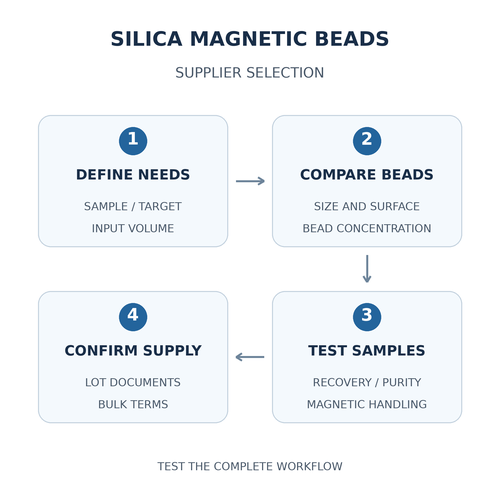
The flowchart summarizes a practical supplier selection process: define the sample and target, compare bead specifications, test recovery and handling, and confirm the supply requirements. Each stage should be completed for the specific bead grade and intended extraction workflow.
Comparison of 10 Silica Magnetic Bead Manufacturers and Suppliers
The table identifies relevant product families and the purchasing questions they raise. Supply formats are based on published product information. Particle dimensions, concentrations and performance specifications should be checked against the selected grade.
Company | Relevant product | Documented supply format | Main purchasing question |
|---|---|---|---|
Cytiva | SeraSil-Mag 400 and 700 | Standalone silica-coated particle suspensions | Which size and buffer method match the sample? |
Thermo Fisher Scientific | Dynabeads MyOne Silane | Standalone beads; manual describes bulk OEM supply | Is the silane grade suitable for the intended extraction chemistry? |
SANYU | Silica magnetic beads | Catalog bead suspensions and customization inquiries | Which particle size, surface and concentration should be evaluated? |
Merck / MilliporeSigma | MagPrep Silica | Catalog silica particle suspension | What are the current grade specifications and supply terms? |
Promega | MagneSil Paramagnetic Particles | Separately sold extraction-system component | Which MagneSil grade belongs to the intended workflow? |
QIAGEN | MagAttract Suspension G | Separately sold bead suspension used in defined methods | Which protocol and instrument configuration apply? |
New England Biolabs | Monarch Mag Beads M1 and M2 | Kit components; M2 also listed separately | Which bead and protocol match extraction or cleanup? |
Magtivio | MagSi-DNA | Development bead suspensions and trial kit | Is the selected grade silica-surface or carboxyl-modified? |
chemicell | geneMAG systems using magnetic silica beads | Sample-specific extraction kits described in protocols | Is standalone SiMAG-DNA supply available for the project? |
G-Biosciences | Silica Magnetic Beads | Standalone bead suspension | How does the published size range behave in the actual workflow? |
1. Cytiva
Cytiva's relevant silica-coated product family is SeraSil-Mag. Its user guide describes nominal particle diameters of 400 nm and 700 nm, supplied as bead suspensions at 20 mg/mL. These products provide two defined submicron candidates for nucleic acid extraction development.
The guide specifies that suitable protocols and buffers are required. This makes SeraSil-Mag useful to compare when a developer wants to evaluate particle grades within an existing extraction formulation or build a method around a documented bead suspension.
Cytiva also offers magnetic particles with other surface chemistries. Sera-Mag carboxylate products and SeraSil-Mag silica beads should be assessed as distinct materials.
When requesting samples, identify the required size and describe the sample matrix, input volume and target nucleic acid. Test magnetic clearance, resuspension and recovery in the intended vessel. Confirm current packaging and volume supply options separately; catalog pack size alone does not establish a production supply agreement.
2. Thermo Fisher Scientific
Thermo Fisher Scientific lists Dynabeads MyOne Silane as 1 µm magnetic particles with silica-like surface chemistry. The manufacturer's terminology matters: the product should be evaluated as the specified silane formulation, without assuming that it is identical to every silica-coated bead.
Its instructions describe DNA and RNA isolation using appropriate sample preparation and reagents. The manual also describes bulk OEM supply, making commercial supply terms a relevant discussion for reagent developers.
Buyers should request the current specification and clarify the recommended binding chemistry, suspension medium and handling procedure. For an automated method, evaluate capture and liquid removal using the actual magnet, vessel and working volume.
Thermo Fisher's magnetic bead portfolio contains multiple chemistries and applications. Selection should therefore start with the exact product, rather than a general brand reference. Any planned transfer into another extraction formulation requires testing of recovery, inhibition and bead carryover under the proposed conditions.
3. SANYU
SANYU manufactures micro- and nanoscale particle materials and offers silica magnetic bead products for nucleic acid extraction development. Its published catalog includes nominal particle size examples such as 200 nm, 300 nm, 800 nm and 1 µm.
The product range gives buyers several candidates to discuss when defining an extraction project. SANYU also describes customization inquiries involving particle size, concentration and surface chemistry. The final specification should be agreed for the selected grade.
Unmodified silica magnetic beads and carboxyl-functionalized silica magnetic beads appear in the broader catalog. Their surfaces should be distinguished when requesting a sample or comparing an extraction protocol.
For a technical inquiry, provide the sample type, target DNA or RNA, input volume, buffer formulation and separation equipment. This helps narrow the initial candidates. Confirm the suspension specification, available documentation and sample quantity before evaluation. Recovery, purity and handling should then be established in the intended workflow rather than inferred from nominal diameter.
4. Merck / MilliporeSigma
Merck offers MagPrep Silica Particles through its life science portfolio. The product is listed in the Sigma-Aldrich catalog, while Merck's technical materials describe its use in magnetic nucleic acid purification.
Those materials describe a 100 nm particle size and discuss DNA and RNA binding under suitable formulation conditions. Buyers should obtain the current specification for the exact supplied grade, including the measurement method behind particle size information.
MagPrep Silica is a relevant comparison candidate for teams evaluating a documented particle suspension within their own extraction chemistry. Review the suspension composition and any preservative requirements before designing a formulation around it.
The catalog provides access to lot documentation. Ask which tests are included in the certificate of analysis and which additional application data are available. Compare final eluate quality and recovery under the project conditions; published magnetic response or adsorption values require their test conditions to be meaningful.
5. Promega
Promega offers MagneSil Paramagnetic Particles through its nucleic acid purification portfolio. Its current product page lists a 25 mL presentation as a separately available component of the MagneSil Blood Genomic MaxYield System.
That supply format is useful for understanding the product's intended role. A separately purchasable suspension can be evaluated as a development candidate, but commercial availability as a kit component does not establish unrestricted OEM supply or equivalence to another MagneSil grade.
Promega uses the MagneSil name across products with different workflow functions. Buyers should identify the exact reagent and its corresponding protocol before requesting comparisons.
For blood genomic DNA work, an established extraction-system protocol can provide a reference for assessing sample preparation, recovery and eluate quality. If the project uses another sample matrix or buffer formulation, document the changes and test them directly. Confirm current bulk availability and technical support arrangements if supply beyond the catalog presentation is required.
6. QIAGEN
QIAGEN lists MagAttract Suspension G as a separately purchasable magnetic particle suspension, including a 13 mL presentation. Its product description explains DNA binding to a silica surface in the presence of chaotropic salt, followed by washing and elution.
QIAGEN's published materials also connect magnetic particle technology with defined automated methods. This gives buyers both a bead component to investigate and protocol information relevant to particular workflows.
The important selection step is to identify which method, sample type and target apply. A method for PCR product purification, a genomic DNA extraction procedure and a viral RNA workflow can have different reagent and handling requirements.
For automation projects, obtain the relevant protocol and confirm the instrument, vessel and consumables it covers. Evaluate the selected combination under the intended operating conditions. A supplier's instrument compatibility statement provides a starting point for development, while the complete configured method still requires verification before routine use.
7. New England Biolabs
New England Biolabs describes Monarch Mag Beads M1 and M2 as silica-coated magnetic particles within its magnetic bead purification portfolio. Monarch Mag Beads M2 is also listed separately, including a 9 mL presentation, and is supplied in the Monarch Mag PCR & DNA Cleanup Kit.
The M2 product information describes a submicron bead formulation. Buyers should use that published description unless a more specific diameter is supplied for the selected grade.
The Monarch range is relevant when comparing documented nucleic acid extraction and cleanup workflows. Choose the bead according to the procedure and target; the shared Monarch name does not establish that M1 and M2 are interchangeable.
Use the corresponding kit instructions to assess whether a published method covers the intended sample matrix and target. Ask separately about production quantities and supply arrangements when planning to use the particles as a manufacturing input.
8. Magtivio
Magtivio's MagSi-DNA range includes bead suspensions intended for nucleic acid purification and protocol development. Its published product information lists particle sizes including 300 nm, 600 nm, 1.2 µm and 3.0 µm across different grades.
Surface chemistry and suspension concentration vary within the range. The supplier describes both silica-surface and carboxyl-modified products, so the exact grade must be identified before using size or concentration data in a comparison.
Magtivio also lists a MagSi-DNA trial kit containing eight 2 mL samples. Such a format can help developers screen several candidates while recording the differences between them.
Prepare a comparison plan that accounts for surface chemistry, bead mass, carrier liquid and the recommended buffer conditions. Then assess recovery, magnetic handling and downstream suitability. Ask the supplier which candidate grades are intended for the target sample and whether the trial samples have the same specifications as the proposed production material.
9. chemicell
chemicell's published geneMAG protocols describe nucleic acid extraction using magnetic silica beads. Examples include genomic DNA procedures for bacteria and serum, while its geneMAG-DNA/Meat protocol identifies SiMAG-DNA silica beads as an extraction reagent.
These documents make chemicell relevant to buyers investigating sample-specific magnetic silica workflows. Their practical value lies in showing how the beads are used within defined extraction procedures.
For sourcing, distinguish the complete geneMAG kit from any standalone SiMAG-DNA material available for purchase. Request current confirmation of the product grade, packaging, particle specification and commercial availability before adding it to a development plan.
If an existing protocol resembles the intended application, use it to identify the required lysis, binding and washing conditions. Changes to the sample type or target still need evaluation. For bulk projects, clarify whether supply covers only the particles or also the associated extraction reagents and technical documentation.
10. G-Biosciences
G-Biosciences lists Silica Magnetic Beads as magnetic iron oxide particles with a silicon dioxide coating. Its product page specifies a 2.5–4.5 µm size range and a suspension concentration of 50 mg/mL.
The listed size range provides a different comparison candidate from the submicron products in this guide. It does not, by itself, establish faster capture, higher recovery or suitability for a particular sample.
The product page describes applications involving DNA, RNA and purification workflows. Buyers should select the relevant method and test the material with their own sample preparation and buffer conditions.
Record the bead mass introduced per extraction when comparing this suspension with more dilute products. Also examine settling during dispensing, ease of resuspension, magnetic collection and residual particles in the eluate. For repeated batch processing, test the suspension throughout the working period so that dosing consistency is assessed under realistic handling conditions.
How to Choose a Silica Magnetic Bead Supplier
Match the Product to the Target and Sample
Start with the intended sample matrix and target. Genomic DNA from tissue, viral RNA from swabs, circulating DNA from plasma and PCR cleanup involve different preparation and recovery requirements.
Specify the input volume, approximate target abundance, required fragment range and downstream assay. For RNA, include RNA integrity and genomic DNA removal requirements. For long DNA, include fragment integrity and handling conditions.
This information helps suppliers propose a relevant grade and protocol. It also prevents a general DNA/RNA application statement from becoming the only basis for selection.
Compare Specifications with Their Test Methods
Request nominal size, size distribution, surface chemistry, solids concentration, suspension medium and magnetic handling information. Ask how each property was measured.
A single diameter does not describe size distribution or aggregation. Likewise, a magnetic clearance time depends on the magnet, vessel, sample viscosity and liquid volume.
For concentration comparisons, 20 µL of a 50 mg/mL suspension contains 1 mg of solids. A 20 mg/mL suspension requires 50 µL to provide the same mass. Equal bead mass is one comparison parameter; it does not guarantee equal binding capacity or equivalent extraction behavior.
Assess the Complete Extraction Method
Follow each supplier's recommended starting method where available. If testing several beads in one common formulation, identify the experiment as a formulation-specific comparison.
Evaluate the final eluate and its intended downstream use. Adsorption to the beads, retention through washing and release during elution all contribute to usable recovery.
For automated extraction, test dispensing, mixing, magnetic collection and aspiration in the actual instrument configuration. Record any protocol adjustments required for each candidate.
How to Run a Supplier Sample Evaluation
Write the acceptance criteria before testing. Include target recovery, purity, inhibitor removal, fragment integrity where relevant, and the practical handling requirements of the process.
Use representative samples and a consistent reference method. Include extraction blanks and appropriate positive or process controls. Record bead grade, lot, dose, input volume, buffer composition, elution volume and separation conditions.
Compare total recovered nucleic acid as well as concentration. A smaller elution volume can increase concentration without increasing total recovery. For amplification-based assessment, use suitable controls to help distinguish target loss from inhibition.
Repeat promising conditions and obtain additional lots when establishing a supply choice. Examine performance over the expected range of sample inputs, including challenging matrices relevant to the project.
The preferred supplier is the one whose material meets the defined requirements reliably and can support the necessary supply arrangement. That decision should follow documented testing, rather than the order of companies in a purchasing guide.
Bulk Supply, Documentation and Cost per Successful Extraction
For manufacturing projects, discuss supply requirements early. Define the expected annual volume, pack size, concentration, labeling, shipping conditions and acceptable lead time. Clarify which customization options are available and whether a custom grade will require separate development.
Request specifications, lot traceability, certificates of analysis, safety data sheets, storage instructions and change notification arrangements. Check which properties are controlled routinely and which require additional application testing.
A separately listed bead bottle does not automatically indicate availability as an OEM raw material. Equally, a manufacturer's statement that it offers bulk supply should be followed by confirmation of the specific grade and commercial terms.
Compare cost per successful extraction. Include bead dose, buffers, enzymes, consumables, process time, failed preparations and repeat testing. Price per milliliter can be misleading when suspension concentration and required dose differ.
For an intended regulated application, obtain the product-specific grade and intended-use documentation required by the project. General corporate information should be assessed alongside the documents for the actual material being purchased.
Frequently Asked Questions
What Is the Difference Between a Bead Manufacturer and an Extraction Kit Supplier?
A manufacturer produces the particle material, while a kit supplier provides an extraction product that may include particles, buffers and instructions. Some companies perform both roles. Confirm the specific supply relationship when sourcing raw beads for manufacturing.
Are All Magnetic DNA Extraction Beads Silica-Based?
No. Magnetic nucleic acid purification uses several surface chemistries, including silica, carboxyl-modified surfaces and affinity coatings. Related products from the same supplier can have different binding mechanisms. Check the exact bead grade and recommended chemistry.
Does a Smaller Particle Size Guarantee Better Recovery?
No. Size affects available surface area and handling, but recovery also depends on surface properties, bead dose, magnetic behavior and buffer conditions. Compare final recovery and downstream results using the intended samples and workflow.
Can Silica Magnetic Beads Be Used with Automated Extractors?
Many products are used in automated methods, but compatibility depends on the complete configuration. Confirm the instrument, magnet, vessels, mixing, dispensing and aspiration settings. Test the proposed method before routine use.
Can One Bead Grade Extract Both DNA and RNA?
Some silica bead formulations support both targets under suitable conditions. The method must still address sample lysis, nuclease activity, washing and elution. RNA applications can also require specific steps to control genomic DNA contamination.
Can Published Binding Capacities Be Compared Directly?
Only when the measurement conditions and reporting basis are comparable. Target type, fragment size, buffer, bead mass and test procedure can differ. Final extraction recovery is also distinct from the amount initially adsorbed onto the particles.
What Information Should Be Sent with a Sample Request?
Provide the sample type, target nucleic acid, input volume, buffer method, instrument, desired elution volume and downstream application. Add expected purchase volume and relevant documentation needs so the supplier can address both technical evaluation and supply planning.
Conclusion
A useful comparison of silica magnetic bead manufacturers starts with the exact product and supply format. Cytiva, Thermo Fisher Scientific, SANYU, Merck, Promega, QIAGEN, New England Biolabs, Magtivio, chemicell and G-Biosciences offer relevant products or documented workflows to investigate. Their materials should be evaluated against the same project requirements, with attention to differences in particle chemistry and method design.
To discuss a SANYU project, explore our silica magnetic beads and nucleic acid extraction silica magnetic beads, then review our guide on how to choose silica magnetic beads. Share your sample matrix, target DNA or RNA, buffer conditions and instrument details when you contact our technical team, so that we can discuss suitable candidates and an evaluation plan.
Related Blogs
-
 Overview of the Fluorescent Microsphere Market Serving RussiaFluorescent microspheres are nano- or microscale spherical particles that contain one or more fluorescent dyes and emit light after excitation at a suitable wavelength.They are used in applications including:Lateral flow immunoassays;Flow
 -
 Overview of the PMMA Microsphere MarketPoly(methyl methacrylate) microspheres, commonly called PMMA microspheres or acrylic microspheres, are spherical polymer particles manufactured from methyl methacrylate-based materials.They are available in forms including:Monodisperse particles;Broad-distribut
 -
 Quick Answer: How to Dehydrate Silica BeadsThe safest general method for dehydrating loose silica gel beads is to spread them in a thin, even layer and heat them in a ventilated electric oven at approximately 105–120°C, or 221–248°F. Begin checking the beads after about two hours and continue drying
 - Magnetic Bead Extraction Troubleshooting: Quick Diagnostic GuideMost magnetic bead nucleic acid extraction failures can be traced to one of seven stages:Sample preparation;Lysis;Nucleic acid binding;Magnetic collection;Washing;Bead drying;Elution and measurement.Do not change several variables at th

