


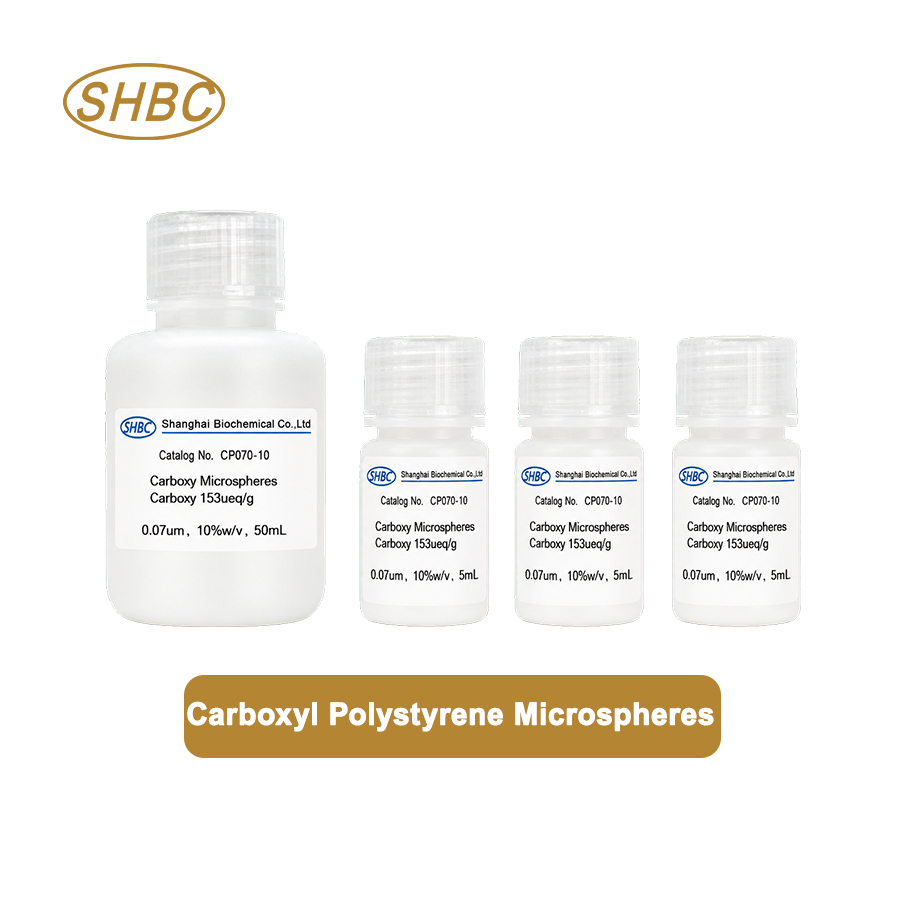

CP90NM-10 is a 90 nm carboxyl polystyrene microsphere dispersion with 5% solids and 86 μmol/g carboxyl groups for biomolecule coupling and research applications.
-
CP90NM-10
-
10%
-
90 nm (0.09 μm)
-
10ml,20ml,50ml,100ml,1000ml
Product Overview
SANYU GROUP CP90NM-10 Carboxyl Polystyrene Microspheres are monodisperse polymer nanoparticles with carboxyl (–COOH) functional groups on the particle surface.
CP90NM-10 has a nominal particle diameter of 90 nm (0.09 μm) and is supplied as a 5% solids aqueous dispersion. The surface carboxyl groups provide active sites for biomolecule immobilization and surface modification.
With nanoscale particle size, stable dispersion performance and controlled surface functionality, CP90NM-10 is suitable for antibody conjugation, protein immobilization, immunoassay development, biosensor research and other life science applications.

Key Features
Particle size: 90 nm
Surface functional group: Carboxyl (–COOH)
Solid content: 5%
Carboxyl content: 86 μmol/g
Uniform particle size distribution
Stable aqueous dispersion
Suitable for EDC/NHS coupling chemistry
Good biomolecule immobilization capability
Technical Specifications
Parameter | Specification |
|---|---|
Product Code | CP90NM-10 |
Product Name | Carboxyl Polystyrene Microspheres |
Material | Polystyrene |
Particle Diameter | 90 nm (0.09 μm) |
Functional Group | Carboxyl (–COOH) |
Carboxyl Content | 86 μmol/g |
Solid Content | 5% |
Dispersion Medium | Deionized Water |
Appearance | White aqueous dispersion |
Applications
CP90NM-10 Carboxyl Polystyrene Microspheres can be used in:
Immunoassay development
Lateral flow assay (LFA)
Antibody and protein conjugation
Biomolecule immobilization
Biosensor development
Diagnostic reagent development
Molecular biology research
Nanoparticle surface modification
Surface Functionalization
The carboxyl groups on CP90NM-10 provide reactive sites for covalent coupling.
After activation with EDC or EDC/NHS chemistry, the microspheres can be conjugated with amino-containing molecules such as antibodies, proteins, peptides and other biomolecules.
Advantages of SANYU Carboxyl Polystyrene Microspheres
Nanoscale and uniform particle size
Stable aqueous dispersion
Controlled surface functional groups
Reliable batch-to-batch consistency
Suitable for biomolecule coupling applications
Customization available
Storage and Handling
Store according to product specifications.
Avoid direct sunlight.
Keep container tightly closed.
Mix gently before use.
Customization Service
SANYU GROUP provides customization services including:
Customized particle sizes
Customized carboxyl density
Customized solid concentrations
Surface functional modification
Customized packaging
Frequently Asked Questions About CP90NM-10
What is CP90NM-10?
CP90NM-10 is a 90 nm carboxyl polystyrene microsphere with surface carboxyl (–COOH) functional groups.
What particle size is CP90NM-10?
CP90NM-10 has a particle diameter of 90 nm (0.09 μm).
What is the solid content of CP90NM-10?
CP90NM-10 is supplied as a 5% solids aqueous dispersion.
What functional group is available on CP90NM-10?
CP90NM-10 contains carboxyl (–COOH) functional groups on the particle surface.
What is the carboxyl content of CP90NM-10?
The carboxyl content of CP90NM-10 is 86 μmol/g.
Can CP90NM-10 be used for antibody or protein coupling?
Yes. The carboxyl groups can be activated using EDC or EDC/NHS chemistry for antibody, protein and biomolecule conjugation.
What applications are suitable for CP90NM-10?
CP90NM-10 is suitable for immunoassays, lateral flow assays, biosensors, biomolecule immobilization and nanomaterial surface modification.
Can particle size and surface properties be customized?
Yes. SANYU GROUP provides customized microspheres according to customer requirements.


Related Blogs
-
 Quick Answer: Leading Carboxyl Polystyrene Microsphere Manufacturers Serving ThailandThe leading carboxyl polystyrene microsphere manufacturers serving Thailand in 2026 include Merck Estapor, SANYU, JSR Life Sciences, Bangs Laboratories, PolyMicrospheres, Polysciences, Spherotech, Thermo Fisher Scie
 - Quick Answer: Top Carboxyl Polystyrene Microsphere Manufacturers Serving Malaysia in 2026The leading carboxyl polystyrene microsphere manufacturers and specialist particle suppliers serving Malaysia in 2026 include Merck Estapor, SANYU GROUP, MBL Materials / IMMUTEX, Bangs Laboratories, Magsphere, P
- Carboxyl Polystyrene Microsphere Market in AustraliaCarboxyl polystyrene microspheres are functionalized polymer particles with carboxyl (-COOH) groups on their surfaces. Because these groups can be chemically activated for covalent biomolecule coupling, carboxyl polystyrene microspheres are widely
-
 Overview of the IVD Magnetic Bead Market in the USAMagnetic beads are critical raw materials for chemiluminescent immunoassays, molecular diagnostics, nucleic acid extraction, immunoprecipitation, protein purification, cell separation and automated bioseparation.In an IVD workflow, magnetic beads pr
