


-
CP020-10
-
5%
-
20nm
-
10ml,20ml,50ml,100ml,1000ml
CP020-10 is a plain carboxyl polystyrene microsphere dispersion with a nominal particle diameter of 20 nm and a solids content of 5%.
The microspheres have carboxyl functional groups on their surfaces, providing reactive sites for further surface modification and covalent immobilization of suitable biomolecules.
CP020-10 may be evaluated for protein and antibody conjugation, diagnostic reagent development, immunoassay research, nanoparticle studies, and other laboratory applications requiring small carboxyl-functionalized polystyrene particles.
Product Number: CP020-10
Particle Size: 20 nm / 0.02 μm
Surface Group: Carboxyl / COOH
Solids Content: 5%
Particle Material: Polystyrene
Particle Type: Plain, non-dyed and non-fluorescent
Supply Form: Liquid microsphere dispersion
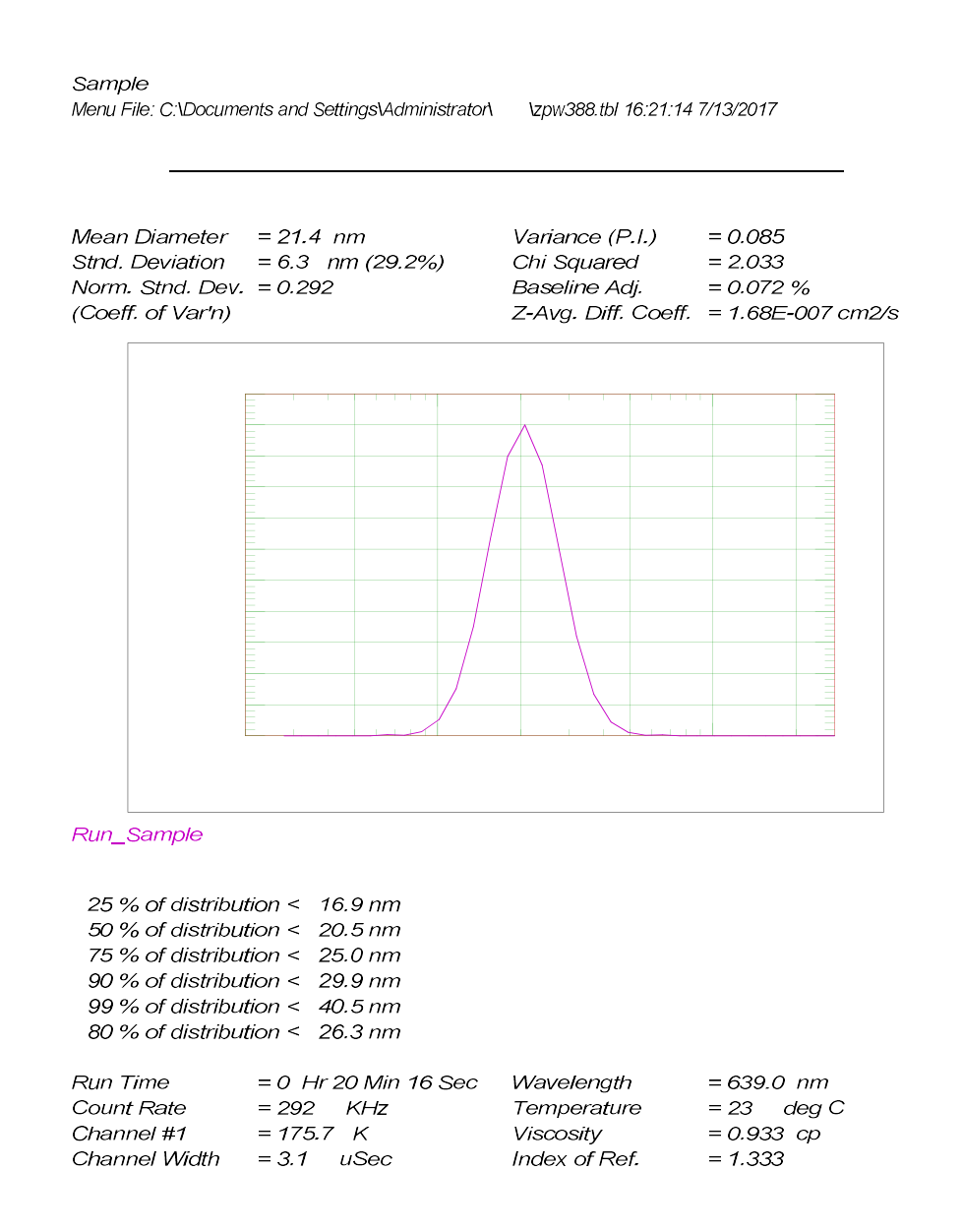
Key Features of CP020-10 Carboxyl Polystyrene Microspheres
Nominal particle diameter of 20 nm
Carboxyl-functionalized particle surface
Plain, non-dyed polystyrene particles
5% solids concentration
Small particle size for nanoparticle and assay-development research
Suitable for customer-developed bioconjugation procedures
Available with lot-specific technical documentation
Custom particle size, concentration and packaging options available upon request
Bulk supply and OEM/ODM cooperation available
Technical Specifications
Product Name: Carboxyl Polystyrene Microspheres
Product Number: CP020-10
Alternative Names: Carboxylated Polystyrene Microspheres, COOH Polystyrene Nanoparticles, Carboxylated Latex Beads
Nominal Particle Diameter: 20 nm
Equivalent Particle Diameter: 0.02 μm
Surface Functional Group: Carboxyl / COOH
Solids Content: 5%
Particle Matrix: Polystyrene
Color: Plain / undyed
Fluorescence: Non-fluorescent
Physical Form: Liquid dispersion
Carboxyl Content: Lot-specific data available upon request
Particle-Size Test Data: Available according to the applicable product specification
Standard Packaging: Please contact SANYU for current packaging options
Custom Packaging: Available upon request
Storage Conditions: Refer to the product label, technical data sheet or certificate of analysis
Shelf Life: Refer to the current lot documentation
Final specifications should be confirmed using the certificate of analysis or technical data sheet supplied with the product.
What Are 20 nm Carboxyl Polystyrene Microspheres?
Twenty-nanometer carboxyl polystyrene microspheres are nanoscale polystyrene particles carrying carboxyl functional groups on their surfaces.
The carboxyl groups provide chemically reactive sites that may be activated for the covalent attachment of suitable amine-containing molecules, including selected proteins, antibodies, peptides and other ligands.
Because CP020-10 has a nominal diameter of only 20 nm, it provides a large particle population per unit mass compared with larger polystyrene microspheres. However, the final performance of any particle-based reagent depends on the complete assay system, including surface chemistry, conjugation conditions, buffer composition, target molecule and detection method.
Customers should evaluate CP020-10 in their own formulations and experimental conditions.
What Are CP020-10 Microspheres Used For?
CP020-10 may be considered for research, reagent development and surface-modification applications in which small carboxyl-functionalized polystyrene particles are required.
Typical development areas may include:
Protein and antibody conjugation
Antigen or peptide immobilization
Carboxyl-activated nanoparticle research
Diagnostic reagent development
Immunoassay development
Homogeneous assay research
Latex-based reagent development
Colloid and dispersion studies
Surface chemistry research
Nanoparticle interaction studies
Method development and laboratory research
Application suitability is dependent on the customer's formulation, coupling procedure, analytical platform and performance requirements.
Protein, Antibody and Biomolecule Conjugation
The carboxyl groups on CP020-10 provide functional sites for further chemical activation.
Under an appropriately developed coupling procedure, activated carboxyl groups may react with accessible primary amine groups on selected biomolecules to form covalent bonds.
Potential conjugation targets may include:
Antibodies
Proteins
Antigens
Peptides
Enzymes
Amine-containing ligands
Selected nucleic-acid derivatives
Other customer-specified biomolecules
The efficiency and stability of conjugation depend on multiple factors, including particle concentration, carboxyl-group density, biomolecule concentration, buffer composition, reaction pH, activation chemistry, blocking conditions and purification method.
A small-scale optimization study is recommended before production-scale conjugation.
EDC/NHS Coupling of Carboxylated Microspheres
EDC or EDC/NHS chemistry is commonly evaluated for activating carboxyl groups before coupling them with molecules containing accessible primary amines.
A typical development process may include:
Dispersing and equilibrating the microspheres.
Activating the surface carboxyl groups.
Adding the target protein, antibody or ligand.
Blocking remaining reactive sites.
Removing unbound material.
Evaluating conjugation efficiency and particle stability.
Optimizing the conjugate for the intended assay.
Reaction conditions should be developed specifically for the selected biomolecule and application.
SANYU does not recommend applying a universal coupling ratio to every project because antibodies, proteins and other ligands can differ significantly in molecular weight, structure, isoelectric point, purity and available amine groups.
Why Choose 20 nm Carboxyl Polystyrene Microspheres?
Particle size can influence surface area, particle number, optical behavior, colloidal stability and biomolecule loading.
Compared with larger microspheres, 20 nm particles generally provide a much larger number of particles at the same mass concentration. Their small size may be useful in research systems requiring nanoscale particles or a high particle population.
However, smaller particles may also require more careful control of:
Dispersion conditions
Ionic strength
Buffer composition
Surface coverage
Conjugation conditions
Purification method
Storage formulation
Aggregation
The ideal particle diameter should be selected according to the complete assay design rather than particle size alone.
20 nm vs. Larger Carboxylated Polystyrene Beads
CP020-10 should be evaluated against larger carboxyl polystyrene microspheres when particle size is an important assay variable.
20 nm Microspheres
Twenty-nanometer microspheres provide a high particle population and nanoscale dimensions. They may be useful for nanoparticle research, surface-modification studies and selected assay-development projects.
They can be more difficult to separate using conventional low-speed centrifugation and may require greater attention to dispersion stability.
50–100 nm Microspheres
Particles in this range may provide a different balance between particle population, surface area, dispersion and separation.
They are often evaluated when 20 nm particles are too difficult to process or when a larger optical or physical response is needed.
200 nm and Larger Microspheres
Larger microspheres may be easier to observe, wash or separate, depending on the formulation and laboratory equipment.
However, their particle number per unit mass is lower than that of smaller particles.
Customers should compare multiple particle sizes during assay development whenever possible.
How to Disperse CP020-10 Before Use
Proper dispersion is important when working with 20 nm polystyrene microspheres.
Before removing material from the original container:
Allow the product to reach the recommended handling temperature.
Inspect the container for visible settling or aggregation.
Mix the dispersion gently and thoroughly.
Use controlled vortex mixing when permitted by the product instructions.
Use bath sonication only when it has been validated for the formulation.
Avoid introducing foam or contamination.
Use clean, low-binding laboratory equipment where appropriate.
Do not use harsh probe sonication unless it has been specifically validated for CP020-10, because excessive energy may affect the particle dispersion or introduce contamination.
How to Minimize Microsphere Aggregation
The colloidal stability of carboxyl polystyrene microspheres can be affected by pH, electrolyte concentration, buffer composition, temperature, particle concentration and surface modification.
To reduce the risk of aggregation:
Follow the recommended storage conditions.
Avoid freezing unless freeze stability has been confirmed.
Avoid repeated freeze-thaw cycles.
Mix the product before sampling.
Use clean laboratory containers and pipette tips.
Avoid unnecessary exposure to high ionic-strength solutions.
Add buffers and reagents gradually during method development.
Monitor the dispersion after activation and conjugation.
Optimize blocking and storage formulations.
Validate any surfactant before use in the final application.
The appropriate dispersion procedure must be determined according to the customer's assay and conjugation system.
Washing and Separation of 20 nm Microspheres
Because CP020-10 has a nominal diameter of 20 nm, it may not form a clearly visible pellet under standard low-speed centrifugation conditions.
Depending on the experimental system, customers may evaluate:
Ultracentrifugation
Membrane filtration
Tangential-flow filtration
Dialysis
Size-exclusion methods
Other validated nanoparticle purification techniques
The selected method should retain the microspheres while efficiently removing unreacted coupling reagents, salts, free proteins or other small molecules.
Customers should confirm particle recovery and dispersion stability after each washing step.
Quality Control and Batch Documentation
Quality documentation is important when microspheres are used in diagnostic development, bioconjugation or controlled research workflows.
Available product and batch information may include:
Product specification
Certificate of analysis
Safety data sheet
Technical data sheet
Nominal particle diameter
Particle-size test results
Solids-content results
Carboxyl-content data
Lot number
Production date
Storage information
Shelf-life information
Please specify the documentation required when requesting a quotation or sample.
Custom Carboxyl Polystyrene Microsphere Options
In addition to CP020-10, SANYU supplies plain carboxyl polystyrene microspheres in a broad selection of nanometer and micrometer particle sizes.
Custom development may include:
Custom Particle Size
Particle sizes may be developed according to the customer's assay, research or material requirements.
Custom Solids Content
Different particle concentrations may be discussed for laboratory evaluation, reagent development or production use.
Custom Carboxyl Content
Surface carboxyl content may be adjusted or selected according to the intended conjugation and assay requirements, subject to technical evaluation.
Custom Dispersion Formulation
Dispersion medium, pH, preservative and stabilizer requirements may be discussed based on feasibility and end-use requirements.
Custom Packaging
Laboratory, pilot-scale and bulk packaging options may be available according to order quantity and handling requirements.
OEM and ODM Services
SANYU supports OEM and ODM cooperation for customers requiring customized microsphere specifications, private labeling or long-term production supply.
How to Select the Right Carboxyl Polystyrene Microsphere
Please provide the following information when requesting product recommendations:
Target particle size
Acceptable particle-size range
Required solids content
Required carboxyl content
Intended application
Target biomolecule
Coupling method
Buffer requirements
Required volume
Packaging requirements
Quality-document requirements
Estimated annual demand
Providing complete application information helps our technical team evaluate the most appropriate standard or custom microsphere option.
How to Order CP020-10
To request a quotation, sample or technical information for CP020-10, please provide:
Product number: CP020-10
Required quantity
Required package size
Intended application
Destination country
Documentation requirements
Expected order schedule
For customized products, also provide the required particle size, solids content, carboxyl content, dispersion medium and estimated annual volume.
Frequently Asked Questions About CP020-10
What is CP020-10?
CP020-10 is a plain carboxyl polystyrene microsphere dispersion with a nominal particle diameter of 20 nm and a solids content of 5%.
Is 20 nm the same as 0.02 μm?
Yes. A particle diameter of 20 nm is equivalent to 0.02 μm.
Are CP020-10 microspheres colored or fluorescent?
No. CP020-10 belongs to the plain carboxyl polystyrene microsphere series and is not intentionally dyed or fluorescent.
Colored and fluorescent carboxyl microspheres are available as separate product series.
What functional group is present on the particle surface?
The microsphere surface contains carboxyl functional groups, commonly written as COOH.
These groups may be activated for further chemical modification or biomolecule conjugation.
Can CP020-10 be conjugated with antibodies or proteins?
CP020-10 may be evaluated for covalent coupling with suitable antibodies, proteins and other amine-containing molecules.
The customer should optimize the activation, coupling, blocking and purification conditions for the selected biomolecule.
Can EDC/NHS chemistry be used with CP020-10?
EDC or EDC/NHS chemistry may be evaluated for activating surface carboxyl groups before coupling them with molecules containing accessible primary amines.
The reaction conditions must be optimized for the specific particle formulation, biomolecule and final application.
What does 5% solids mean?
The solids content indicates the concentration of microsphere material in the supplied dispersion.
Please refer to the current product specification or certificate of analysis for the applicable concentration basis and test method.
What is the carboxyl content of CP020-10?
Carboxyl-content data should be confirmed from the current product specification or lot-specific documentation.
Please request this information when submitting your inquiry.
How should CP020-10 be mixed before use?
The product should be gently and thoroughly mixed before sampling.
Controlled vortex mixing or bath sonication may be evaluated when permitted by the product instructions. Avoid harsh processing that has not been validated.
Can CP020-10 be centrifuged?
Due to the small 20 nm particle size, conventional low-speed centrifugation may not produce an easily visible pellet.
Customers may need to evaluate ultracentrifugation, filtration, dialysis or another appropriate nanoparticle-purification method.
How should CP020-10 be stored?
Store CP020-10 according to the product label, technical data sheet or certificate of analysis.
Avoid freezing or repeated freeze-thaw cycles unless freeze stability has been specifically confirmed.
Can the particle size or concentration be customized?
Yes. Custom particle size, solids content, carboxyl content, formulation and packaging may be discussed according to technical feasibility and order requirements.
Do you provide samples?
Sample availability depends on the required specification, quantity and destination.
Please contact SANYU with your application and testing requirements.
What documents can I request?
Customers may request applicable product specifications, certificates of analysis, safety data sheets, technical data sheets and available particle test information.
Request a Sample or Quotation
Looking for 20 nm carboxyl polystyrene microspheres for bioconjugation, assay development or nanoparticle research?
Contact SANYU and provide your required particle size, solids content, carboxyl content, application, order quantity and documentation requirements.
Our team will review your project and recommend a standard or customized microsphere solution.


Related Blogs
-
 Quick Answer: Top Carboxyl Polystyrene Microsphere Manufacturers Serving Malaysia in 2026The leading carboxyl polystyrene microsphere manufacturers and specialist particle suppliers serving Malaysia in 2026 include Merck Estapor, SANYU GROUP, MBL Materials / IMMUTEX, Bangs Laboratories, Magsphere, P
 -
 Carboxyl Polystyrene Microsphere Market in AustraliaCarboxyl polystyrene microspheres are functionalized polymer particles with carboxyl (-COOH) groups on their surfaces. Because these groups can be chemically activated for covalent biomolecule coupling, carboxyl polystyrene microspheres are widely
 -
 Quick Answer: Top 10 Carboxyl Polystyrene Microsphere Manufacturers Serving SpainThe top 10 carboxyl polystyrene microsphere manufacturers and specialist suppliers serving Spain in 2026 are:Merck / EstaporSANYU GROUPBangs LaboratoriesPolysciencesSpherotechThermo Fisher ScientificMagsphereJSR Life Sc
 - Quick Answer: Top Carboxyl Polystyrene Microsphere Manufacturers Serving Turkey in 2026The top 10 carboxyl polystyrene microsphere manufacturers and specialist particle suppliers serving Turkey (Türkiye) in 2026 are:Thermo Fisher ScientificSANYUJSR Life SciencesMerck EstaporPolysciencesBangs Laborat
