Product Overview
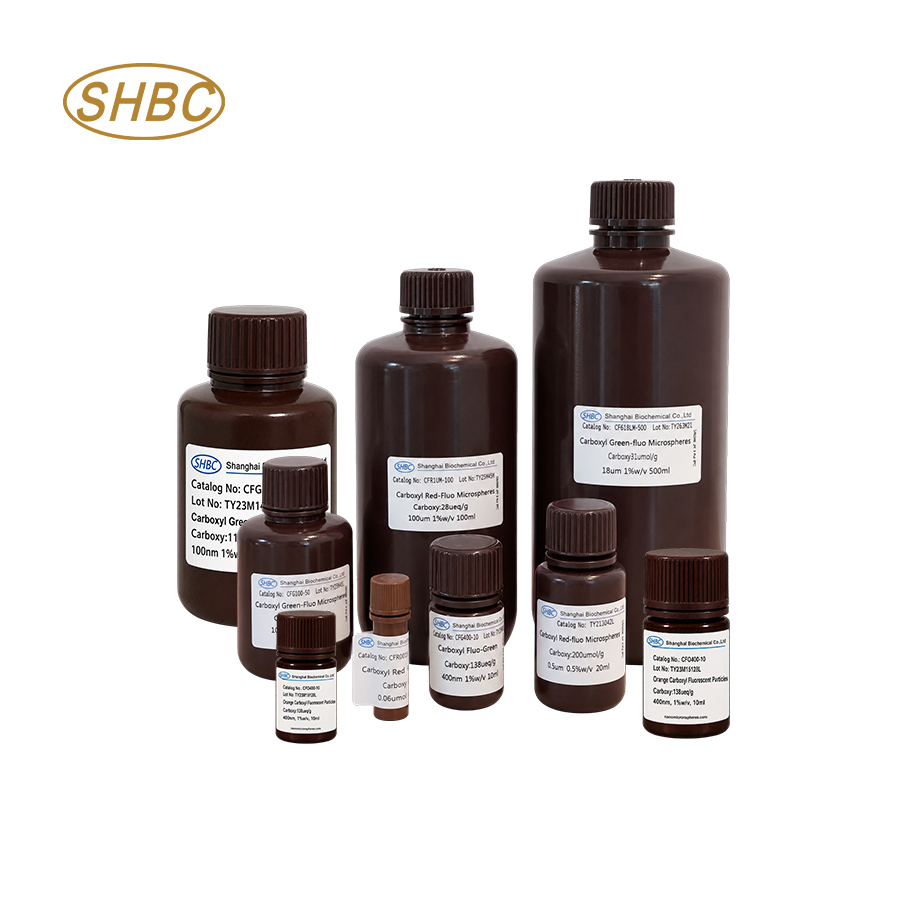
CFP400-10 Carboxyl Purple Fluorescent Microspheres are 400 nm fluorescent microspheres functionalized with reactive carboxyl (-COOH) groups.
Supplied as a 1% suspension, these microspheres provide purple fluorescence with an excitation wavelength of 545 nm and an emission wavelength of 615 nm.
The carboxyl-functionalized surface provides reactive sites for biomolecule immobilization and conjugation, making CFP400-10 suitable for fluorescence-based assays, biomolecule labeling, fluorescence imaging, particle tracking and diagnostic research.
Key Features
Uniform 400 nm particle size
Purple fluorescence
Surface carboxyl (-COOH) functional groups
1% solid content
Excitation wavelength: 545 nm
Emission wavelength: 615 nm
Suitable for biomolecule conjugation
Compatible with EDC/NHS coupling chemistry
Suitable for fluorescence imaging
Suitable for fluorescence-based assay development
Suitable for particle tracking and labeling research
Technical Specifications
Parameter | Specification |
|---|
Product Code | CFP400-10 |
Product Name | Carboxyl Purple Fluorescent Microspheres |
Particle Size | 400 nm (0.4 μm) |
Surface | Carboxyl (-COOH) |
Solid Content | 1% |
Fluorescence Color | Purple |
Excitation Wavelength | 545 nm |
Emission Wavelength | 615 nm |
Form | Fluorescent Microsphere Suspension |
Package | 10 mL / 20 mL / 100 mL / 1000 mL |
Carboxyl-Functionalized Surface
CFP400-10 features reactive carboxyl (-COOH) groups on the microsphere surface.
The carboxyl-functionalized surface provides reactive sites for covalent attachment of biomolecules and makes the particles suitable for applications requiring surface conjugation rather than fluorescence detection alone.
EDC/NHS Biomolecule Conjugation
The surface carboxyl groups can be activated using EDC/NHS coupling chemistry for covalent conjugation with amine-containing biomolecules.
Suitable conjugation targets can include:
This combination of fluorescence and reactive surface chemistry makes CFP400-10 suitable for developing functional fluorescent particle systems.
Applications
CFP400-10 Carboxyl Purple Fluorescent Microspheres can be used for:
Carboxyl Purple Fluorescent Microspheres for Assay Development
CFP400-10 combines a defined 400 nm particle size, purple fluorescence and reactive carboxyl surface chemistry.
Unlike plain fluorescent particles used primarily as optical markers, carboxyl-functionalized fluorescent microspheres provide reactive surface groups for biomolecule conjugation.
This makes CFP400-10 suitable for developing particle-based fluorescence assays where both fluorescence detection and biomolecule immobilization are required.
Carboxyl Purple Fluorescent Microspheres for Biomolecule Labeling
The combination of Ex 545 nm / Em 615 nm fluorescence and surface carboxyl (-COOH) groups enables CFP400-10 to be evaluated for biomolecule labeling applications.
Antibodies, proteins, peptides and other suitable amine-containing biomolecules can be covalently attached through appropriate carboxyl coupling chemistry.
Fluorescence Imaging and Particle Tracking
With a defined particle diameter of 400 nm and purple fluorescence, CFP400-10 can also be used in compatible fluorescence imaging and particle tracking applications.
Potential research applications include fluorescence microscopy, particle localization, particle distribution studies and fluorescence-based analytical methods.
Product Advantages
CFP400-10 combines:
400 nm uniform fluorescent microspheres
Reactive carboxyl (-COOH) surface
Purple fluorescence
Ex 545 nm / Em 615 nm
1% solid content
Biomolecule conjugation capability
EDC/NHS coupling compatibility
Fluorescence detection and surface functionalization in one particle platform
The combination of fluorescent properties and reactive carboxyl groups makes CFP400-10 more suitable for functional assay development than non-functionalized fluorescent particles.
Storage and Handling
Protect from unnecessary light exposure.
Keep the container tightly sealed.
Mix gently before use to obtain a uniform suspension.
Avoid contamination during handling.
Do not allow the suspension to dry.
Follow the product documentation for recommended storage conditions.
Customization Service
SANYU GROUP provides customized carboxyl fluorescent microspheres including:
Customized particle sizes
Customized fluorescence intensity
Customized excitation and emission wavelengths
Customized carboxyl surface functionality
Customized solid content
OEM manufacturing
Bulk production
Custom packaging
Frequently Asked Questions
What are CFP400-10 Carboxyl Purple Fluorescent Microspheres?
CFP400-10 are 400 nm purple fluorescent microspheres functionalized with reactive carboxyl (-COOH) groups and supplied at 1% solid content.
Are CFP400-10 microspheres carboxyl-functionalized?
Yes. CFP400-10 features carboxyl (-COOH) functional groups on the particle surface.
What are the excitation and emission wavelengths?
The excitation wavelength is 545 nm, and the emission wavelength is 615 nm.
What is the particle size?
The nominal particle diameter is 400 nm (0.4 μm).
What is the solid content?
CFP400-10 is supplied at 1% solid content.
Can CFP400-10 be used for antibody conjugation?
Yes. The surface carboxyl groups provide reactive sites for covalent biomolecule conjugation using appropriate coupling chemistry such as EDC/NHS.
What biomolecules can be conjugated to the microspheres?
Suitable amine-containing biomolecules can include antibodies, proteins and peptides.
What are Carboxyl Purple Fluorescent Microspheres used for?
They can be used for biomolecule conjugation, fluorescence assays, immunoassay development, fluorescence imaging, particle tracking, labeling and diagnostic research.
What is the difference between carboxyl and plain fluorescent microspheres?
Carboxyl fluorescent microspheres contain reactive -COOH surface groups that enable biomolecule conjugation, while plain fluorescent microspheres do not provide the same carboxyl-functionalized surface chemistry.




 Overview of China’s IVD Magnetic Bead IndustryChina has developed a growing group of magnetic bead manufacturers serving chemiluminescent immunoassay, molecular diagnostics, nucleic acid extraction, protein purification, cell separation and other in-vitro diagnostic applications.IVD magnetic beads a
 How Microspheres PPT Enhances Drug Delivery SystemsMicrospheres have emerged as a pivotal component in the evolution of drug delivery systems, providing distinct advantages through their unique properties. The application of Polymethylmethacrylate (PPT) microspheres in pharmaceutical formulations ha
