8um Carboxyl Red-Fluo Microspheres CFR8UM-10
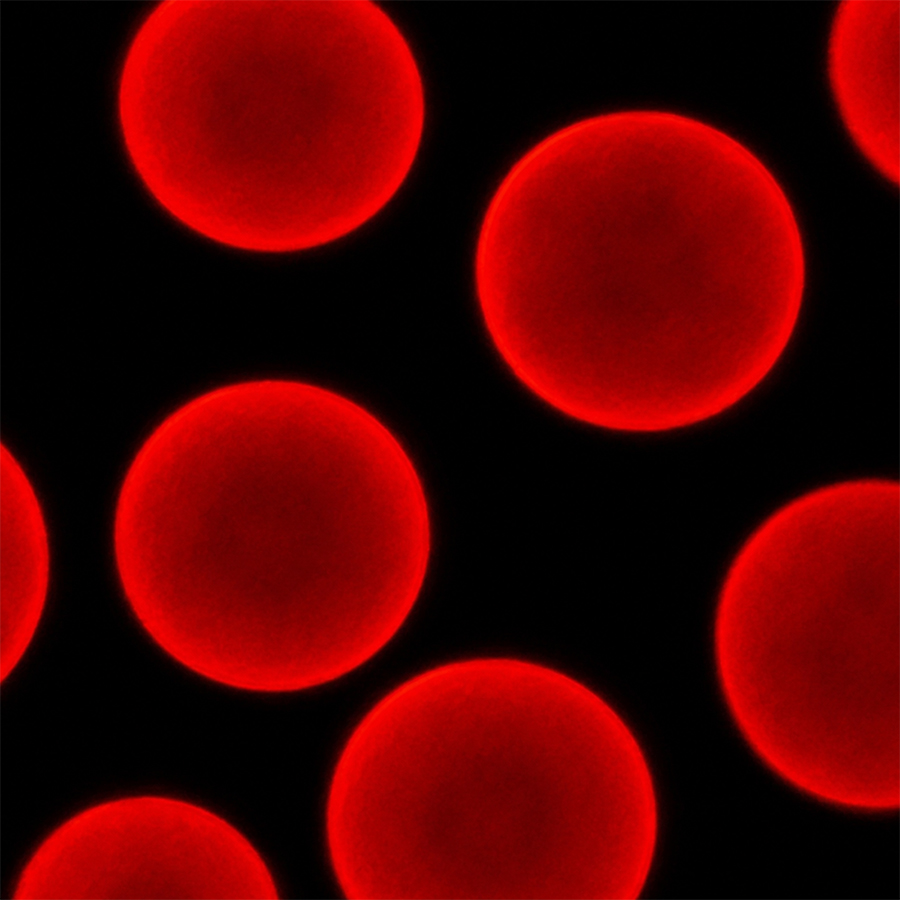
SHBC CFR8UM-10 are 8 μm carboxyl-functionalized red fluorescent microspheres developed for flow cytometry, fluorescence microscopy, cell interaction studies and biomolecule immobilization.
The microspheres feature excitation at 535 nm, emission at 610 nm and 1% solid content. Surface carboxyl groups support covalent coupling with antibodies, antigens, proteins and peptides.
Product Specifications
Parameter | Specification |
|---|
Product Name | Carboxyl Red-Fluo Microspheres |
Catalog Number | CFR8UM-10 |
Nominal Particle Size | 8 μm |
Solid Content | 1% |
Surface Group | Carboxyl, COOH |
Excitation Wavelength | 535 nm |
Emission Wavelength | 610 nm |
Fluorescence Color | Red |
Supply Form | Suspension |
Brand | SHBC |
Manufacturer | Shanghai SanYu Biotechnology Co., Ltd. |
Batch-specific particle size, particle size distribution, carboxyl content and fluorescence data are available in the Certificate of Analysis.
Red Fluorescence at 535/610nm
CFR8UM-10 produces red fluorescence with excitation at approximately 535 nm and emission centered at approximately 610 nm.
The fluorescence profile is suitable for compatible flow cytometers, fluorescence microscopes, imaging systems and fluorescence readers.
Key Advantages
Uniform 8um Particle Size
Controlled particle sizing supports repeatable fluorescence detection, surface coupling and particle analysis.
Readily Detectable Fluorescence
The micrometer-scale particles provide a clear fluorescent signal for imaging and flow-based detection.
Reactive Carboxyl Surface
Surface COOH groups support covalent immobilization of antibodies, antigens, proteins, peptides and other amino-containing molecules.
Large Coupling Surface
The 8 μm particle diameter provides substantial surface area per particle for biomolecule immobilization.
Easy Particle Recovery
The micrometer-scale particles can be collected by centrifugation during washing and conjugation procedures.
Custom and Bulk Supply
SHBC supports laboratory samples, customized specifications, pilot production and bulk manufacturing.
Main Applications
Flow Cytometry
CFR8UM-10 can be evaluated for particle detection, fluorescence channel testing and flow-based assay development.
Fluorescence Microscopy
The red fluorescent signal supports particle localization, distribution and imaging studies.
Phagocytosis Studies
The 8 μm particles can be used in macrophage uptake, phagocytosis and immune-cell interaction research.
Cell–Particle Interaction
Suitable for studying particle adhesion, cellular contact, surface recognition and uptake.
Particle-Based Immunoassays
Antibodies or antigens can be immobilized on the carboxyl surface for suspension immunoassays and agglutination studies.
Biomolecule Immobilization
Suitable for coupling proteins, enzymes, peptides and other molecules containing primary amine groups.
Microfluidic and Flow Research
Can be evaluated in particle transport, channel visualization, filtration and fluid-flow studies.
Instrument Evaluation
Suitable for selected fluorescence detection, particle counting and imaging method development.
Biomolecule Coupling
Surface carboxyl groups can be activated using EDC/NHS chemistry and coupled with primary amine groups on antibodies or proteins.
A typical coupling workflow includes:
Wash and redisperse the microspheres.
Activate the carboxyl groups with EDC and NHS.
Add the antibody or target protein.
Block remaining active sites.
Wash and resuspend the conjugated particles.
Evaluate coupling and fluorescence performance.
Activation pH, reagent concentration, protein loading and reaction time should be optimized for each biomolecule.
Coupling Benefits
CFR8UM-10 provides:
Reactive surface carboxyl groups
Large surface area per particle
Stable covalent immobilization
Easy centrifugation and washing
Clear fluorescence detection
Flexible ligand modification
Compatibility with bead-based assays
Custom conjugation support
Flow Cytometry Considerations
Recommended parameters to optimize include:
Particle concentration
Sample flow rate
Excitation source
Emission filter
FSC and SSC settings
Detector voltage
Gating strategy
Doublet discrimination
Particle aggregation
Select a fluorescence channel compatible with emission near 610 nm.
Cell and Phagocytosis Studies
For cellular studies, evaluate:
Include untreated cells, particle-only samples and suitable fluorescence controls.
The product should be evaluated for compatibility with the selected cell model before use.
Dispersion and Handling
Before use:
Mix by gentle inversion or controlled vortexing
Redisperse settled particles completely
Avoid excessive bubbles and foam
Protect the suspension from strong light
Prevent the particles from drying
Avoid repeated freeze-thaw cycles
Confirm buffer compatibility
Use clean laboratory equipment
Controlled bath sonication may be used to break weak aggregates when required.
Storage Recommendations
Keep the container tightly closed and protected from light.
Do not return unused suspension to the original container. Refer to the product label, Technical Data Sheet and Certificate of Analysis for batch-specific storage conditions.
Custom Carboxyl Fluorescent Microspheres
SHBC can customize fluorescent microspheres according to research and production requirements.
Customization options may include:
Please provide the target application, required wavelength, surface ligand and order quantity when requesting customization.
Quality Control and Documents
Available product documents may include:
Why Choose SHBC?
Shanghai SanYu Biotechnology Co., Ltd. supplies fluorescent microspheres, colored latex particles, magnetic beads and functional microsphere materials.
SHBC provides:
Controlled microsphere manufacturing
Stable particle size distribution
Multiple fluorescence wavelengths
Functional surface modification
Batch-to-batch consistency
Sample evaluation support
Pilot and bulk production
OEM and ODM services
Frequently Asked Questions
What is CFR8UM-10?
CFR8UM-10 is an 8 μm carboxyl-functionalized red fluorescent microsphere suspension with 1% solid content.
What are the excitation and emission wavelengths?
The excitation wavelength is 535 nm and the emission wavelength is 610 nm.
What is CFR8UM-10 mainly used for?
It is suitable for flow cytometry, fluorescence microscopy, phagocytosis research, cell–particle interaction and biomolecule coupling.
Can antibodies be coupled to CFR8UM-10?
Yes. Antibodies and proteins containing primary amine groups can be covalently coupled to the carboxyl surface.
Which coupling chemistry is recommended?
EDC/NHS chemistry is commonly used to activate surface carboxyl groups for protein immobilization.
Is CFR8UM-10 suitable for flow cytometry?
Yes. Excitation compatibility, emission filters, scatter settings, particle concentration and gating conditions should be optimized.
Can CFR8UM-10 be used for phagocytosis studies?
Yes. The 8 μm particles can be evaluated in macrophage uptake and particle–immune cell interaction studies.
Is CFR8UM-10 suitable for lateral flow assays?
The 8 μm particles are generally too large for conventional nitrocellulose membrane migration. Smaller fluorescent particles are usually more suitable for standard LFIA formats.
How should CFR8UM-10 be dispersed?
Use gentle inversion, controlled vortexing or compatible bath sonication while avoiding excessive foam and particle damage.
Can CFR8UM-10 be customized?
Yes. Particle size, fluorescence wavelength, carboxyl density, solid content, buffer, surface ligand and packaging can be customized.
Are samples and bulk quantities available?
Yes. SHBC supports laboratory samples, pilot orders and industrial batch production.
Request a Sample or Quotation
Contact SHBC for CFR8UM-10 samples, technical specifications, conjugation support and bulk pricing.
Please provide:
Target application
Target biomolecule
Detection instrument
Required quantity
Preferred packaging
Estimated annual demand
Product: 8um Carboxyl Red-Fluo Microspheres
Catalog Number: CFR8UM-10
Particle Size: 8 μm
Solid Content: 1%
Excitation/Emission: 535/610 nm
Surface Group: Carboxyl, COOH
Brand: SHBC
Manufacturer: Shanghai SanYu Biotechnology Co., Ltd.




 Quick Answer: Leading PMMA Microsphere Manufacturers Serving Saudi ArabiaThe leading PMMA microsphere manufacturers and specialist particle suppliers serving Saudi Arabia in 2026 include Cospheric, SANYU, microParticles GmbH, Polysciences, Matsumoto Yushi-Seiyaku, Sekisui Kasei, Bangs Laboratories,
 Overview of the PMMA Microsphere Market Serving Italy in 2026Poly(methyl methacrylate) microspheres, commonly referred to as PMMA microspheres, PMMA particles, acrylic microspheres or PMMA beads, are engineered spherical polymer particles manufactured primarily from methyl methacrylate.Unlike conven
 Quick Answer: Top PMMA Microsphere Manufacturers Serving Australia in 2026The top 10 PMMA microsphere manufacturers and specialist particle suppliers serving Australia in 2026 are:Cospheric LLCSANYUPolysciencesmicroParticles GmbHMatsumoto Yushi-SeiyakuSekisui KaseiMagsphereKolon IndustriesSunjin Bea
