


Quick Answer
For buyers in Russia, ten carboxyl polystyrene microsphere manufacturers and suppliers worth evaluating in 2026 are MBL Materials / MBL, Agilent Technologies, SANYU GROUP / SHBC, Thermo Fisher Scientific, Polysciences, Bangs Laboratories, Spherotech, Magsphere, microParticles GmbH and Merck Estapor.
These companies offer relevant carboxyl-functionalized polystyrene or polystyrene-based latex products. Their portfolios differ in particle diameter, surface chemistry, concentration, optical properties and intended applications.
The right supplier depends on your assay. Immunoturbidimetric reagents require an appropriate scattering response and controlled aggregation. Protein-coupling projects require accessible surface groups and stable conjugates. Lateral flow applications also require a suitable colored or fluorescent reporter.
This Top 10 is an editorial shortlist, not a ranking based on independently tested performance or market share. Inclusion identifies technical candidates for Russian customers; it does not establish current delivery availability. Confirm the exact grade and purchasing route before qualification.
What Are Carboxyl Polystyrene Microspheres?
Carboxyl polystyrene microspheres are polymer particles with carboxyl groups available at their surface. These groups provide a route for covalently attaching biomolecules containing suitable primary amines, including antibodies, antigens, proteins and amino-modified oligonucleotides.
Manufacturing approaches differ. Some products use functional monomers incorporated during polymerization; others employ additional surface layers or modifications. Products marketed as polystyrene latex can therefore include styrene-based copolymers. The supplier’s composition statement should determine how the material is classified.
Carboxyl functionality is separate from the optical label. An uncolored COOH particle, a dyed COOH particle and a fluorescent COOH particle can share a coupling principle while serving different detection methods.
It is also separate from magnetism. Ordinary carboxyl polystyrene microspheres are not magnetically recoverable. A magnetic particle requires an additional magnetic component and a different handling workflow.
Choose the particle as an assay component with defined specifications, then evaluate the finished conjugate under the intended operating conditions.
Top 10 Suppliers at a Glance
No. | Company | Relevant product family | Main evaluation focus |
|---|---|---|---|
1 | MBL Materials / MBL | IMMUTEX Carboxyl | Diagnostic latex, COOH content and surface specifications |
2 | Agilent Technologies | PL-Latex Carboxyl and SuperCarboxyl | Surface-density options and coupling guidance |
3 | SANYU GROUP / SHBC | Carboxyl polystyrene microspheres | IVD-oriented grades and customization discussions |
4 | Thermo Fisher Scientific | IDC carboxyl latex beads | Surface charge and formulation compatibility |
5 | Polysciences | Polybead Carboxylate Microspheres | Standard aqueous particles for assay development |
6 | Bangs Laboratories | Carboxyl Polystyrene Microspheres | Uncolored, dyed and fluorescent particle options |
7 | Spherotech | SPHERO Carboxyl Polystyrene Particles | Functionalized particles and alternative optical formats |
8 | Magsphere | Carboxylated PS Latex | Standard, colored, fluorescent and surfactant-free options |
9 | microParticles GmbH | PS-COOH particles | Documented diameter, distribution and COOH content |
10 | Merck Estapor | Estapor White Carboxylated Microspheres | Latex immunoturbidimetry and grade-specific composition |
The numbers indicate reading order. SANYU GROUP / SHBC is the only China-based company included. Product relevance and confirmed supply availability should be assessed separately.
1. MBL Materials / MBL
MBL lists IMMUTEX Carboxyl particles for covalent attachment of antibodies or antigens. Current product pages identify MBL Materials as the manufacturer. Older documentation may refer to JSR, so buyers should use the current product identity when requesting quotations and technical documents.
IMMUTEX includes separate plain and carboxylated series. These are important distinctions: a plain latex intended for adsorption should not automatically replace a COOH grade selected for covalent coupling.
Individual carboxyl product entries provide information such as diameter, COOH content, solids content and, for some grades, parking area. These specifications help developers compare surfaces within the portfolio.
For Russian projects, request the exact catalogue code and the corresponding specification. Establish whether the sample and subsequent production orders will use the same grade, formulation and acceptance limits.
Selection focus: Diagnostic latex development where particle size and surface-group information are central to reagent optimization.
2. Agilent Technologies
Agilent offers uniform polystyrene-based particles through its PL-Latex portfolio. Its technical documentation distinguishes Carboxyl and SuperCarboxyl product lines according to their surface-group density and associated parking area.
The company also publishes guidance for coupling biomolecules to carboxyl-modified latex. This makes PL-Latex relevant when developers want to compare particle selection and conjugation conditions within a documented platform.
A higher-density surface is an option to evaluate, rather than an automatic improvement. Protein crowding, colloidal stability and the functional activity of the immobilized ligand can affect the final assay response.
Start by comparing appropriate diameters and surface types using controlled coupling conditions. Then optimize the preferred combination with the actual antibody or antigen.
Confirm current catalogue availability and package size for the chosen product. A product listed on a regional website does not by itself confirm a supply route into Russia.
Selection focus: Projects requiring a structured comparison of carboxyl surface densities and access to manufacturer coupling guidance.
3. SANYU GROUP / SHBC
SANYU GROUP / SHBC manufactures carboxyl polystyrene microspheres for diagnostic reagent development, bioconjugation and related particle-based applications. Its Nanomicron Spheres catalogue includes uncolored carboxyl particles, immunoturbidimetric grades, colored particles and fluorescent carboxyl polystyrene microspheres.
This range allows developers to select the detection format before narrowing the particle specification. An uncolored latex for a turbidity assay and a fluorescent reporter for an optical reader should be evaluated as different product choices.
SANYU also offers discussions around particle size, concentration, surface chemistry and packaging. For an OEM project, these requirements should be translated into a written specification tied to the selected grade.
Russian customers can begin with the assay format, target diameter, required solids concentration and ligand-coupling approach. Request the available sample options and technical data relevant to those requirements.
Selection focus: IVD-oriented particle selection and customization projects that need a defined path from sample evaluation to repeat supply.
4. Thermo Fisher Scientific
Thermo Fisher Scientific offers IDC carboxyl latex beads within its latex-particle portfolio. Its High Activity Latex documentation describes carboxyl charge-stabilized hydrophobic polystyrene particles and explains differences between carboxyl-only and mixed carboxyl/sulfate surfaces.
Those distinctions matter during buffer changes and coupling. Two particles with similar diameters can respond differently to pH and electrolyte conditions because their stabilizing surface groups differ.
Select the exact product type before adopting a protocol. Do not assume that every carboxyl-containing particle has the same charge profile or acidic-buffer compatibility.
The portfolio is relevant for projects investigating how particle size and surface characteristics influence adsorption, covalent attachment and suspension behavior.
For Russian customers, verify the current product code, solids concentration and formulation. Separate catalogue specifications from lot-specific measurements, and obtain the relevant handling instructions for the selected bead.
Selection focus: Assay development where surface charge and buffer compatibility need explicit control.
5. Polysciences
Polysciences supplies Polybead Carboxylate Microspheres. Its product descriptions identify them as monodisperse polystyrene particles containing surface carboxyl groups for covalent protein attachment.
Standard product listings include aqueous suspensions and specifications associated with individual diameters. These provide a practical starting point for evaluating particle handling, coupling and assay behavior.
Use the information for the selected product rather than extending one grade’s concentration or size distribution to the entire portfolio. A nominal diameter is a product designation; the relevant acceptance limits and lot data provide the basis for qualification.
Polybead particles can be considered for general assay-development and bioconjugation work. Confirm whether a listed grade supports the intended manufacturing use and documentation requirements.
For repeat procurement, identify the catalogue code, package size, required quantity and storage conditions together. This reduces ambiguity when moving from an initial bottle to a larger order.
Selection focus: Standard carboxylated polystyrene suspensions for controlled laboratory evaluation.
6. Bangs Laboratories
Bangs Laboratories offers Carboxyl Polystyrene Microspheres alongside dyed and fluorescent carboxyl polystyrene products. The portfolio supports comparisons across particle chemistry and optical detection format.
For a turbidity-based assay, begin with the relevant uncolored particle. For a visual or fluorescence-based assay, assess the corresponding labeled product, including its optical properties and stability after conjugation.
An optical label adds qualification requirements. Developers should check whether washing, storage and assay buffers affect the color or fluorescence response, as well as the particle’s dispersion.
The same antibody may behave differently on distinct particle grades. Compare functional binding, background and recovery instead of selecting only by nominal size or apparent brightness.
Russian buyers should request the exact product identity and the specification for the proposed supply lot. If larger quantities are needed, discuss continuity of formulation and the technical requirements for repeat orders.
Selection focus: Projects comparing uncolored, visibly dyed and fluorescent COOH particle platforms.
7. Spherotech
Spherotech lists SPHERO Carboxyl Polystyrene Particles within its functionalized-particle portfolio. Related offerings include colored and fluorescent particle formats for different research and assay-development applications.
The relevant starting point is the product entry, including surface functionality, diameter designation and concentration. Functionalized particles and already coated particles represent different stages of reagent preparation.
A carboxyl particle still requires a suitable conjugation process. A particle carrying an existing biological coating may instead support a different attachment strategy. These formats should not be treated as interchangeable during purchasing.
For a COOH particle project, evaluate the selected grade with the intended ligand and buffer system. Check dispersion before activation and after the final washing step.
Customers in Russia should confirm the exact product code and documentation, then establish a purchasing route for that product rather than relying on the availability of another Spherotech material.
Selection focus: Functionalized polystyrene particles with options to compare alternative optical or coating formats.
8. Magsphere
Magsphere manufactures polystyrene-based latex particles and lists a dedicated Carboxylated PS Latex category. Its catalogue also distinguishes colored carboxylated, fluorescent carboxylated and surfactant-free carboxylated products.
These distinctions are useful when formulation compatibility is a key development variable. Surfactants can influence particle dispersion and subsequent reagent preparation, but removing them does not guarantee better assay performance.
Compare the actual formulations and follow the selected product’s handling guidance. Include particle recovery and redispersion in the evaluation, particularly when washing or changing buffers.
Magsphere’s carboxylated-latex page provides information about standard packaging, concentration, storage and certificates of analysis. Confirm those details against the current quotation and selected grade.
For Russian projects, determine whether the preferred formulation is available for both initial trials and later supply quantities. Avoid substituting another category solely because its nominal diameter appears similar.
Selection focus: Formulation-sensitive projects comparing standard and surfactant-free carboxylated latex options.
9. microParticles GmbH
Germany-based microParticles GmbH offers functionalized polystyrene particles, including a PS-COOH series. Its public catalogue presents diameter, standard deviation, coefficient of variation, COOH content and solids content for listed products.
This combination of parameters helps buyers make a more specific comparison than a nominal-size label alone. It is particularly useful when particle distribution and surface chemistry are both important to the experiment.
The company’s broader portfolio also includes other particle matrices and functional groups. Select the PS-COOH product explicitly when carboxylated polystyrene is required.
Treat catalogue values as the starting specification and request the data appropriate to the supplied lot. Ask how the diameter and COOH measurements are obtained before comparing them with results from another manufacturer.
Russian customers should confirm the proposed grade, pack size and order availability. For a custom requirement, define the target material and analytical criteria before discussing development.
Selection focus: Projects needing documented particle-distribution and surface-group information.
10. Merck Estapor
Merck’s Estapor portfolio includes White Carboxylated Microspheres positioned for latex turbidimetric immunoassay development. Product information describes carboxylated surfaces for antibody or antigen conjugation using EDC/NHS chemistry.
Grade-specific composition deserves attention. For example, the K1-040 White COOH PS listing identifies a polystyrene-co-acrylate matrix. Buyers requiring a particular polymer composition should therefore check the individual specification.
The portfolio is relevant to developers comparing diameter, carboxyl content and optical response in latex-based assays. A material’s diagnostic-development positioning does not establish the analytical performance of a finished reagent.
Evaluate the selected particle with your ligand, sample matrix and instrument settings. Confirm background, response range and stability after conjugation.
For Russian customers, establish current order availability and request the applicable specification and lot documentation. Keep the selected Estapor grade consistent throughout qualification and production planning.
Selection focus: Immunoturbidimetric reagent development with attention to surface chemistry and polymer composition.
How to Select the Right Carboxyl Polystyrene Microspheres
Start with the assay readout. An immunoturbidimetric system measures changes in light scattering associated with the reaction. A visual lateral flow test needs a suitable visible reporter. A fluorescence assay requires a compatible excitation and emission profile. Specify the detection method before choosing the particle.
Compare diameter and distribution together. Particle size affects surface area per unit mass, particle number and optical behavior. A nominal value such as 200 nm or 1 μm is only part of the specification. Ask for the distribution, measurement method and acceptance criteria. Results from microscopy and dynamic light scattering may describe different aspects of the same suspension.
Understand COOH measurements. Suppliers may express surface functionality as μmol/g, mmol/g, charge density or parking area. Convert compatible units before comparing values, and check the analytical method. Total titratable groups are not necessarily equivalent to groups accessible to a large protein.
Assess the supplied formulation. Record solids content, buffer, pH, surfactants and preservatives. A 10% w/v suspension corresponds to 100 mg/mL of solids; a 10% w/w specification describes a mass fraction and requires the suspension density for conversion to mg/mL. Keep that distinction in purchasing documents.
Check colloidal stability throughout preparation. Inspect the starting suspension, activated particles and finished conjugate. Track recovery after washing and assess aggregation in the intended assay buffer. Choose a separation method appropriate to the particle size rather than assuming all latex grades pellet under the same conditions.
Measure useful biological activity. Protein attachment alone is insufficient. Compare target recognition, background, response range and reproducibility using the intended assay format. Define the necessary acceptance criteria before selecting the final material.
Understanding Protein Coupling to a COOH Surface
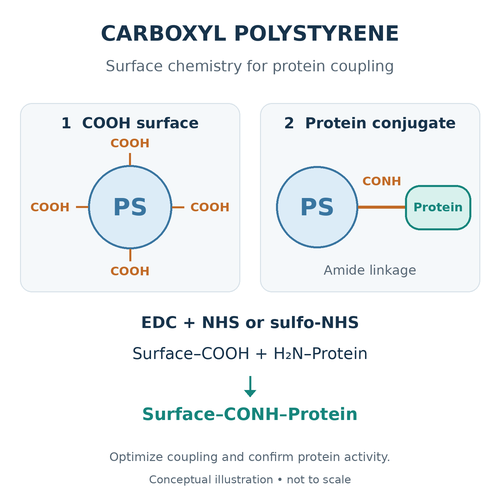
A common approach uses EDC with NHS or sulfo-NHS to activate particle carboxyl groups. Suitable primary amines on the protein can then form amide bonds with the activated surface.
This description explains the chemistry, not a universal recipe. Activation conditions, reagent ratios, protein loading and washing steps should follow the selected manufacturer’s guidance and be optimized for the particular particle and ligand.
Keep protein formulation in view. Buffer components or additives can interfere with activation or attachment, and a formulation that preserves the protein in solution may not be suitable for the coupling stage.
After attachment, evaluate blocking, removal of unbound material and redispersion. Excessive protein loading or unsuitable reaction conditions can produce unstable conjugates or reduce useful binding activity.
A mass-balance measurement can help estimate protein association, but it cannot by itself establish covalent attachment or preserved biological function. Combine it with appropriate controls and functional testing.
Include uncoated particles, relevant negative samples and a reference conjugate where available. These comparisons help separate particle background from ligand-specific response.
Confirm that the finished conjugate retains the required biological activity and remains dispersed in the intended assay buffer.
Purchasing Considerations for Customers in Russia
Technical suitability and commercial availability are separate questions. Before an extended development program, ask the supplier whether it can accept the order and supply the intended destination through a confirmed purchasing channel.
Request a quotation tied to the exact catalogue code, package size, solids concentration and required quantity. Include the delivery location, documentation needs and expected repeat-order volume. This allows the supplier to evaluate the actual request.
Compare quotations by usable material rather than bottle volume alone. Two 100 mL suspensions can contain different quantities of solids. Include particle losses during preparation when estimating how many reagent batches a shipment can support.
Obtain storage and transport instructions for the selected grade. Arrange receiving procedures that follow those instructions, and inspect the shipment before using it in qualification.
For recurring supply, discuss lead time, shelf life at receipt, lot reservation where available and notification of specification changes. Retain a reference sample and test new lots using the same assay-relevant criteria.
A second source can improve purchasing flexibility, but it requires its own qualification. Similar diameter and COOH labels do not guarantee interchangeable reagent behavior.
Frequently Asked Questions
Which supplier is best for carboxyl polystyrene microspheres in Russia?
The best supplier is the one whose specific grade meets your technical and purchasing requirements. Compare documented particle specifications, finished-conjugate performance and confirmed supply availability. The companies in this article form a shortlist for evaluation rather than an independently validated performance ranking.
Are carboxyl polystyrene microspheres the same as plain latex?
No. Plain latex is commonly used for adsorption-based attachment, while a carboxyl-functionalized surface provides sites for covalent coupling. Surface charge, formulation and manufacturing details also influence performance. Confirm the exact chemistry instead of assuming that two polystyrene products are interchangeable.
Does a higher COOH density always improve antibody coupling?
No. Higher density can increase available reaction sites, but useful antibody activity also depends on accessibility, loading, orientation and suspension stability. Evaluate the finished conjugate. A lower-density grade can be preferable if it provides a more suitable balance of binding and background.
Can these particles be used directly as a lateral flow reporter?
The particle must match the detection format. Visual tests generally need a suitable colored reporter, while fluorescence-based tests need a compatible fluorescent particle and reader. The conjugate must also release and migrate appropriately in the selected strip system.
Are ordinary COOH polystyrene particles magnetic?
No. Carboxyl functionality does not make a particle magnetic. Magnetic recovery requires a magnetic component. Choose the material according to the intended separation method, and do not apply a magnetic-bead handling process to an ordinary latex suspension.
Does an IVD-oriented raw material make the finished assay clinically approved?
No. A particle is a component of the reagent. The finished assay requires its own analytical evaluation, clinical evidence where applicable and the requirements associated with its intended use. Raw-material documentation supports development but does not replace finished-product qualification.
What information should accompany a sample request?
Provide the assay format, target diameter, surface functionality, required concentration, preferred formulation and initial quantity. Add the ligand type, detection method and important acceptance criteria. State the delivery destination and anticipated production needs so technical selection and purchasing feasibility can be considered together.
Conclusion
Carboxyl polystyrene microsphere selection should connect particle specifications with the behavior of the finished reagent. Diameter, distribution, COOH chemistry and supplied formulation provide the starting point; functional testing determines whether the conjugate meets the application.
For customers in Russia, the ten companies above offer relevant platforms to investigate. Select a documented grade, confirm a purchasing route and establish repeatable acceptance criteria before committing to routine supply.
SANYU GROUP / SHBC offers carboxyl polystyrene microspheres for coupling and assay development, together with immunoturbidimetric carboxyl microspheres for latex-based reagent projects. Developers requiring optical reporters can also explore colored carboxyl polystyrene microspheres and fluorescent carboxyl polystyrene microspheres.
To discuss a suitable grade, sample evaluation or OEM requirements, contact us with your assay format, target size, formulation preferences and expected quantity.
Related Blogs
-
 Overview of China’s IVD Magnetic Bead IndustryChina has developed a growing group of magnetic bead manufacturers serving chemiluminescent immunoassay, molecular diagnostics, nucleic acid extraction, protein purification, cell separation and other in-vitro diagnostic applications.IVD magnetic beads a
 -
 How Microspheres PPT Enhances Drug Delivery SystemsMicrospheres have emerged as a pivotal component in the evolution of drug delivery systems, providing distinct advantages through their unique properties. The application of Polymethylmethacrylate (PPT) microspheres in pharmaceutical formulations ha
 - Top Carboxyl Polystyrene Microsphere Suppliers Serving the US MarketCarboxyl polystyrene microspheres are widely used in in-vitro diagnostics, immunoturbidimetric assays, latex agglutination tests, lateral flow immunoassays, biomolecule conjugation, flow cytometry and scientific research.Their surfa

