


Quick Answer
Brazilian buyers can evaluate PMMA particle manufacturers and specialist suppliers including Cospheric, microParticles GmbH, SANYU GROUP/SHBC, Matsumoto Yushi-Seiyaku, Sekisui Kasei, Soken Chemical & Engineering, Microbeads/Lamberti Group, Polysciences, Bangs Laboratories and Makevale.
The right choice depends on whether the project needs precision research microspheres, functional industrial additives or acrylic bead polymers for further processing. Important specifications include particle diameter, size distribution, crosslinking, morphology, surface chemistry and supply format.
This Top 10 is an editorial sourcing shortlist. The numbering indicates presentation order, rather than independently measured performance or Brazilian market share. The companies listed are international options for Brazilian buyers; local stock and current delivery terms require confirmation.
What Are PMMA Particles?
PMMA stands for poly(methyl methacrylate), an acrylic polymer. PMMA particles may be supplied as spherical microspheres, bead powders or application-specific polymer particles.
Specialty microspheres are selected for controlled particle properties. They should be distinguished from acrylic sheets, bulk molding pellets and an unspecified acrylic powder. The polymer name alone does not describe the particle geometry, distribution or processing behavior.
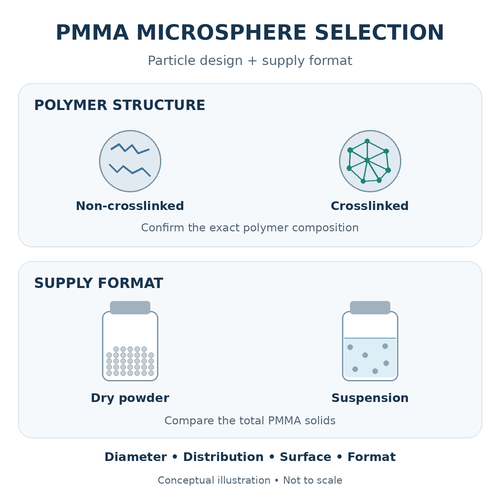
Commercial products also differ in composition. Some are non-crosslinked PMMA, while others incorporate a crosslinked network. A wider acrylic particle catalogue may contain copolymers or other acrylic materials, so the exact chemistry should be confirmed for the selected grade.
Potential applications include coatings, light diffusion, polymer films, particle research, spacers and ceramic pore-forming processes. Each role requires a different set of acceptance criteria.
A useful supplier comparison therefore starts with the intended function of the particle and then identifies the material properties needed to support it.
Main PMMA Particle Categories
Particle category | Relevant selection variables | Example development direction |
|---|---|---|
Precision PMMA microspheres | Mean diameter, distribution and morphology | Particle research, microfluidics and reference materials |
Crosslinked PMMA beads | Network chemistry and behavior in the working medium | Coatings, films and functional additives |
Non-crosslinked PMMA beads | Molecular properties and dissolution or swelling behavior | Acrylic formulations and further processing |
Functionalized PMMA particles | Surface group, accessible functionality and dispersion | Surface modification and biomolecule-coupling research |
Porous, hollow or modified-shape particles | Morphology, porosity and absorption characteristics | Specialized formulation and material development |
Acrylic bead polymers | Composition, distribution and process compatibility | Application-specific acrylic manufacturing |
Crosslinking can change solvent response and dimensional behavior, but it does not establish universal solvent resistance. Porous and hollow particles should also be distinguished from solid, nonporous microspheres.
Specify the required particle structure and supply format before comparing quotations.
Top 10 PMMA Particle Suppliers for Brazil at a Glance
No. | Manufacturer or supplier | Base or portfolio origin | Relevant product direction |
|---|---|---|---|
1 | Cospheric | United States | PMMA spheres, dry powders and specialty-coated particles |
2 | microParticles GmbH | Germany | Precision PMMA particles and functionalized formats |
3 | SANYU GROUP / SHBC | China | PMMA microspheres and surface-functionalized particles |
4 | Matsumoto Yushi-Seiyaku | Japan | M-series PMMA microbeads with different structures |
5 | Sekisui Kasei | Japan | TECHPOLYMER grades, including PMMA spherical particles |
6 | Soken Chemical & Engineering | Japan | Acrylic fine particles and PMMA-related grades |
7 | Microbeads / Lamberti Group | Norway / Italy | Spheromers crosslinked PMMA beads |
8 | Polysciences | United States | Monodisperse and broad-distribution PMMA microspheres |
9 | Bangs Laboratories | United States | Laboratory microspheres and PMMA technical information |
10 | Makevale | United Kingdom | PMMA and other acrylic bead polymers |
These suppliers represent different purchasing categories. The application suggestions below are starting points for evaluation, not results from a comparative laboratory study.
1. Cospheric
Cospheric offers PMMA microspheres and spheres in dry-powder formats, alongside specialty products such as silver-coated PMMA particles. Its catalogue provides multiple diameter ranges for different research and material applications.
This makes Cospheric relevant when the requirement concerns a physical particle rather than an acrylic resin intended to dissolve during processing. An uncoated PMMA sphere and a silver-coated sphere should be treated as different materials.
For a Brazilian laboratory or development team, the first task is to identify the desired size specification and whether any coating is required.
Selection focus: Check whether the product is described by a size interval, nominal diameter or measured mean. Review the distribution, morphology, quantity and coating information for the exact item.
For spacer, tracer or material studies, test the particles in the intended medium and equipment. A catalogue description does not establish compatibility with every solvent or processing temperature.
Cospheric is a relevant candidate for buyers investigating research quantities, specialty particle diameters or coated acrylic spheres.
2. microParticles GmbH
microParticles GmbH supplies monodisperse PMMA particles in crosslinked and non-crosslinked forms. Its published PMMA portfolio extends from 100 nm to 200 μm, with numerous discrete particle sizes.
The company also presents functionalized and fluorescent particle options within its wider microsphere portfolio. These should be discussed according to the exact matrix and surface required by the project.
For Brazilian research groups, the portfolio provides a route to compare precision particles with defined diameter and distribution information.
Selection focus: Specify whether the requirement concerns plain, functionalized or fluorescent PMMA. Request the measurement method, particle-size data, concentration and dispersion medium for the proposed product.
Keep the distribution requirement separate from the nominal diameter. A project needing closely matched particles should define its acceptance criteria before ordering.
microParticles GmbH is relevant to particle research, microfluidics and material-development projects where size control is important. Confirm the selected grade's crosslinking and medium compatibility rather than extending one product's properties to the entire catalogue.
3. SANYU GROUP / SHBC
SANYU GROUP/SHBC is a China-based microsphere manufacturer offering PMMA particles for research and advanced material development. Its portfolio includes PMMA microspheres and functionalized products such as carboxyl and amino PMMA particles.
The PMMA product information also presents crosslinked and other application-specific options. For a particular inquiry, the material structure and available supply form should be confirmed against the required specification.
Brazilian buyers investigating coatings, optical materials, ceramic pore formers or particle-based research can begin by defining the role of the microsphere in the complete process.
Selection focus: Provide the required diameter in nm or μm, distribution requirement, crosslinking preference, surface group, powder or suspension preference and quantity. Include the working medium and processing conditions where relevant.
Review the available COA and product information for the proposed grade. Application-specific results, such as optical haze, coating gloss, final ceramic porosity or biomolecule-coupling performance, should be established through evaluation.
SANYU/SHBC is a practical option for buyers comparing PMMA microsphere materials from China. Begin with a suitable evaluation quantity and use the results to define subsequent purchasing requirements.
4. Matsumoto Yushi-Seiyaku
Matsumoto Yushi-Seiyaku offers its M-series PMMA microbeads in crosslinked and non-crosslinked forms. The published portfolio includes variations in particle size, surface morphology and internal structure.
Its product information distinguishes conventional spherical grades from modified shapes and hollow or porous formats. The related S-series is described as a different acrylic particle platform and should not automatically be treated as PMMA.
This makes precise grade selection important. A smooth solid bead, a hollow particle and a modified-shape particle may produce different formulation effects even when their size ranges overlap.
Selection focus: Confirm the product composition, morphology, size range and absorption characteristics. Select the relevant PMMA grade rather than relying only on the general microsphere brand name.
For formulation or pore-forming studies, compare the proposed material in the actual process and evaluate the resulting properties.
Matsumoto is a relevant candidate for Brazilian developers investigating specialized microbead structures and industrial formulation effects. Current availability and documentation should be confirmed for the exact grade.
5. Sekisui Kasei
Sekisui Kasei supplies TECHPOLYMER organic polymer microparticles. The wider portfolio covers multiple polymer chemistries, while selected grades are specifically identified as PMMA spherical particles.
The company presents applications in light diffusion, coatings and cosmetic formulations. These application categories indicate possible development directions, but the relevant polymer and product grade still need to be selected.
For a Brazilian buyer, a TECHPOLYMER brand reference alone is insufficient to specify a PMMA material. The chemical description should accompany the grade code in the inquiry and quotation.
Selection focus: Confirm that the selected product is PMMA or the intended MMA-based material. Review size distribution, crosslinking, processing guidance and the expected role in the formulation.
For optical work, evaluate the finished film or molded article. For coatings, compare gloss, texture and dispersion under the same test conditions.
Sekisui Kasei is relevant to industrial developers considering spherical polymer additives. Match the selected grade to the matrix and process rather than assuming that every TECHPOLYMER product has the same composition.
6. Soken Chemical & Engineering
Soken's fine-particle portfolio includes acrylic particles with different distribution and crosslinking characteristics. Its product information presents PMMA grades alongside other polymer and copolymer chemistries.
The portfolio includes narrow-, middle- and wide-distribution acrylic particle families. This provides a useful reminder that an industrial application may need a particular distribution profile rather than the narrowest possible distribution.
For Brazilian coating, film or optical-material development, the relevant comparison should concern the selected particle's chemistry and performance in the intended matrix.
Selection focus: Request the exact composition, average size, distribution information and crosslinking description. Distinguish PMMA from styrene-containing or other acrylic copolymers within the wider catalogue.
Evaluate the property the particle is intended to influence, such as surface appearance, diffusion or handling. Keep the additive loading and processing conditions consistent during the initial comparison.
Soken is a relevant candidate for projects investigating acrylic fine-particle additives. Select by grade-specific technical information and verify current purchasing terms for Brazil.
7. Microbeads / Lamberti Group
Microbeads, part of the Lamberti Group, offers Spheromers crosslinked PMMA beads. Its published product information emphasizes spherical shape and a narrow particle-size distribution.
The Spheromers portfolio is positioned for functional-additive applications including coatings, plastics, light diffusion and anti-blocking. These are industrial particle roles rather than interchangeable substitutes for every laboratory reference material.
For Brazilian manufacturers, this platform may be relevant when a repeatable particle geometry is needed within a coating, film or polymer compound.
Selection focus: Match the grade's diameter and distribution to the final matrix and process. For light diffusion, assess both haze and transmission. For films or coatings, measure the intended surface property as well as unwanted changes.
The final result depends on particle loading, matrix properties and processing conditions. A narrow distribution alone does not establish the desired performance.
Microbeads/Lamberti is a relevant candidate for industrial PMMA additive development. Confirm the current grade, supply quantity and available technical support for the intended formulation.
8. Polysciences
Polysciences offers PMMA microspheres in both monodisperse and broad-distribution product categories. Its catalogue includes aqueous-suspension and dry-particle formats, depending on the selected product.
This range illustrates why “PMMA microspheres” should be followed by a detailed particle specification. Different distribution and formulation options serve different laboratory and material-development requirements.
Its monodisperse PMMA product information also describes surface chemistry and the presence of surfactant. Those details can matter when a particle is introduced into a sensitive experiment or a coupling workflow.
Selection focus: Review whether the product is dry or suspended, its concentration, size distribution and any listed additives. Confirm whether the surface information suits the intended interaction.
If the particle will be modified, evaluate the washing and coupling sequence with the actual material. If it will serve as a physical model, establish that the formulation does not interfere with the experiment.
Polysciences is a relevant candidate for Brazilian laboratories comparing research-oriented PMMA particle formats.
9. Bangs Laboratories
Bangs Laboratories publishes technical information covering its solid, nonporous polystyrene and PMMA microspheres. Its laboratory microsphere resources are relevant to particle-based research and material comparisons.
An important distinction in its PMMA material-properties information is that listed bulk-polymer values are not presented as empirical measurements of every bead product. This is useful when deciding which information can support a purchasing specification.
For a Brazilian project, identify the current PMMA product or supply option before treating a general technical note as a product data sheet.
Selection focus: Confirm the available product code, diameter, distribution, formulation and quantity. Ask which properties are measured for the supplied material and which are literature-based reference values.
When density, solvent response or thermal behavior is critical, use data appropriate to the exact particle and application.
Bangs Laboratories is a relevant specialist contact for laboratory microsphere inquiries. Current PMMA availability and specifications should be established directly rather than inferred from the broader polymer portfolio.
10. Makevale
Makevale manufactures acrylic bead polymers using suspension polymerization. Its portfolio includes PMMA alongside other acrylic polymer chemistries, and its public information discusses how bead characteristics are tailored to the final application.
This is a different purchasing category from ordering a small bottle of precision reference microspheres. The bead polymer may be incorporated into a formulation or undergo further processing.
For Brazilian manufacturers, the development specification may therefore include composition and molecular properties as well as particle diameter and distribution.
Selection focus: Describe the intended formulation and manufacturing process. Confirm polymer chemistry, distribution, relevant residual-content requirements and the properties needed for processing.
For specialized dental or other demanding material applications, use the documentation and qualification framework appropriate to the exact grade and finished product.
Makevale is relevant to projects requiring application-specific acrylic bead polymers or custom material development. Confirm the proposed specification and commercial scale before comparing it with a laboratory microsphere quotation.
How to Compare PMMA Particle Specifications
Confirm the polymer identity. Ask whether the product is non-crosslinked PMMA, crosslinked PMMA or a specified acrylic copolymer. A general description such as “acrylic beads” may cover different chemistries. Record the agreed composition with the product code.
Define the size requirement. Distinguish a nominal diameter, measured mean, median and size interval. A powder supplied within a broad interval is different from a monodisperse suspension with a defined mean. Specify the distribution metric and sizing method needed by the project.
Review morphology. Solid spheres, hollow beads, porous particles and modified shapes behave differently. Request available microscopy or morphology information. If the intended function depends on spherical geometry, make that requirement explicit.
Match crosslinking to the process. Crosslinking can influence swelling, dissolution and mechanical behavior. Its effect depends on composition and the working conditions. Compare the material in the actual medium rather than assuming that “crosslinked” means unaffected by every solvent.
Evaluate the relevant material property. For an optical application, measure the finished material's transmission and scattering behavior. For a coating, assess gloss, texture and film quality. For a pore former, examine the thermal removal process and resulting ceramic structure.
Check surface and formulation details. Functional groups, surfactants and dispersion media can influence interactions with the sample or matrix. A nominally plain particle may still be supplied with additives. Review the formulation information before interpreting experimental results.
Separate typical values from release tests. A technical data sheet may provide representative values, while a COA reports the characteristics included for a batch. Literature values for bulk PMMA do not automatically establish the properties of a crosslinked, coated or porous microsphere.
Assess repeatability. Compare further batches when available and keep the lot identity with the test record. Define acceptance criteria around the properties that influence the process. A successful first sample should lead to a clear repeat-order specification.
The objective is to select a material that performs consistently in the complete application. Catalogue specifications help identify candidates; application testing establishes whether they meet the requirement.
Powder or Suspension: Which Format Should You Choose?
Dry powder can be convenient when PMMA particles will be weighed into a formulation or mixed with another solid. It avoids introducing a liquid carrier, but dispersibility must be evaluated in the intended medium.
A suspension can be convenient for liquid handling and particle-based experiments. Its concentration, carrier and additives should be compatible with the workflow. Follow the product's redispersion instructions before taking an aliquot.
Compare quotations using total PMMA solids. For example, 10 mL of a 5% w/v suspension contains 0.5 g of particles. It is therefore not equivalent in solids quantity to 1 g of dry powder. This is an illustrative calculation, not a specification for every PMMA product.
Do not assume that a dried suspension will reproduce the behavior of a powder prepared by the manufacturer. Drying and redispersion can change aggregation and handling.
Choose the format around the process and confirm the exact concentration or net powder mass before ordering.
Purchasing Considerations for Brazilian Buyers
Identify the current purchasing route and confirm whether the supplier can quote the selected product for Brazil. An international catalogue does not establish local stock, a fixed transit time or an available distributor for every grade.
Discuss evaluation quantity, minimum order, packaging, lead time and transport conditions. Request a quotation using a clear material specification rather than only a broad PMMA description.
Review the available COA, technical information and safety documentation. Clarify which application-specific measurements will need to be completed by the customer.
For bulk or custom orders, record composition, size distribution, supply form and acceptance criteria. Discuss how changes in formulation or production will be communicated before repeat purchases.
Compare cost against usable material and process performance. A lower price per kilogram may not be economical if the material disperses poorly or cannot produce the required final properties.
Frequently Asked Questions
Are these all Brazilian PMMA particle manufacturers?
No. This article presents international manufacturers and specialist suppliers for Brazilian buyers to evaluate. It does not describe them as Brazilian domestic producers or guarantee local inventory.
Are PMMA particles the same as acrylic resin pellets?
Not necessarily. Specialty PMMA particles are selected for particle-specific properties such as diameter, distribution and morphology. Molding pellets and acrylic sheets are different product forms.
Are crosslinked and non-crosslinked PMMA interchangeable?
They should be evaluated separately. Crosslinking changes the polymer structure and can alter swelling, dissolution and processing behavior. Compare the exact materials under the intended conditions.
Does monodisperse mean every particle has exactly the same diameter?
No. It indicates a relatively narrow distribution. Ask for the reported distribution metric, sizing method and acceptance range for the selected product.
Can PMMA microspheres be used as ceramic pore formers?
PMMA particles can be evaluated as sacrificial pore-forming materials. Final pore size and structure depend on dispersion, particle loading, thermal removal and ceramic shrinkage, so the finished ceramic must be assessed.
Can a COA prove performance in my coating or optical film?
A COA records the batch characteristics and tests included by the manufacturer. Gloss, haze, transmission and other finished-material properties require testing in the actual formulation and process.
What should I include in a PMMA sample inquiry?
Provide the application, diameter, distribution requirement, polymer or crosslinking preference, surface group, supply form and quantity. Include the working medium and processing conditions where they influence performance.
Conclusion
The right PMMA particle supplier for Brazil depends on whether the project needs precision research spheres, functional industrial additives or acrylic bead polymers for further processing.
Compare composition, diameter, distribution, morphology, crosslinking and supply form. Evaluate the proposed material in the complete application and confirm current purchasing terms before expanding the order.
SANYU GROUP/SHBC offers PMMA particle materials for research and industrial development. Explore our PMMA microspheres and carboxyl PMMA beads, or contact us with your required specification to discuss an evaluation quantity.
Related Blogs
-
 Overview of China’s IVD Magnetic Bead IndustryChina has developed a growing group of magnetic bead manufacturers serving chemiluminescent immunoassay, molecular diagnostics, nucleic acid extraction, protein purification, cell separation and other in-vitro diagnostic applications.IVD magnetic beads a
 -
 How Microspheres PPT Enhances Drug Delivery SystemsMicrospheres have emerged as a pivotal component in the evolution of drug delivery systems, providing distinct advantages through their unique properties. The application of Polymethylmethacrylate (PPT) microspheres in pharmaceutical formulations ha
 - Top Carboxyl Polystyrene Microsphere Suppliers Serving the US MarketCarboxyl polystyrene microspheres are widely used in in-vitro diagnostics, immunoturbidimetric assays, latex agglutination tests, lateral flow immunoassays, biomolecule conjugation, flow cytometry and scientific research.Their surfa

