


Carboxyl Polystyrene Microsphere Market Overview Serving Vietnam
Carboxyl polystyrene microspheres, also called carboxylated polystyrene microspheres, COOH polystyrene beads, carboxyl latex particles or carboxyl-functionalized PS microspheres, are spherical polymer particles carrying reactive carboxyl groups on their surfaces.
These surface carboxyl groups can be activated to covalently immobilize antibodies, antigens, proteins, peptides, enzymes and other suitable biomolecules.
Carboxyl polystyrene microspheres are widely evaluated in:
Latex-enhanced immunoturbidimetric assays;
Latex agglutination tests;
Lateral flow assays;
POCT development;
Immunoassays;
Antibody immobilization;
Antigen immobilization;
Biosensors;
Multiplex assays;
Flow cytometry;
Diagnostic reagent development.
Vietnam's growing medical-device and diagnostic sector creates demand for high-quality functional particles used as critical raw materials in IVD reagent development.
For Vietnamese IVD companies, selecting the correct microsphere is not simply a matter of choosing a nominal particle diameter.
Commercial assay performance can also depend on:
Particle-size distribution;
Carboxyl-group density;
Surface charge;
Solids concentration;
Surfactant;
Buffer composition;
Protein-coupling efficiency;
Nonspecific binding;
Lot-to-lot consistency;
Commercial supply continuity.
This guide compares ten manufacturers and specialist suppliers of carboxyl polystyrene microspheres relevant to customers serving Vietnam in 2026:
Merck Estapor;
SANYU;
JSR Life Sciences;
Bangs Laboratories;
Polysciences;
Spherotech;
Magsphere;
microParticles GmbH;
Thermo Fisher Scientific;
DiaSorin Luminex.
SANYU is the only China-based manufacturer included in this comparison. Other Chinese microsphere manufacturers have been excluded.
Most companies listed here manufacture outside Vietnam and serve Vietnamese customers through direct international sales, regional distributors or OEM supply relationships.
The ranking is an editorial comparison based on publicly available product information, IVD relevance, particle-size range, carboxyl surface chemistry, application support, customization and commercial manufacturing potential.
It is not based on audited Vietnamese revenue, verified market share or independent head-to-head laboratory testing.
Quick Answer: Leading Manufacturers Serving Vietnam
The leading carboxyl polystyrene microsphere manufacturers serving Vietnam in 2026 include Merck Estapor, SANYU, JSR Life Sciences, Bangs Laboratories, Polysciences, Spherotech, Magsphere, microParticles GmbH, Thermo Fisher Scientific and DiaSorin Luminex.
Merck Estapor ranks first because its carboxylated polymer microspheres have a long-standing and highly application-specific position in in-vitro diagnostics.
Merck specifically positions carboxylated Estapor microspheres for Latex Turbidimetric Immunoassays and Latex Agglutination Tests and publishes a two-step EDC/Sulfo-NHS conjugation workflow for covalent attachment of proteins.
SANYU ranks second because it provides a broad range of carboxyl polystyrene microspheres from nanoscale to larger particle sizes and supports customization of particle diameter, solids concentration, carboxyl content, formulation and packaging.
For example, SANYU currently lists:
20 nm CP020-10 at 5% solids;
40 nm CP040-10 at 5% solids;
110 nm CP110-10 at 10% solids;
250 nm CP250-10 at 10% solids.
Its 110 nm and 250 nm products are specifically positioned for immunoassay, lateral flow and biomolecule conjugation using EDC or EDC/NHS chemistry.
JSR Life Sciences ranks third because its IMMUTEX diagnostic latex platform offers approximately 0.05–0.5 μm particles with multiple surface chemistries and two levels of carboxyl density specifically designed to help adjust assay sensitivity and dynamic range.
The best supplier ultimately depends on the assay rather than ranking alone.

What Are Carboxyl Polystyrene Microspheres?
Carboxyl polystyrene microspheres consist of a polystyrene polymer matrix with carboxyl functional groups located at or near the particle surface.
The polystyrene core provides:
Spherical particle morphology;
Optical scattering;
Relatively low particle density;
Established colloidal behavior;
Compatibility with many immunoassay formats.
The carboxylated surface provides chemically reactive COOH groups.
These groups can be activated using carbodiimide chemistry and subsequently reacted with primary amino groups on biomolecules.
Typical biomolecules include:
Antibodies;
Antigens;
Proteins;
Peptides;
Enzymes;
Amino-modified oligonucleotides.
Compared with plain polystyrene particles relying primarily on passive adsorption, carboxylated particles provide an additional route for covalent immobilization.
Why Carboxylated PS Microspheres Are Used in IVD
Carboxylated polystyrene is particularly attractive to IVD developers because particle properties can be adjusted across several dimensions.
Controlled Particle Size
Particle diameter affects:
Surface area;
Particle number;
Light scattering;
Agglutination;
Membrane migration;
Protein-loading capacity;
Sedimentation.
Covalent Biomolecule Coupling
Carboxyl groups can be activated to form stable bonds with suitable amino-containing molecules.
Merck's current Estapor technical materials describe activation of carboxyl groups with EDC followed by Sulfo-NHS stabilization and reaction with primary amines to form a stable amide bond.
Surface Chemistry Control
Carboxyl density influences:
Surface charge;
Biomolecule-loading potential;
Colloidal stability;
Protein orientation;
Nonspecific interactions.
JSR's IMMUTEX Carboxy platform provides two carboxyl-density levels specifically to help developers adjust assay sensitivity and dynamic range.
Optical Signal
In particle-enhanced immunoassays, antibody-coated particles aggregate in the presence of target analytes.
Aggregation increases light scattering, allowing quantitative detection by turbidimetry or nephelometry.
Merck describes Estapor microspheres as established components in LTIA and LAT platforms, including automated diagnostic systems.
How We Selected the Top 10 Manufacturers
The manufacturers were evaluated according to factors relevant to Vietnamese IVD reagent companies, POCT developers and biotechnology laboratories.
IVD Application Relevance
Priority was given to products suitable for:
LTIA;
Latex agglutination;
Lateral flow;
Immunoassays;
Biomolecule coupling;
Multiplex assays;
Flow cytometry.
Particle-Size Range
A broad diameter range enables developers to screen particle size as an assay variable.
Carboxyl Surface Chemistry
We considered whether the supplier provides:
Standard COOH surfaces;
Multiple carboxyl densities;
Custom COOH levels;
Published coupling guidance.
Particle Uniformity
Important characteristics include:
Mean diameter;
Standard deviation;
CV;
D10;
D50;
D90.
Solids Concentration
Commercial microspheres may be supplied at:
2.5%;
5%;
10%;
Other concentrations.
Concentration affects both handling and commercial reagent manufacturing.
IVD Development Support
Additional consideration was given to companies with documented experience in:
Clinical diagnostics;
LTIA;
Lateral flow;
Protein coupling;
OEM manufacturing.
Commercial Supply
Relevant factors include:
Bulk packaging;
Manufacturing consistency;
Lot traceability;
COA availability;
Change control;
Customization.
Vietnam-Specific Suitability
Vietnamese buyers should also consider:
Regional Asian logistics;
Import lead time;
Tropical transportation;
Distributor support;
Technical communication;
Regulatory documentation.
Quick Comparison of the Top 10 Manufacturers
Rank | Manufacturer | Key Carboxyl PS Capability | Main Strength | Best Suited For |
|---|---|---|---|---|
1 | Merck Estapor | Carboxylated diagnostic latex | Established IVD/LTIA platform | LTIA, LAT and commercial diagnostics |
2 | Nano- to micro-scale COOH PS with customizable surface chemistry | Broad customization and OEM flexibility | LTIA, LFA, POCT and custom IVD development | |
3 | JSR Life Sciences | IMMUTEX Carboxy, 0.05–0.5 μm | Controlled COOH density | Immunoturbidimetry and agglutination |
4 | Bangs Laboratories | ~25 nm–20 μm carboxyl PS | Broad size range and diagnostic expertise | LTIA, coupling and custom diagnostics |
5 | Polysciences | Plain and dyed carboxylate PS | Broad development catalog | LFA, agglutination and assay development |
6 | Spherotech | Functionalized PS, ~0.05–140 μm | Wide microsphere and coating portfolio | Flow cytometry, coupling and research |
7 | Magsphere | Carboxylated plain, colored and fluorescent PS | Lateral-flow relevance | Rapid tests and particle screening |
8 | microParticles GmbH | Monodisperse COOH PS | Very tight size control | Precision assays and analytical development |
9 | Thermo Fisher Scientific | Fluorescent carboxylate-modified PS | Fluorescent research platform | Flow cytometry and assay R&D |
10 | DiaSorin Luminex | Carboxylated PS multiplex beads | xMAP multiplex technology | Multiplex biomarker assays |
1. Merck Estapor
Merck Estapor is one of the most established suppliers of polymeric microspheres for in-vitro diagnostics.
Its portfolio includes:
White microspheres;
Carboxylated microspheres;
Dyed microspheres;
Fluorescent microspheres;
Magnetic particles;
Custom microspheres.
Carboxylated Estapor for LTIA
Merck specifically offers carboxylated white microspheres for the development of Latex Turbidimetry Immunoassay diagnostic tests.
The manufacturer provides particles with different:
Polymer matrices;
Particle sizes;
Carboxyl contents.
This allows developers to compare multiple surface and size conditions rather than treating carboxyl PS as one standardized material.
EDC/NHS Coupling
Merck describes a two-step approach involving:
Activation of carboxyl groups with EDC;
Stabilization using Sulfo-NHS;
Reaction with primary amines on proteins.
This produces covalent immobilization of proteins on the carboxyl-modified particle surface.
LTIA and Latex Agglutination
Estapor particles are specifically positioned for:
Latex Turbidimetric Immunoassays;
Latex Agglutination Tests;
Manual assays;
Automated analyzers.
Key Strengths
Strong IVD-specific positioning;
Multiple carboxyl contents;
Multiple particle sizes;
EDC/NHS technical guidance;
LTIA experience;
Latex agglutination applications;
Commercial diagnostic focus;
Custom development.
Best Suited For
Merck Estapor is particularly relevant to Vietnamese manufacturers developing:
CRP reagents;
D-dimer reagents;
Cystatin C reagents;
Clinical chemistry assays;
Latex-enhanced immunoturbidimetry;
Latex agglutination products.
2. SANYU
SANYU specializes in functional microspheres and magnetic particles for IVD, POCT, bioseparation and biotechnology applications.
SANYU is the only China-based manufacturer included in this ranking.
Carboxyl Polystyrene Portfolio
SANYU supplies carboxyl polystyrene microspheres across multiple nano- and micrometre particle sizes.
Published examples include:
as well as additional standard and custom sizes.
CP020-10 – 20 nm
CP020-10 is a 20 nm carboxyl polystyrene microsphere dispersion supplied at 5% solids.
The product is positioned for:
Protein conjugation;
Antibody conjugation;
Diagnostic reagent development;
Immunoassay development;
Nanoparticle research.
Its small particle diameter can be useful where developers require:
High particle population;
High surface-area-to-mass ratio;
Nanoscale behavior.
CP110-10 – 110 nm
CP110-10 has a nominal diameter of 110 nm and is supplied at 10% solids.
SANYU describes it for:
Immunoassays;
Lateral flow;
Diagnostic reagent development;
Antibody immobilization;
Biosensors.
The surface COOH groups are compatible with customer-developed EDC or EDC/NHS coupling procedures.
CP250-10 – 250 nm
CP250-10 provides a 250 nm carboxyl polystyrene particle at 10% solids.
This size can be evaluated for:
Lateral flow;
Immunoassays;
Protein conjugation;
Diagnostic reagent development.
Custom Carboxyl Content
SANYU supports customization that may include:
Particle diameter;
Solids concentration;
Carboxyl content;
Dispersion formulation;
Packaging;
OEM/ODM supply.
This is particularly valuable when a Vietnamese IVD company needs to optimize the particle specifically for its own antibody or analyzer.
Key Strengths
Broad nano/micro particle range;
Plain carboxyl PS;
Colored carboxyl PS options;
Multiple solids concentrations;
Custom COOH content;
Custom formulation;
Bulk packaging;
OEM and ODM support.
Best Suited For
SANYU may be particularly suitable for Vietnamese:
IVD reagent manufacturers;
POCT developers;
Lateral flow manufacturers;
Immunoturbidimetric reagent companies;
Biosensor developers;
OEM diagnostic projects.
Considerations for Vietnamese Buyers
Before commercial qualification, request:
Particle-size specification;
Particle-size distribution;
Carboxyl-content data;
Solids concentration;
Dispersion medium;
Surfactant information;
Preservative information;
COA;
TDS;
SDS;
Storage information;
Change-control procedure.
3. JSR Life Sciences
JSR Life Sciences supplies IMMUTEX polystyrene latex particles specifically for clinical diagnostic agglutination assays.
Particle-Size Range
IMMUTEX is available from approximately:
0.05 μm;
Up to 0.5 μm.
This size range is particularly relevant to:
Latex agglutination;
Latex-enhanced immunoturbidimetry.
IMMUTEX Carboxy
The Carboxy Series consists of carboxylated polystyrene latex suitable for covalent coupling of antibodies or antigens.
Two Carboxyl Densities
A major advantage is the availability of two levels of COOH density.
This helps assay developers optimize:
Coupling capacity;
Surface charge;
Sensitivity;
Dynamic range;
Colloidal stability.
JSR explicitly identifies surface chemistry as a tool for controlling assay sensitivity and dynamic range.
Key Strengths
Strong clinical-diagnostics focus;
50–500 nm size range;
Uniform particle size;
Two carboxyl densities;
Ready-to-use suspensions;
Surface-engineering expertise.
Best Suited For
JSR is particularly relevant to:
Immunoturbidimetric assays;
Latex agglutination;
Clinical chemistry;
High-volume reagent development.
4. Bangs Laboratories
Bangs Laboratories is a specialist microsphere manufacturer with extensive experience in diagnostic and analytical particle applications.
Its current carboxyl polystyrene product family covers approximately:
25 nm;
50 nm;
70 nm;
100 nm;
125 nm;
150 nm;
175 nm;
200 nm;
300 nm;
400 nm;
500 nm;
Multiple micrometre sizes;
Up to approximately 20 μm.
Surface Chemistry
The carboxyl surface is suitable for covalent immobilization of:
Proteins;
Peptides;
Nucleic acids.
Bangs specifically describes EDAC-mediated attachment of amine-containing biomolecules to the particle surface.
Standard Product Format
Current carboxyl PS products are generally supplied as approximately 10% solids aqueous suspensions with stabilizing surfactant and preservative.
LTIA
Bangs also documents carboxylated and plain polystyrene particles in approximately the 0.05–0.5 μm range for turbidimetric reagent development.
This size range is particularly relevant to quantitative latex immunoassays.
Key Strengths
Very broad particle-size range;
Diagnostic expertise;
EDC/EDAC coupling support;
Submicron LTIA particles;
Fluorescent carboxyl particles;
Custom manufacturing.
Best Suited For
Bangs is especially relevant to:
LTIA;
Custom diagnostic development;
Antibody coupling;
Fluorescent assays;
OEM particle projects.
5. Polysciences
Polysciences provides a broad portfolio of polystyrene microspheres, including carboxylated and internally dyed carboxylate particles.
Dyed Carboxylate Microspheres
Polysciences offers dyed carboxylate PS microspheres in multiple:
Colors;
Diameters;
Surface configurations.
The company positions these particles for latex agglutination and membrane-enhanced immunoassays.
Lateral Flow
Colored carboxyl PS can be particularly useful for lateral-flow tests because the particle combines:
Visible signal;
Reactive COOH surface;
Stable spherical polymer carrier.
Applications can include:
Rapid antigen testing;
Rapid antibody testing;
Visual immunoassays;
Assay-development studies.
Key Strengths
Wide development catalog;
Colored carboxyl particles;
Multiple sizes;
Multiple colors;
Diagnostic assay relevance;
Convenient evaluation quantities.
Best Suited For
Polysciences may be particularly useful for:
Lateral flow development;
Latex agglutination;
Early assay screening;
Research-to-product feasibility work.
6. Spherotech
Spherotech supplies functionalized polystyrene microspheres for biochemical, analytical and flow-cytometry applications.
Its functionalized microsphere platform spans approximately 0.05–140 μm and includes:
Carboxyl groups;
Amino groups;
Click-chemistry groups;
Other custom surfaces.
Carboxyl Surface
COOH-functionalized particles enable covalent coupling of proteins and other ligands.
Polystyrene Platform
Spherotech's overall polystyrene portfolio extends across a very broad particle-size range and includes:
Plain beads;
Functionalized beads;
Fluorescent beads;
Colored particles;
Flow cytometry standards.
Key Strengths
Broad functionalized particle sizes;
Carboxyl surface chemistry;
Flow-cytometry experience;
Fluorescent microspheres;
Custom coated beads.
Best Suited For
Spherotech is particularly relevant to:
Flow cytometry;
Multiplex research;
Biomolecule coupling;
Specialty immunoassays;
Instrument calibration.
7. Magsphere
Magsphere manufactures uniform polystyrene nano- and microspheres.
Its standard plain PS range extends from approximately 30 nm to 15 μm, with both carboxylated and aminated surface-modified particles available.
Carboxylated PS
Magsphere provides carboxylated polystyrene for covalent binding.
Its application guidance recommends carboxylated or aminated latex when covalent biomolecule binding is required.
Lateral Flow
Magsphere specifically highlights:
Blue 400 nm carboxylated PS;
Red 400 nm carboxylated PS
for lateral-flow rapid tests.
It also notes that 300 nm and 400 nm colored particles are widely used in rapid-test applications.
Key Strengths
Uniform PS microspheres;
Carboxyl functionalization;
Colored COOH PS;
Lateral-flow specialization;
Custom color intensity;
Small and development-scale quantities.
Best Suited For
Magsphere may be especially useful for Vietnamese:
Rapid-test manufacturers;
Lateral-flow developers;
POCT R&D;
Colored-particle screening.
8. microParticles GmbH
microParticles GmbH manufactures highly monodisperse functionalized polystyrene particles.
Its functionalized PS platform includes:
Carboxyl;
Amino;
Streptavidin;
Custom functional groups.
Precision Carboxyl PS
Published examples include carboxyl PS microspheres with very low CV values.
Examples currently listed include:
0.816 μm, CV 2.8%, COOH 60 μmol/g;
1.65 μm, CV 1.4%, COOH 100 μmol/g;
2.35 μm, CV 1.9%, COOH 40 μmol/g;
3.90 μm, CV 2.7%, COOH 22 μmol/g.
This makes the company especially relevant when both particle diameter and COOH density must be characterized precisely.
Diagnostic Applications
microParticles positions functionalized PS for:
Latex agglutination;
ELISA platforms;
Lateral flow;
Protein binding;
Calibration.
Key Strengths
High monodispersity;
Published COOH density;
Precise size characterization;
Diagnostic applications;
Custom functionalization.
Best Suited For
microParticles GmbH is particularly suitable for:
Precision assay development;
Method validation;
Research requiring tight CV;
Analytical instrumentation.
9. Thermo Fisher Scientific
Thermo Fisher Scientific provides carboxylate-modified polystyrene microspheres through the FluoSpheres platform.
These particles are internally fluorescent and have a carboxyl-containing hydrophilic surface layer.
The carboxyl groups can support covalent attachment of:
Proteins;
Nucleic acids;
Other biomolecules.
Wide Fluorescent Range
FluoSpheres carboxylate-modified products are available across multiple:
Particle sizes;
Fluorescence colors;
Excitation wavelengths;
Emission wavelengths.
Important Intended-Use Limitation
Current FluoSpheres catalog products are generally marked:
For Research Use Only. Not for use in diagnostic procedures.
This is important for Vietnamese commercial IVD manufacturers.
Thermo Fisher is therefore more appropriate in this ranking for:
Research;
Feasibility studies;
Flow cytometry;
Fluorescent assay development
unless an appropriate OEM or further-manufacturing arrangement is confirmed.
10. DiaSorin Luminex
DiaSorin's Luminex MicroPlex platform uses carboxylated polystyrene microparticles in multiplex assays.
MicroPlex beads are internally color-coded into up to 100 spectrally distinct bead regions and can be coupled to proteins or nucleic acids.
Main Strength
Unlike ordinary carboxyl PS particles sold primarily as raw materials, MicroPlex is a highly specialized multiplex bead platform.
It enables multiple analytes to be measured from a single sample using compatible xMAP instrumentation.
Key Strengths
Carboxylated polystyrene;
Multiplex coding;
Protein coupling;
Nucleic-acid coupling;
100-plex capability;
Established instrument ecosystem.
Best Suited For
DiaSorin Luminex is relevant to:
Multiplex immunoassays;
Biomarker panels;
Research laboratories;
High-complexity diagnostic development.
It is less suitable where a customer simply needs bulk plain white carboxyl PS latex for a conventional LTIA reagent.
Best Manufacturers by IVD Application
Application | Manufacturers to Consider |
|---|---|
Latex-enhanced immunoturbidimetry | Merck Estapor, JSR Life Sciences, SANYU, Bangs Laboratories |
Latex agglutination | Merck Estapor, JSR Life Sciences, Bangs, Polysciences |
Plain carboxyl PS | Merck, SANYU, JSR, Bangs, Spherotech |
Colored carboxyl PS | SANYU, Polysciences, Magsphere |
Lateral flow | SANYU, Polysciences, Magsphere, Merck |
Sub-100 nm COOH PS | SANYU, Bangs Laboratories |
Highly monodisperse COOH PS | microParticles GmbH, JSR, SANYU |
Multiple COOH densities | JSR Life Sciences, Merck, SANYU |
Flow cytometry | Spherotech, Thermo Fisher, microParticles |
Multiplex assays | DiaSorin Luminex, Spherotech |
Custom carboxyl PS | SANYU, Bangs, microParticles |
Commercial IVD raw material | Merck Estapor, SANYU, JSR, Bangs |
Final selection should be based on assay testing rather than supplier ranking alone.
How to Choose Carboxyl Polystyrene Microspheres
1. Start with the Assay Format
First determine whether the microsphere will be used for:
LTIA;
Latex agglutination;
Lateral flow;
Fluorescent detection;
Flow cytometry;
Multiplex assays.
Different assay architectures require different particle sizes and surface properties.
2. Select Particle Diameter
Particle diameter influences:
Surface area;
Number of particles per unit mass;
Light scattering;
Membrane migration;
Sedimentation;
Biomolecule loading.
For LTIA, submicron particles are particularly common.
JSR's IMMUTEX diagnostic latex range spans approximately 50–500 nm, while Bangs identifies approximately 50–500 nm plain and carboxyl PS particles as relevant to turbidimetric reagent development.
For lateral flow, particles around several hundred nanometres are frequently evaluated.
Magsphere specifically highlights 300 nm and 400 nm colored PS particles in rapid-test applications.
3. Evaluate Particle-Size Distribution
Ask for:
Mean diameter;
Standard deviation;
CV;
D10;
D50;
D90;
Measurement method.
Narrow distribution can improve:
Optical reproducibility;
Protein loading;
Membrane migration;
Assay consistency.
4. Compare Carboxyl Density
Do not assume that the highest COOH value is automatically the best.
Higher carboxyl density can increase potential coupling sites but also changes:
Surface charge;
Colloidal behavior;
Protein orientation;
Nonspecific adsorption.
JSR's use of two different COOH-density levels demonstrates why carboxyl density should be treated as an assay-development variable.
5. Check Solids Concentration
Commercial particles may be supplied at different solids contents.
For example:
SANYU CP020-10: 5%;
SANYU CP110-10: 10%;
Bangs carboxyl PS: approximately 10%;
Polysciences dyed particles: commonly 2.5%.
Always confirm whether concentration is reported as:
w/w;
w/v;
Another basis.
6. Review Buffer and Surfactant
Ask the supplier for information about:
Dispersion medium;
Surfactant;
Preservative;
pH.
Surfactants can affect:
Protein adsorption;
EDC coupling;
Aggregation;
Membrane migration.
7. Test Several Particle Sizes
Do not qualify a single diameter without comparison.
For LTIA, testing several nearby particle sizes may help optimize:
Sensitivity;
Baseline absorbance;
Dynamic range;
Reaction kinetics.
8. Test Multiple COOH Levels
When available, compare lower and higher carboxyl densities.
The best particle is the one that produces the optimal functional assay, not the highest ligand-loading number.
How Particle Size Affects LTIA and Lateral Flow Performance
LTIA
In Latex Turbidimetric Immunoassay, particle size influences light scattering.
Important variables include:
Particle diameter;
Analyzer wavelength;
Particle concentration;
Antibody loading;
Target concentration.
Too much baseline scattering can reduce usable dynamic range.
Too little scattering may reduce analytical response.
Lateral Flow
In lateral flow, particle size influences:
Release from the conjugate pad;
Migration through nitrocellulose;
Test-line accumulation;
Visual intensity;
Assay time.
Larger particles may produce stronger visible signal but can migrate differently from smaller particles.
The optimum diameter must therefore be tested with the final membrane.
Why Carboxyl Density Matters
Carboxyl-group density can influence several stages of reagent development.
Coupling Capacity
More COOH groups can potentially provide more attachment sites.
Surface Charge
At suitable pH, deprotonated carboxyl groups create negative surface charge.
This affects colloidal stability.
Protein Orientation
High ligand density does not necessarily mean high functional antibody activity.
Excessive surface loading can sometimes reduce access to antigen-binding regions.
Nonspecific Binding
Surface hydrophilicity and charge can affect nonspecific interactions with proteins and matrix components.
The optimum COOH density should therefore be established experimentally.
EDC vs EDC/NHS Coupling
EDC-Only Coupling
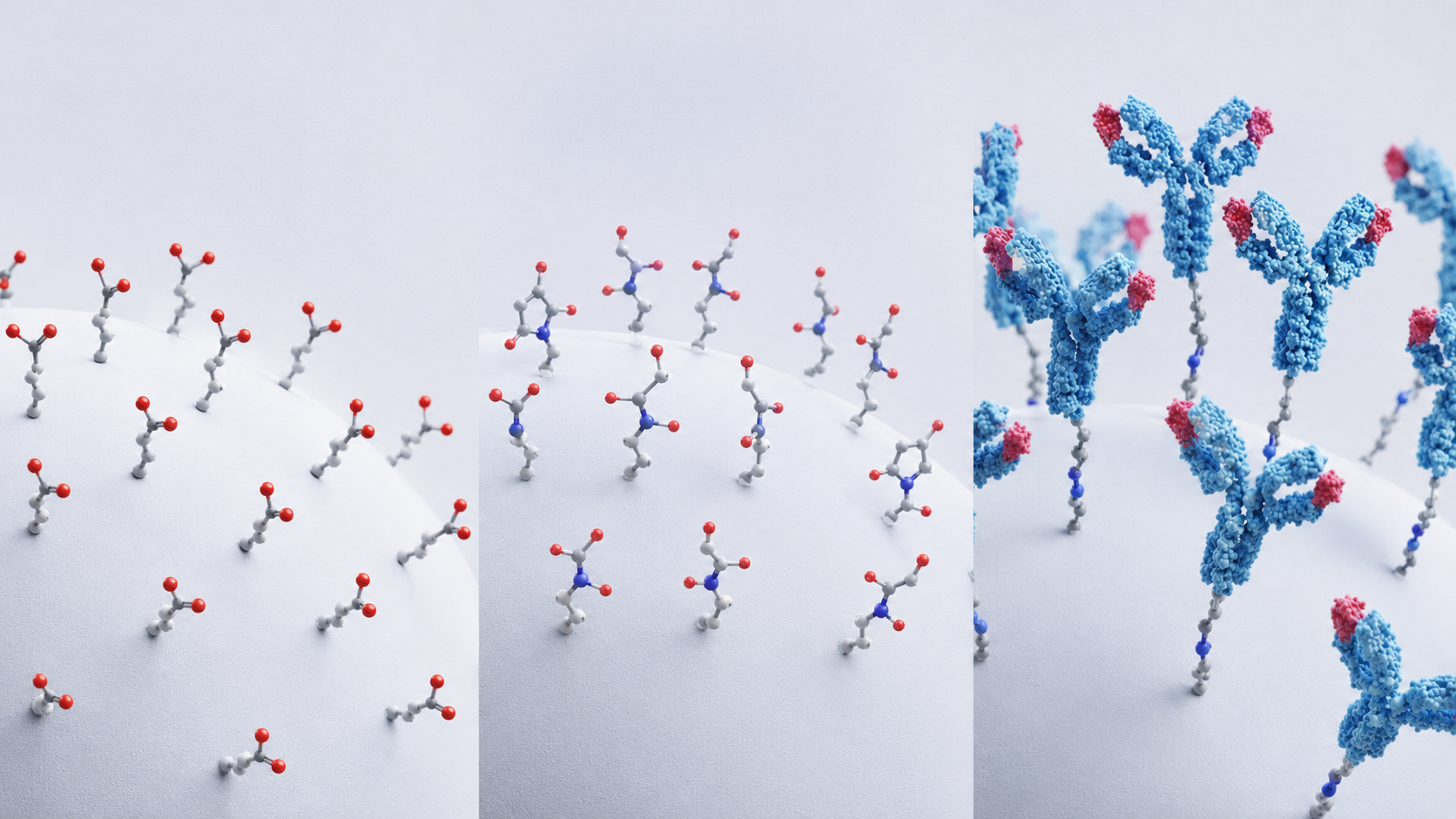
EDC activates carboxyl groups to form an intermediate capable of reacting with primary amines.
The intermediate is relatively short-lived and susceptible to hydrolysis.
EDC/NHS or EDC/Sulfo-NHS
Adding NHS or Sulfo-NHS forms a more stable activated ester intermediate.
Merck's published Estapor procedure uses EDC and Sulfo-NHS in a two-step coupling workflow.
Variables to Optimize
Do not simply copy one supplier's protocol unchanged.
Optimize:
Activation pH;
EDC concentration;
NHS concentration;
Activation time;
Protein concentration;
Protein-to-particle ratio;
Coupling pH;
Blocking reagent;
Washing method;
Storage buffer.
Plain vs Carboxyl vs Colored Carboxyl Microspheres
Particle Type | Main Binding Method | Main Use |
|---|---|---|
Plain PS | Passive adsorption | Latex agglutination and LTIA |
White carboxyl PS | Covalent coupling | LTIA and immunoassay |
Colored carboxyl PS | Covalent coupling + visual label | Lateral flow |
Fluorescent carboxyl PS | Covalent coupling + fluorescence | Quantitative assays and flow cytometry |
Multiplex-coded carboxyl PS | Covalent coupling + spectral code | Multiplex biomarker assays |
Vietnam-Specific Procurement and Logistics Considerations
Direct Manufacturer vs Vietnamese Distributor
A distributor can provide:
Vietnamese-language communication;
Local quotation;
Local invoicing;
Import handling;
Faster delivery from local stock.
Direct manufacturer communication is often preferable for:
Custom particle size;
Custom COOH content;
Bulk supply;
OEM manufacturing;
Quality agreements;
Technical investigations.
Asian Regional Supply
Vietnamese buyers should ask whether inventory is held in:
Vietnam;
Singapore;
Thailand;
Malaysia;
Japan;
Other Asian locations.
Regional inventory can reduce lead time.
Tropical Transportation
Vietnam's climate can create temperature challenges for aqueous microsphere suspensions.
Confirm:
Storage temperature;
Maximum shipping temperature;
Freeze sensitivity;
Temperature-excursion limits;
Sedimentation behavior;
Redispersion procedure.
Safety Stock
For critical imported raw materials, consider sufficient inventory to cover:
Production lead time;
International shipping;
Customs clearance;
Incoming QC;
Unexpected lot rejection.
Commercial Scale-Up
Do not assume that an R&D sample automatically represents future bulk supply.
Ask whether:
Sample and commercial lots use the same manufacturing process;
Larger batches have comparable particle size and COOH density;
Lot reservation is available.
Vietnam Medical Device and IVD Regulatory Considerations
Vietnam regulates medical devices under its Ministry of Health framework.
The Ministry of Health's medical-device regulatory portal continues in 2026 to list Decree No. 98/2021/ND-CP on medical-device management and its subsequent amendments among the applicable regulatory materials.
Under the framework described for Vietnam medical-device registration, lower-risk Class A and B devices use notification procedures through local health authorities, while Class C and D devices are subject to registration with the Ministry of Health.
Raw Microspheres vs Finished IVD Products
A bottle of carboxyl polystyrene microspheres supplied purely as a raw manufacturing material should not automatically be assumed to follow the same registration pathway as a finished diagnostic reagent.
Regulatory treatment depends on:
Intended purpose;
Claims;
Labeling;
Packaging;
How the product is placed on the Vietnamese market.
For a finished IVD, however, the manufacturer should control microspheres as critical raw materials within its quality system.
Relevant controls can include:
Approved raw-material specification;
Supplier qualification;
Incoming QC;
Lot traceability;
Change control;
Stability;
Performance validation.
The exact regulatory treatment should be confirmed for the specific commercial product.
Documents to Request from a Microsphere Supplier
Before commercial qualification, Vietnamese IVD manufacturers should consider requesting:
Product specification;
Certificate of Analysis;
Technical Data Sheet;
Safety Data Sheet;
Mean particle-size data;
Particle-size distribution;
CV;
Measurement method;
Carboxyl density or carboxyl content;
Surface chemistry;
Solids concentration;
Dispersion medium;
Buffer;
Surfactant information;
Preservative information;
Recommended coupling protocol;
Storage conditions;
Shipping conditions;
Shelf life;
Manufacturing-site information;
Country of origin;
Quality-management certificate where applicable;
Batch-traceability procedure;
Change-control policy;
Complaint-handling procedure;
Business-continuity information;
Quality-agreement template.
Recommended Supplier Qualification Process
Step 1: Define the Target Particle Specification
Specify:
Particle material;
Target diameter;
Allowed size distribution;
COOH density;
Solids concentration;
Suspension formulation;
Annual demand.
Step 2: Shortlist Three to Five Suppliers
Include manufacturers representing different technical strengths.
Step 3: Request Representative Samples
Confirm that the evaluation samples are representative of normal commercial manufacturing.
Step 4: Optimize Each Microsphere Separately
Do not use identical coupling conditions automatically.
Optimize:
Activation chemistry;
Protein loading;
Blocking;
Washing;
Storage formulation.
Step 5: Test the Final Clinical Matrix
Evaluate using the intended sample type:
Serum;
Plasma;
Whole blood;
Urine;
Other matrices.
Step 6: Use the Final Instrument or Membrane
For LTIA, use the intended analyzer.
For lateral flow, use the final:
Nitrocellulose membrane;
Conjugate pad;
Sample pad;
Running buffer.
Step 7: Compare Analytical Performance
Evaluate:
Sensitivity;
Limit of detection;
Precision;
Linearity;
Dynamic range;
Background;
Interference.
Step 8: Compare Multiple Lots
Commercial qualification should ideally include several representative production lots.
Step 9: Conduct Stability Studies
Evaluate:
Real-time stability;
Accelerated stability;
Transportation stability;
Freeze-thaw exposure where relevant;
Final reagent stability.
Step 10: Complete Commercial Review
Confirm:
MOQ;
Price;
Batch size;
Capacity;
Lead time;
Safety stock;
Change notification;
Complaint procedure.
Frequently Asked Questions
Who Are the Leading Carboxyl Polystyrene Microsphere Manufacturers Serving Vietnam?
Leading manufacturers and specialist suppliers include Merck Estapor, SANYU, JSR Life Sciences, Bangs Laboratories, Polysciences, Spherotech, Magsphere, microParticles GmbH, Thermo Fisher Scientific and DiaSorin Luminex.
Why Is SANYU Ranked Second?
SANYU ranks second because it provides a broad carboxyl polystyrene platform including nano-scale and submicron sizes, different solids concentrations, customized carboxyl content, formulation customization and OEM/ODM supply.
Merck Estapor ranks first because of its long-established IVD-specific positioning and extensive documented use in LTIA and latex agglutination.
Which Manufacturer Is Best for LTIA?
Merck Estapor and JSR Life Sciences are particularly strong established options.
SANYU and Bangs Laboratories are also relevant where:
Custom particle sizes;
Custom COOH density;
Flexible commercial supply
are important.
Which Manufacturers Offer 50–500 nm Carboxyl PS?
Relevant options include:
Merck Estapor;
SANYU;
JSR Life Sciences;
Bangs Laboratories;
Magsphere.
JSR's IMMUTEX specifically covers approximately 50–500 nm.
Which Manufacturer Offers Very Small Carboxyl PS Nanoparticles?
SANYU and Bangs Laboratories both provide very small particles.
SANYU currently lists a 20 nm CP020-10 product, while Bangs' carboxyl PS range begins at approximately 25 nm.
Which Manufacturers Offer Colored Carboxyl Polystyrene Microspheres?
Relevant suppliers include:
SANYU;
Polysciences;
Magsphere;
Spherotech.
Colored carboxyl PS is particularly relevant to lateral flow.
What Particle Size Is Best for Immunoturbidimetry?
There is no universal best size.
Submicron particles, particularly approximately 50–500 nm, are commonly evaluated for turbidimetric reagent development.
The optimum diameter depends on:
Analyzer wavelength;
Target concentration;
Antibody;
Particle concentration;
Required dynamic range.
What Particle Size Is Best for Lateral Flow?
Several-hundred-nanometre particles are frequently evaluated.
Magsphere specifically identifies 300 nm and 400 nm colored PS particles as widely used in rapid tests.
The final optimum must be tested with the intended membrane and buffer.
Is Higher Carboxyl Density Always Better?
No.
Higher COOH density may provide more potential coupling sites, but it can also alter:
Surface charge;
Colloidal stability;
Protein orientation;
Nonspecific binding.
The best COOH density is assay-specific.
Why Does JSR Offer Two Carboxyl Densities?
JSR states that different carboxyl densities and surface chemistries can be used to control assay sensitivity and dynamic range.
This demonstrates why surface chemistry should be optimized rather than treated as a fixed specification.
What Is the Difference Between Plain and Carboxyl Polystyrene Microspheres?
Plain polystyrene typically relies on passive adsorption of proteins.
Carboxyl polystyrene provides reactive COOH groups that can be chemically activated for covalent attachment.
What Is EDC/NHS Coupling?
EDC activates carboxyl groups.
NHS or Sulfo-NHS creates a more stable intermediate that subsequently reacts with primary amino groups on proteins to form an amide bond.
Merck publishes this approach for Estapor carboxyl microspheres.
Which Manufacturers Are Best for Lateral Flow?
Relevant candidates include:
SANYU;
Polysciences;
Magsphere;
Merck Estapor.
For visual tests, colored carboxyl PS can provide both the visible label and a reactive surface for biomolecule immobilization.
Are Thermo Fisher FluoSpheres Suitable for Commercial IVD Production?
Current standard FluoSpheres carboxylate-modified products are generally labeled Research Use Only and not for diagnostic procedures.
Commercial IVD developers should therefore verify an appropriate OEM or further-manufacturing arrangement.
What Documents Should I Request for Commercial IVD Manufacturing?
At minimum, consider requesting:
Specification;
COA;
TDS;
SDS;
Particle size;
CV;
COOH content;
Solids concentration;
Buffer composition;
Storage information;
Change-control policy.
Should Vietnamese Buyers Use a Local Distributor?
A local distributor may help with:
Import handling;
Samples;
Local invoices;
Vietnamese-language communication.
Direct manufacturer contact is generally more important for:
Custom particle development;
Bulk supply;
OEM projects;
Quality agreements.
Do Raw Carboxyl Polystyrene Microspheres Require Vietnam Medical Device Registration?
Not necessarily.
A raw material supplied for further manufacturing should not automatically be treated the same as a finished IVD.
The exact treatment depends on intended use, claims and commercial presentation.
The finished IVD manufacturer should nevertheless qualify and control the microsphere as a critical raw material.
How Many Microsphere Suppliers Should Be Evaluated?
During early assay development, evaluating at least three technically suitable microsphere platforms is useful.
For a critical commercial product, a technically acceptable secondary supplier can improve supply-chain resilience.
However, two particles with the same nominal diameter should not be assumed to be interchangeable.
Final Recommendations
Vietnam's growing IVD, POCT and medical-device market creates increasing demand for reliable carboxyl polystyrene microspheres used in immunoturbidimetry, latex agglutination, lateral flow and other particle-based diagnostic platforms.
Merck Estapor ranks first because of its highly established IVD microsphere portfolio and specific technical support for Latex Turbidimetric Immunoassays, Latex Agglutination Tests and EDC/Sulfo-NHS protein coupling.
SANYU ranks second and is the only Chinese manufacturer included. Its major advantages include carboxyl polystyrene particles from very small nanoscale formats such as 20 nm through larger submicron and micrometre products, multiple solids concentrations, customizable carboxyl content, formulation customization and OEM/ODM manufacturing.
JSR Life Sciences ranks third because its IMMUTEX platform provides uniform 50–500 nm diagnostic latex and two levels of carboxyl density specifically intended to help control assay sensitivity and dynamic range.
Bangs Laboratories offers one of the broadest carboxyl polystyrene size portfolios, from approximately 25 nm to 20 μm, together with strong diagnostic coupling expertise.
Polysciences provides dyed and plain carboxylate particles relevant to latex agglutination, lateral flow and assay development.
Spherotech supplies functionalized polystyrene particles over a broad size range and is particularly relevant to specialized coupling, flow cytometry and analytical applications.
Magsphere is a useful candidate for lateral flow because it provides colored carboxylated PS particles and specifically identifies 300–400 nm particles for rapid-test applications.
microParticles GmbH is especially attractive where high monodispersity and precisely characterized COOH density are required.
Thermo Fisher Scientific provides an extensive fluorescent carboxyl PS research platform, although commercial IVD developers need to consider its current RUO labeling.
DiaSorin Luminex provides specialized carboxylated polystyrene multiplex microspheres for high-complexity xMAP assays.
Vietnamese IVD manufacturers should compare suppliers according to:
Particle diameter;
Particle-size distribution;
CV;
Carboxyl density;
Solids concentration;
Dispersion medium;
Surfactant;
Protein-coupling efficiency;
Nonspecific binding;
Optical response;
Lot-to-lot consistency;
Quality documentation;
Regional inventory;
Commercial manufacturing capacity;
OEM customization;
Change-control procedures.
The most reliable selection process is to test several particle sizes and carboxyl densities using the actual antibody or antigen, final clinical matrix, intended analyzer or membrane, and representative production process.
For commercial IVD manufacturing in Vietnam, particle performance, supplier quality, supply continuity and regulatory documentation should all be evaluated together rather than selecting a supplier based only on price or nominal particle diameter.
Related Blogs
-
 Quick Answer: Top 10 Carboxyl Polystyrene Microsphere Manufacturers Serving Europe in 2026Carboxyl polystyrene microspheres are widely used as functional particle materials in IVD, immunoassay, lateral flow, latex agglutination, particle-enhanced immunoturbidimetric assays, fluorescence assays and b
 -
 Quick Answer: Leading Carboxyl Polystyrene Microsphere Manufacturers Serving ThailandThe leading carboxyl polystyrene microsphere manufacturers serving Thailand in 2026 include Merck Estapor, SANYU, JSR Life Sciences, Bangs Laboratories, PolyMicrospheres, Polysciences, Spherotech, Thermo Fisher Scie
 -
 Quick Answer: Top Carboxyl Polystyrene Microsphere Manufacturers Serving Malaysia in 2026The leading carboxyl polystyrene microsphere manufacturers and specialist particle suppliers serving Malaysia in 2026 include Merck Estapor, SANYU GROUP, MBL Materials / IMMUTEX, Bangs Laboratories, Magsphere, P
 - Carboxyl Polystyrene Microsphere Market in AustraliaCarboxyl polystyrene microspheres are functionalized polymer particles with carboxyl (-COOH) groups on their surfaces. Because these groups can be chemically activated for covalent biomolecule coupling, carboxyl polystyrene microspheres are widely

