


Choosing Fluorescent Microsphere Suppliers for Russian Buyers
Fluorescent microspheres combine a particle substrate with a detectable optical signal. They can serve as assay labels, imaging tracers, instrument reference materials or encoded populations for multiplex research. Choosing a supplier requires matching both the particle and its fluorescence to the intended measurement.
For buyers in Russia, the search includes international manufacturers and local development sources. A supplier may have a technically relevant product without offering a confirmed order route for a particular Russian delivery address. Product selection and purchasing availability therefore need separate confirmation.
This guide compares ten sources with publicly documented fluorescent particle products or development capabilities. It identifies their product focus and the questions that help turn a broad supplier search into a specific grade evaluation.
What This Russia Supplier Guide Covers
The companies and research group below are an editorial shortlist. Their numbers identify entries; they do not represent measured rankings of market share, brightness or assay performance.
Most entries are international businesses. GTS, the Template Synthesis Group, is included as a Russian research and development source. Its laboratory capabilities should be evaluated differently from a stocked commercial particle catalog.
SANYU publishes this guide and appears as a China-based microsphere manufacturer. Its materials should be assessed using the same specification, sample testing and documentation requirements applied to other sources.
The application notes identify starting points for evaluation. Before committing to a grade, ask the chosen seller whether it can supply the exact product to the stated destination and confirm the current commercial terms. A public catalog listing alone does not establish delivery availability.
What a Fluorescent Microsphere Specification Describes
A fluorescent bead specification should describe the matrix, dimensions, optical response and surface chemistry together. Two particles with the same nominal diameter and color name may behave differently in a reader or formulation.
The matrix may be polystyrene, PMMA, silica or another material. It influences handling, solvent compatibility and interactions with the surrounding medium. Magnetic fluorescent particles introduce a separation function that ordinary nonmagnetic beads do not provide.
For the optical component, request excitation and emission spectra rather than relying only on a description such as green or red. Also establish how fluorescence intensity and its distribution were measured.
Surface chemistry determines the available route for attaching ligands or adjusting particle interactions. Carboxyl, amino, streptavidin-coated and unmodified surfaces require different preparation strategies. An embedded dye and a surface fluorophore can also leave different options for subsequent modification.
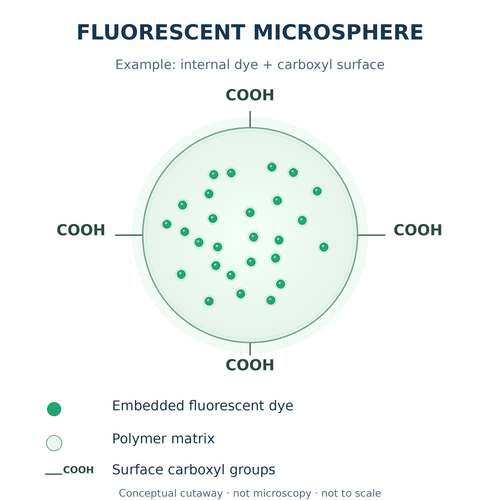
The illustration shows one common design: fluorescent dye embedded in a polymer bead with carboxyl groups at its surface. It is a conceptual example; suppliers also offer other matrices, dye arrangements and surface chemistries.
Quick Comparison of Ten Sourcing Options
No. | Source | Documented fluorescent offering | Main inquiry focus |
|---|---|---|---|
1 | Polysciences | Fluoresbrite carboxylated and multifluorescent microspheres | Catalog grade, surface chemistry and spectral combination |
2 | Bangs Laboratories | Plain, functionalized, magnetic and coated fluorescent particles; custom dyeing | Assay substrate, surface option and dye specification |
3 | Spherotech | SPHERO single- and multiple-fluorophore particles; Rainbow calibration products | Particle function and instrument-standard requirements |
4 | Thermo Fisher Scientific | Invitrogen FluoSpheres, including internally dyed carboxylate-modified polystyrene beads | Size, excitation/emission and labeling application |
5 | SANYU | Fluorescent polymer microspheres and carboxylated product categories | Grade selection, surface requirements and customization |
6 | Merck Estapor | XC fluorescent and europium microspheres for lateral flow development | Assay-reader compatibility and conjugation requirements |
7 | microParticles GmbH | Fluorescent particles across multiple matrices and UV-to-near-IR spectral options | Matrix, spectrum, diameter and surface functionality |
8 | Magsphere | Polystyrene fluorescent particles with unmodified, carboxylated or aminated surfaces | Available size/color/surface combinations |
9 | GTS / Template Synthesis Group | Polymer particle development and spectral coding with fluorescent dyes | Development feasibility, sample definition and commercial supply |
10 | Cospheric | Dry fluorescent polymer tracer powders and polyethylene particles | Matrix, density, dispersibility and tracing conditions |
Polysciences and Bangs Laboratories belong to the Ott Scientific family. Their separate entries represent different product and support channels, rather than independent parent groups.
Ten Manufacturers and Development Sources to Compare
1. Polysciences
Polysciences supplies Fluoresbrite microspheres, including carboxylated polystyrene particles and multifluorescent products containing more than one fluorescent dye. Its carboxylated grades provide a surface chemistry that can support appropriate covalent protein-coupling procedures.
The catalog is a useful starting point for research that needs an identified particle grade rather than an open-ended development project.
Request the chosen product's diameter, distribution, spectra, concentration and suspension composition. For a multifluorescent particle, identify which signals are needed and whether additional emission channels would complicate the measurement. For ligand attachment, assess fluorescence after coupling and washing as well as before modification. Confirm the current seller, destination-specific availability and handling requirements for the exact catalog number.
2. Bangs Laboratories
Bangs Laboratories documents fluorescent particles for markers, assay substrates and instrument standards. Its portfolio includes plain and carboxylated polystyrene particles, fluorescent magnetic particles and streptavidin-coated fluorescent beads. The company also offers custom dyeing services.
This makes Bangs relevant when a project requires a particular combination of fluorescence and particle-surface functionality.
Define whether the request is for a raw assay substrate, a coated reagent or a reference material. These products have different acceptance criteria. Ask which dye, matrix and surface are proposed, and request characterization relevant to the final use. For custom work, agree the sample specification, evaluation quantities and manufacturing scope before treating the development material as a routine production grade.
3. Spherotech
Spherotech offers SPHERO fluorescent particles with single or multiple fluorophores and different surface configurations. Its Rainbow calibration products provide particle populations with different fluorescence intensities for instrument evaluation.
The company is a relevant candidate for both fluorescent particle research and flow-cytometer setup or performance tracking, provided the correct product family is selected.
Describe the intended task precisely: alignment, sensitivity assessment, fluorescence quantitation, compensation or assay labeling. A bead that works for one task may not meet another task's requirements. Request the relevant instructions, lot-specific information and supported detector channels. For multicolor measurements, use reference materials appropriate to the fluorophores being measured. General Rainbow fluorescence does not by itself establish a suitable compensation control for every stain.
4. Thermo Fisher Scientific
Thermo Fisher Scientific offers Invitrogen FluoSpheres in different sizes and fluorescent colors. Its carboxylate-modified polystyrene particles contain dye within the bead and provide surface carboxylic acid groups for suitable ligand-attachment procedures.
The range is relevant to microscopy, particle tracing and fluorescent labeling studies where the catalog's size and spectral information help define a starting material.
Select the actual size and dye combination rather than choosing only by the FluoSpheres name. Confirm the suspension medium, concentration and handling instructions. For an imaging study, assess background and particle detectability in the intended sample. For a conjugated assay label, check aggregation, signal retention and binding performance after modification. Published bead fluorescence does not establish the performance of the complete assay.
5. SANYU
SANYU manufactures fluorescent polymer microspheres and lists product categories including carboxylated fluorescent polystyrene particles. Its platform covers several fluorescent colors and describes customization of size, fluorescence, surface functionality, concentration and packaging.
SANYU is a relevant candidate for projects that need to discuss particle requirements alongside a commercial supply specification. These may include fluorescent immunoassay labels, particle-based research and custom material development.
Provide the instrument's excitation source and detection band, the target diameter, the required surface and the intended formulation. Request available grade-specific spectra, size-distribution information and suspension details. Evaluate representative samples after the proposed processing or conjugation steps. Agree which requirements are documented product specifications and which require additional testing, then confirm current order availability, quantity and delivery terms.
6. Merck Estapor
Merck's Estapor portfolio includes polystyrene fluorescent microspheres for lateral flow development. Its published material distinguishes conventional XC fluorescent particles from europium microspheres and describes carboxylated surfaces for protein conjugation.
This provides a useful comparison point for developers selecting labels for a quantitative lateral flow reader.
Confirm the reader's excitation source, detection filters and any time-gated measurement requirements. A change between conventional fluorescence and a europium-based label may require adjustments to both optical settings and assay formulation. Compare conjugate release, background, test-line response and the working calibration range in the actual strip system. Supplier descriptions of improved label properties should be checked against the complete assay's measured performance and acceptance criteria.
7. microParticles GmbH
microParticles GmbH manufactures fluorescent nano- and microspheres with different matrices, dye choices, intensities and surface functionalities. Its public portfolio includes polystyrene, PMMA, melamine resin and silica, with fluorescent options spanning UV to near-infrared regions.
The range is relevant when the project needs a matrix or spectral combination beyond a standard visible-color polystyrene bead.
Specify the complete material environment, including liquids, solvents and biological components. Request characterization for the proposed matrix and dye rather than transferring one product family's properties to another. For a custom fluorescent population, define the diameter distribution, optical measurement conditions and required separation from other populations. Confirm which combinations are existing catalog products and which need development.
8. Magsphere
Magsphere documents fluorescent polystyrene nanospheres and microspheres in several colors. Its listed surface options include unmodified, carboxylated and aminated particles, with excitation and emission information provided for the fluorescent product families.
The company is a relevant source when size, fluorescent color and surface chemistry must be selected together.
Request the currently available combination rather than assuming every color is offered at every diameter and surface configuration. Confirm particle concentration, suspension additives and the handling instructions for the proposed grade. For coupling studies, evaluate the selected surface with the intended ligand and blocking conditions. For tracing, assess detectability and dispersion in the actual medium. If an instrument standard is needed, request a product documented for that specific measurement purpose.
9. GTS / Template Synthesis Group
GTS describes itself as a Russian scientific team formed at the Boreskov Institute of Catalysis. Its polymer-microsphere page documents polystyrene and PMMA particle development, surface functionalization and spectral coding using fluorescent dyes at different concentrations.
The page gives a broader polymer-particle range of approximately 50–5000 nm. This should not be read as a stocked fluorescent catalog covering every size, dye and surface combination.
GTS is relevant to local development inquiries involving particle design or spectral encoding. Ask for a defined sample proposal, available characterization, production quantities and the arrangement for repeat supply. Establish the contracting organization, documentation and delivery conditions before treating a laboratory capability as an approved commercial source for a manufacturing project.
10. Cospheric
Cospheric supplies fluorescent polymer particles for tracing and process studies. Its public portfolio includes dry fluorescent tracer powders and polyethylene microspheres with different size and density options.
This makes Cospheric relevant to projects where dispersibility, density and particle movement matter alongside fluorescence. Examples include flow visualization, filtration studies and particle-based cleaning assessments.
Identify the matrix and grade before adapting a tracer to a new experiment. Dry polyethylene particles should not be assumed to behave like carboxylated diagnostic latex. Check wetting, any dispersant requirements, buoyancy or settling behavior and detection under the proposed illumination. For filtration testing, specify the distribution relevant to the challenge. For biological work, separately establish surface and formulation suitability.
Match the Fluorescent Product to Its Role
Assay labels need suitable surface chemistry, controlled conjugation behavior and reproducible signal in the intended sample. For lateral flow, migration and conjugate release matter alongside fluorescence. A brighter particle can still produce poor results if it aggregates or raises background.
Instrument reference materials need documentation appropriate to the measurement. Alignment particles, intensity standards, counting beads and compensation controls serve different purposes. Identify the required function before comparing colors or bead size.
Imaging and transport tracers need sufficient contrast in the sample, suitable dispersion and behavior consistent with the study. Particle detection alone does not prove cell internalization or transport through a particular biological pathway.
Encoded populations require separation between bead classes and compatibility with the assay's reporting signal. Test the population boundaries after washing, coupling and exposure to the working matrix. Encoding performance should be assessed under the same instrument settings used for the final measurement.
Compare Optical Performance Under Defined Conditions
A color name is an initial descriptor, not a complete optical specification. Request spectra and check their overlap with the available excitation source, emission filters and detector response.
Compare candidate particles under consistent conditions. Record particle concentration, illumination, acquisition settings and the surrounding medium. Apparent brightness can change when any of these factors changes.
Particle-size variation and fluorescence-intensity variation describe different properties. A size CV does not establish a fluorescence CV. A DLS polydispersity index also should not be substituted directly for a microscopy-based size CV.
For multicolor flow cytometry, spectral overlap requires controls appropriate to the actual fluorophores and analysis method. Internally dyed reference beads and fluorophore-matched or antibody-capture controls may serve different functions.
Time-resolved detection introduces additional requirements, including excitation timing, measurement delay and the detection window. Confirm these with the reader and label specifications. A conventional fluorescent bead and a europium-containing bead should not be treated as interchangeable solely because both are described as red.
Specifications to Request From a Supplier
A useful inquiry states the application, instrument and critical acceptance criteria. It helps the supplier identify a specific grade and avoids comparing products that serve different functions.
Specification | Information to request | Purpose |
|---|---|---|
Product identity | Code, matrix, surface chemistry and dye or label family | Connects the sample to a repeatable material |
Particle dimensions | Diameter definition, method and distribution | Supports size-related acceptance criteria |
Optical response | Excitation/emission spectra and defined intensity measurements | Establishes reader compatibility |
Fluorescence variation | Distribution, analysis settings and relevant lot data | Separates intensity consistency from size uniformity |
Surface characteristics | Functional-group or coating information where available | Supports conjugation and interaction studies |
Suspension composition | Medium, solids basis, surfactant and preservative information | Enables correct dosing and formulation review |
Stability | Relevant light, storage and formulation-exposure information | Guides handling and sample qualification |
Purchasing availability | Quantity, seller, delivery destination and current commercial terms | Establishes a workable order for the selected grade |
Request a certificate of analysis or other quality documentation that identifies the actual batch. Distinguish tested lot results from nominal catalog values and general product descriptions. If a required measurement is unavailable, define how it will be evaluated during qualification.
Qualify Samples and Confirm the Supply Arrangement
Start with a small number of grades that meet the matrix, spectral and surface requirements. Keep the assay or measurement conditions consistent so that particle differences can be assessed meaningfully.
Evaluate incoming dispersion and particle distribution, then measure fluorescence in the intended medium. For conjugated products, repeat the relevant checks after coupling, washing and blocking. Assess background and functional performance using controls appropriate to the application.
Where production consistency matters, evaluate additional lots or a pilot quantity after the first screen. Agree the product identity, acceptance limits and any notification requirements for changes to dye, surface treatment or formulation.
For delivery to Russia, confirm the exact product, quantity and destination with the seller before relying on a proposed order. Agree payment terms, packaging, temperature requirements, shipping responsibility and lead time. Storage instructions are grade-specific, and a transport excursion should be assessed against the selected product's documented requirements.
Frequently Asked Questions
Are all suppliers in this guide based in Russia?
No. The guide includes international manufacturers and a Russian development source. It is intended to help Russian buyers compare technically relevant options. Current order acceptance and delivery availability must be confirmed for the selected product and destination.
Does GTS offer a standard fluorescent microsphere catalog?
Its public page describes polymer particle development, functionalization and fluorescent spectral coding. Ask which fluorescent combinations are available as defined products, which require development and what documentation and repeat-supply arrangements can be provided.
Can green fluorescent beads be used with any green detection channel?
No. Review the bead's excitation and emission spectra against the source, filters and detector. Different products described as green can have different optical responses. Confirm the signal and background in the actual instrument before selecting a grade.
Are fluorescent assay labels and calibration beads interchangeable?
They may have different purposes and documentation. An assay label must support the required formulation and binding behavior. A calibration or QC bead must meet the reference function it is intended to perform. Select and qualify the product for that specific role.
Does a low particle-size CV guarantee uniform fluorescence?
No. Diameter distribution and fluorescence-intensity distribution are separate properties. Request both where they matter, together with the measurement method and settings. Also evaluate whether processing changes aggregation, background or the observed fluorescence distribution.
Can carboxylated fluorescent beads be coupled to antibodies?
Carboxylated surfaces can support suitable covalent coupling procedures. The method still needs optimization for the bead, antibody and assay. Check aggregation, retained fluorescence, binding activity and background after conjugation. Surface functionality alone does not establish final assay performance.
Can I assume every listed manufacturer currently ships to Russia?
No. Confirm the exact product, quantity, delivery address and current order terms with the seller. The shortlist documents technical relevance; it does not verify a shipment or payment arrangement for every company or product.
Conclusion
A useful fluorescent microsphere comparison starts with the particle's role: assay label, instrument reference, imaging tracer or encoded research population. Match the matrix, diameter, spectrum and surface to that role, then evaluate representative samples under defined conditions. For Russian buyers, a suitable material and a confirmed purchasing arrangement are both necessary.
For SANYU evaluations, review our fluorescent microspheres, compare fluorescent carboxyl polystyrene microspheres when ligand coupling is required, and explore green fluorescent microspheres as one color-specific product category. Send your instrument details, formulation and particle requirements to the SANYU technical team to identify a grade for testing and confirm current order availability.
Related Blogs
-
 Overview of the Fluorescent Microsphere Market Serving RussiaFluorescent microspheres are nano- or microscale spherical particles that contain one or more fluorescent dyes and emit light after excitation at a suitable wavelength.They are used in applications including:Lateral flow immunoassays;Flow
 -
 Overview of the PMMA Microsphere MarketPoly(methyl methacrylate) microspheres, commonly called PMMA microspheres or acrylic microspheres, are spherical polymer particles manufactured from methyl methacrylate-based materials.They are available in forms including:Monodisperse particles;Broad-distribut
 -
 Quick Answer: How to Dehydrate Silica BeadsThe safest general method for dehydrating loose silica gel beads is to spread them in a thin, even layer and heat them in a ventilated electric oven at approximately 105–120°C, or 221–248°F. Begin checking the beads after about two hours and continue drying
 - Magnetic Bead Extraction Troubleshooting: Quick Diagnostic GuideMost magnetic bead nucleic acid extraction failures can be traced to one of seven stages:Sample preparation;Lysis;Nucleic acid binding;Magnetic collection;Washing;Bead drying;Elution and measurement.Do not change several variables at th

