


Choosing PMMA Microsphere Manufacturers in 2026
PMMA microspheres are spherical particles made from poly(methyl methacrylate), commonly called acrylic. Buyers use them in optical materials, coatings, polymer composites, sacrificial templates and laboratory research. However, two products described as PMMA beads can differ substantially in composition, particle distribution, crosslinking, surface chemistry and supply format.
The right manufacturer or supplier therefore depends on the grade your process needs. A narrow distribution may matter for spacer applications, while a ceramic pore former requires a suitable decomposition profile. A coating additive must disperse in the actual binder and survive its processing conditions.
This guide compares ten companies with publicly documented PMMA or relevant MMA-based acrylic particle offerings. It explains what each company supplies and what buyers should confirm before ordering.
How to Read This Manufacturer and Supplier Shortlist
The numbered entries form an editorial shortlist, rather than a measured ranking of sales, market share or particle performance. Inclusion reflects identifiable product information; it does not establish that one company's particles outperform another's.
The list includes manufacturers, related product businesses and a regional chemical supplier. These are different commercial routes, so ten entries should not be interpreted as ten independent production networks. Country references identify the company or supply organization discussed, rather than guaranteeing the manufacturing origin of every grade.
SANYU publishes this guide and is included as a China-based microsphere manufacturer. Buyers should assess its products against the same specification and sample-testing requirements applied to other companies. Availability, customization and commercial quantities remain subject to confirmation for the selected product.
PMMA, Crosslinked PMMA and Acrylic Copolymers
A supplier's brand name alone does not identify particle composition. Start with the material declaration for the exact product code.
Noncrosslinked PMMA particles have a thermoplastic polymer structure. Certain organic solvents can dissolve or alter them, which may be useful for sacrificial templates but problematic in solventborne coatings.
Crosslinked PMMA particles contain a polymer network formed with a crosslinking component. Crosslinking can improve dimensional stability and resistance to some processing conditions. It does not establish compatibility with every solvent, temperature or exposure time.
MMA-based acrylic particles may contain substantial crosslinker or other comonomers. Their optical, mechanical and thermal properties should not automatically be assigned the values associated with bulk PMMA.
Porous, hollow, fluorescent and metal-coated particles introduce further differences. A silver-coated PMMA core, for example, provides a conductive surface that an ordinary uncoated PMMA sphere does not provide. A porous particle also has a different accessible structure from a solid sphere.
Specify which of these features your application requires before comparing prices.
Dry Powder or Aqueous Dispersion?
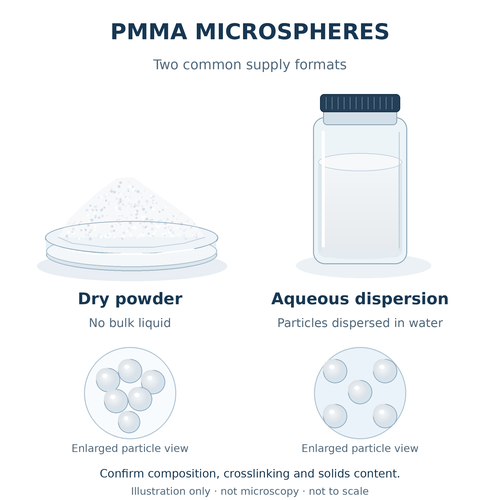
Dry powder can suit dry blending, polymer compounding and formulations where the buyer controls the liquid phase. Check moisture, agglomeration, dust handling and the mixing energy needed to distribute the particles.
An aqueous dispersion can simplify dosing into compatible waterborne systems. Its solids concentration, stabilizers, pH, storage conditions and redispersion behavior still require review. The suspension mass is not the same as the mass of polymer delivered.
For purchasing comparisons, calculate cost per unit of usable particle solids and include transport, handling and formulation work. Changing from a suspension to powder may also change how easily the particles redisperse.
The illustration compares two common supply forms: dry PMMA microsphere powder and an aqueous particle dispersion. It shows product format only; particle composition, crosslinking and solids content must be checked for the selected grade.
Quick Comparison of 10 PMMA Microsphere Companies
No. | Company | Country or supply organization | Documented PMMA-related offering | Main comparison point |
|---|---|---|---|---|
1 | Cospheric | United States | Clear noncrosslinked PMMA powder; silver-coated PMMA particles | Size fractions and coating requirements |
2 | microParticles GmbH | Germany | PMMA particles across approximately 100 nm–200 μm; functional and fluorescent options | Discrete size, surface and labeling choices |
3 | SANYU | China | PMMA powders and crosslinked grades; a listed 10 μm crosslinked product offers powder or 10% aqueous suspension | Exact composition, format and industrial sample evaluation |
4 | Sekisui Kasei | Japan | TECHPOLYMER MB, MBX and related PMMA families | Noncrosslinked, crosslinked and specialized grade distinctions |
5 | Polysciences | United States | Polybead PMMA products, including monodisperse suspension and broad-distribution dry powder | Distribution, surfactant and surface chemistry |
6 | Matsumoto Yushi-Seiyaku | Japan | Matsumoto Microsphere M-series PMMA and crosspolymer grades | Shape, structure and crosslinking |
7 | Soken Chemical & Engineering | Japan | Chemisnow MMA-based acrylic families, including crosslinked MX particles | Polymer composition and coating compatibility |
8 | Nippon Shokubai | Japan | EPOSTAR MX PMMA-based crosslinked nanoparticle dispersions | Submicron size and waterborne formulation |
9 | Bangs Laboratories | United States | Technical documentation describes solid, nonporous PMMA beads | Current product availability and technical support |
10 | Kowa American Corporation | United States; Japanese group | Commercially supplied PMMA/acrylic particle series | Distribution route and upstream manufacturer confirmation |
The entries cover different product categories. A nanoparticle dispersion, an industrial coating powder and a coated spacer bead should be compared only after their intended roles are defined.
Top 10 PMMA Microsphere Manufacturers and Suppliers
1. Cospheric (United States)
Cospheric offers clear, noncrosslinked PMMA spheres in dry powder form. Its published range extends from approximately 1 μm to 3.5 mm, covering fine particles through sizes much larger than conventional microspheres. The company also lists silver-coated PMMA products for conductive spacer applications.
This makes Cospheric worth evaluating when the project needs a particular size fraction, a larger spherical particle or a conductive coating over a polymer core.
Buyers should distinguish a stated size interval from a monodisperse product specification. Ask for the supplied fraction's distribution, fines content, morphology and coating details where applicable. For spacers, test deformation under the intended assembly pressure. For templates, confirm removal behavior in the actual process. Certification or traceability must be checked for the specific product.
2. microParticles GmbH (Germany)
microParticles GmbH documents PMMA particles from approximately 100 nm to 200 μm, with noncrosslinked and crosslinked options. Its product platform also includes surface-functionalized and fluorescent PMMA particles.
The company is a relevant candidate when research requires a defined particle size, a particular surface group or a fluorescent label. These requirements differ from simply sourcing an acrylic filler by nominal diameter.
Request the current batch diameter, measurement method and distribution, together with suspension concentration and medium. For functional particles, establish the available group chemistry and a suitable characterization method. For fluorescence, specify excitation and emission requirements, background, storage and exposure conditions. A fluorescent research particle should not automatically be treated as a certified instrument standard; check the documentation appropriate to the measurement task.
3. SANYU (China)
SANYU manufactures PMMA microspheres for materials development and industrial applications. Its catalog includes dry PMMA powder and crosslinked product options. A listed nominal 10 μm crosslinked grade is available as powder or a 10% aqueous suspension, with laboratory and kilogram-scale packaging options.
The product range is relevant to buyers evaluating pore formers, sacrificial templates, polymer fillers and other particle-based materials. SANYU also describes customization of particle size, surface characteristics and supply format.
Specify the exact grade rather than assuming every PMMA product has the same polymer architecture. Request its composition, size-distribution results, morphology, moisture or dispersion specifications and representative sample. For thermal removal, evaluate decomposition and residue under the intended conditions. Agree the sample-to-production specification before scaling up, including packaging, lot identification and change notification.
4. Sekisui Kasei (Japan)
Sekisui Kasei manufactures TECHPOLYMER organic polymer particles. Its MB series is identified as PMMA, while MBX is crosslinked PMMA supplied as powder. The wider platform includes porous PMMA and other polymer families.
TECHPOLYMER is therefore a useful comparison point for optical materials, paints and specialized particle additives. Buyers should select the relevant series before comparing particle diameter or performance.
Request the grade's crosslinking designation, distribution, solvent compatibility and processing limits. For optical materials, test performance in the intended matrix and finished thickness. For coatings, evaluate gloss, texture and adhesion alongside dispersion. A cosmetic particle grade and an industrial additive may carry different documentation and formulation requirements; product-family membership alone does not establish suitability for a particular finished product or market.
5. Polysciences (United States)
Polysciences offers Polybead PMMA products, including a monodisperse aqueous product and broad-distribution dry powder. Its product descriptions identify surfactant and surface carboxylic acid groups, details that can affect how the particles behave in a formulation.
This is a useful catalog option for laboratory evaluations where product documentation and clearly identified supply forms help define the experiment.
Buyers should check the chosen product's distribution rather than treating every Polybead PMMA grade as monodisperse. Confirm solids content, medium, surface chemistry and any washing requirements before designing an adsorption or coupling study. If the work progresses toward larger quantities, request commercial availability and packaging for that same material. Substituting a dry broad-distribution product for a narrow suspension can change more than handling convenience.
6. Matsumoto Yushi-Seiyaku (Japan)
Matsumoto Yushi-Seiyaku identifies its Microsphere M-series as PMMA-based particles with crosslinked and noncrosslinked types. The published range includes differences in surface texture and geometry, including selected hollow or porous grades.
The M-series is relevant when particle structure and surface effects matter alongside size. A smooth solid sphere and a hollow porous crosspolymer should not be treated as interchangeable additives.
Confirm the product's composition, shape, size distribution and absorption characteristics. Compare actual dispersion and finished-material properties under controlled formulation conditions.
Matsumoto also offers F and FN thermally expandable microcapsules. These have a distinct structure and operating principle from the M-series. An inquiry for solid PMMA microspheres should identify that requirement explicitly so the supplier can propose the appropriate family.
7. Soken Chemical & Engineering (Japan)
Soken's Chemisnow platform includes particles based on methyl methacrylate, styrene and their copolymers. Its MX series is described as crosslinked acrylic particles with a narrow distribution and nominal average sizes spanning approximately 0.8–30 μm.
The range is worth evaluating for optical and coating formulations requiring controlled surface texture or light diffusion. The selected acrylic grade's composition matters because the broader Chemisnow brand also covers other polymer types.
Request the base polymer, crosslinking category, refractive index and compatibility data for the actual binder. Evaluate haze or gloss together with appearance, dispersion and mechanical performance. Where the coating contains solvents, include the relevant exposure time and curing conditions in sample trials. Do not assign the properties of a styrene-based grade to an MMA-based acrylic grade.
8. Nippon Shokubai (Japan)
Nippon Shokubai's EPOSTAR MX series consists of aqueous dispersions of PMMA-based crosslinked nanoparticles. The company describes an adjustable particle-size range of approximately 10–800 nm and lists typical products with grade-specific diameters and solids contents.
Its published applications include film reinforcement, slip modification and void formation. The series provides a distinct starting point for waterborne systems requiring particles below one micrometer.
Confirm the currently available grade rather than treating the full adjustable range as stocked products. Ask about solids content, dispersion additives, stability and compatibility with the intended resin. Evaluate the particle distribution after incorporation into the formulation. If processing involves drying, check whether the resulting material meets the required redispersion or film-property targets.
9. Bangs Laboratories (United States)
Bangs Laboratories manufactures microsphere reagents and analytical instrument calibrators. Its technical material describes PMMA beads as solid, nonporous particles, while noting that published bulk-polymer properties are estimates rather than measurements of every bead product.
This makes Bangs a useful technical inquiry route for research projects requiring clarity about bead structure and material behavior. Buyers should confirm the current PMMA offering, including size, surface options, medium, quantities and whether development work is needed.
Bangs Laboratories and Polysciences belong to the Ott Scientific family. Their separate entries reflect different product and support channels, rather than independent parent groups. When continuity of supply is important, assess the manufacturing and sourcing arrangement behind the chosen material, as well as the company name on the quotation.
10. Kowa American Corporation (United States)
Kowa American Corporation supplies specialty chemicals through a distribution network and manages sales for external manufacturers under agency arrangements. Its PMMA/acrylic microsphere page lists several particle series differentiated by crosslinking and distribution, including noncrosslinked submicron MP grades.
Kowa is included as a commercial supply route for acrylic particle additives. Its role should be distinguished from a confirmed manufacturing site for the selected microspheres.
Ask which company manufactures the proposed grade, where it is produced and which technical documents govern its specification. Confirm packaging, supply form, lead time and regional availability. For repeat purchasing, establish how grade substitutions and production changes are communicated. A distributor can support practical sourcing, but upstream product identity remains important when qualifying a material.
Match the Particle Grade to the Application
For optical diffusion, compare performance in the actual resin, film or coating. Particle diameter matters, but refractive-index contrast, loading, dispersion and finished thickness also influence the result. Define the desired balance between diffusion and light transmission before selecting samples.
For matte coatings, evaluate gloss at a specified measurement geometry, surface feel, appearance and durability. A visible matting effect does not by itself establish good adhesion or scratch resistance.
For porous ceramics and sacrificial templates, investigate compatibility with the green-body formulation, particle removal and the resulting pore structure. Final pore dimensions can change through packing, agglomeration and sintering shrinkage. Nominal bead diameter is therefore a starting point, rather than a guarantee of identical final pores.
For spacers, specify diameter tolerance, assembly pressure and deformation limits. For research particles, focus on the measurement or surface interaction the beads must support. Regulatory suitability should be assessed for the intended finished product and market.
Specifications to Request Before Buying
A useful inquiry describes the application and its acceptance criteria. Sending only a desired average diameter leaves several important properties undefined.
Requirement | Information to request | Why it matters |
|---|---|---|
Material identity | Polymer, comonomers, crosslinker and relevant surface treatments | Similar product names can conceal different compositions |
Size distribution | Diameter definition, method, distribution basis and lot results | Number-based and volume-based measurements are not interchangeable |
Morphology | Representative microscopy and assessment of agglomerates | Shape and clustering can affect dispersion and defects |
Supply form | Powder moisture, or suspension medium and solids basis | Determines dosing, handling and formulation compatibility |
Process compatibility | Solvent, temperature, exposure and mixing conditions | Establishes whether the particles retain the required behavior |
Thermal removal | Relevant decomposition and residue data | Supports pore-former and sacrificial-template evaluation |
Commercial continuity | Product code, lot traceability, quantities, lead time and change policy | Connects successful samples to repeat purchasing |
A coefficient of variation is the standard deviation divided by the mean, usually expressed as a percentage. When comparing CV values, check the measurement method and population being described. Likewise, D10, D50 and D90 need a stated distribution basis; the numbers alone do not establish equivalence.
Qualify Samples Before Scaling Up
Begin with a small set of candidate grades and a written test plan. Keep formulation, equipment and processing conditions consistent so a particle substitution can be assessed meaningfully.
Confirm incoming identity, morphology and distribution, then evaluate dispersion under the proposed mixing conditions. Test the finished material against the application's requirements instead of judging only the appearance of the supplied powder or liquid.
For a ceramic pore former, assess debinding behavior, residue and the resulting pore structure. For an optical additive, measure the relevant optical and mechanical properties at the chosen loading. For a research particle, verify the assay or measurement response that motivated the selection.
After the initial screen, evaluate additional lots or a pilot quantity where variability could affect production. Agree acceptance limits with the supplier and record any required adjustments to storage, mixing or formulation. These results provide a stronger basis for purchasing than a general statement that a material is “high quality.”
Frequently Asked Questions
What is the difference between PMMA and acrylic microspheres?
PMMA is a specific acrylic polymer. The term acrylic microspheres can also cover other acrylate or methacrylate polymers, copolymers and crosslinked networks. Request the exact grade composition rather than treating every acrylic particle as noncrosslinked PMMA.
Are all PMMA microspheres monodisperse?
No. Suppliers offer both narrow and broader distributions. A nominal mean diameter does not describe the distribution width. Request lot-specific results and the measurement method, particularly when particle uniformity affects spacing, surface defects or final pore structure.
Does crosslinked PMMA resist every solvent?
No. Crosslinking can improve resistance, but behavior depends on the network, solvent, exposure time and temperature. Particles may swell or otherwise change even when they do not visibly dissolve. Test the selected grade under the intended formulation conditions.
Should I buy dry powder or an aqueous suspension?
Choose the format that fits your process. Powder can support dry blending or control over the liquid phase. A suspension can simplify compatible liquid dosing. Compare solids content, additives, redispersion requirements and usable particle cost before deciding.
Can PMMA microspheres be used as ceramic pore formers?
Suitable grades can serve as sacrificial pore-forming particles. Qualification should cover mixing, green-body behavior, thermal removal, residue and the final ceramic structure. The resulting pores depend on the complete process, including packing and sintering, so their size is not determined by bead diameter alone.
Which company is the best PMMA microsphere manufacturer?
There is no universal best choice. Start with suppliers offering the required composition, size, structure and format, then compare documentation, sample performance and supply continuity. The numbering in this guide indicates an editorial shortlist and does not establish a performance ranking.
What should a PMMA microsphere quotation request include?
Include the application, target diameter and acceptable distribution, polymer or crosslinking requirements, surface chemistry, supply form, required particle-solids quantity and expected order scale. Add critical processing conditions and any documentation needed for qualification. This helps the supplier propose a specific grade and a meaningful quotation.
Conclusion
Comparing PMMA microsphere manufacturers starts with product identity. Noncrosslinked PMMA, crosslinked acrylic networks, porous particles and nanoparticle dispersions can serve different purposes, even when their names sound similar. Narrow the shortlist using composition, distribution, supply format and process compatibility, then confirm performance with representative samples.
For projects evaluating SANYU materials, explore the available PMMA microspheres, review cross-linked PMMA beads when network structure is relevant, and consider porous PMMA beads when particle porosity is required. Share your application and purchasing specification with the SANYU technical team to identify a suitable grade for evaluation.
Related Blogs
-
 Overview of the Fluorescent Microsphere Market Serving RussiaFluorescent microspheres are nano- or microscale spherical particles that contain one or more fluorescent dyes and emit light after excitation at a suitable wavelength.They are used in applications including:Lateral flow immunoassays;Flow
 -
 Overview of the PMMA Microsphere MarketPoly(methyl methacrylate) microspheres, commonly called PMMA microspheres or acrylic microspheres, are spherical polymer particles manufactured from methyl methacrylate-based materials.They are available in forms including:Monodisperse particles;Broad-distribut
 -
 Quick Answer: How to Dehydrate Silica BeadsThe safest general method for dehydrating loose silica gel beads is to spread them in a thin, even layer and heat them in a ventilated electric oven at approximately 105–120°C, or 221–248°F. Begin checking the beads after about two hours and continue drying
 - Magnetic Bead Extraction Troubleshooting: Quick Diagnostic GuideMost magnetic bead nucleic acid extraction failures can be traced to one of seven stages:Sample preparation;Lysis;Nucleic acid binding;Magnetic collection;Washing;Bead drying;Elution and measurement.Do not change several variables at th

