


Quick Answer
For customers in Russia, ten PMMA particle manufacturers and suppliers worth evaluating in 2026 are Cospheric, microParticles GmbH, SANYU GROUP / SHBC, Sekisui Kasei, Polysciences, Matsumoto Yushi-Seiyaku, Soken Chemical & Engineering, Microbeads / Lamberti Group, Makevale and Nippon Shokubai.
These companies offer different types of PMMA or PMMA-based particles, including precision microspheres, crosslinked acrylic beads, spherical powders, functionalized particles and aqueous dispersions.
The appropriate manufacturer depends on the application. Optical materials require control of scattering and dispersion. Ceramic pore-forming projects require suitable particle dimensions and verified thermal behavior. Research applications may need a narrow size distribution, a defined surface chemistry or a specific suspension formulation.
This Top 10 is an editorial shortlist. The numbers indicate reading order rather than independently measured performance, market share or superiority. Inclusion identifies technically relevant candidates for Russian buyers; current order acceptance and delivery availability must be confirmed with each supplier.
Which PMMA Particle Products Does This Guide Cover?
PMMA stands for poly(methyl methacrylate). In this guide, PMMA particles include spherical polymer materials selected according to their diameter, distribution, composition, structure and supplied form.
Relevant products include non-crosslinked PMMA microspheres, crosslinked PMMA beads, functionalized PMMA particles and materials explicitly identified by their manufacturer as PMMA-based acrylic particles.
These categories should be distinguished from ordinary PMMA resin pellets used as bulk molding or extrusion feedstock. A resin pellet is not automatically a substitute for a microsphere with a controlled diameter and morphology.
The term “acrylic particle” also requires clarification. Acrylic portfolios can contain PMMA, other methacrylate polymers and copolymers. A brand name alone does not establish the composition of every grade.
Supply form is another independent characteristic. Dry powder can contain either narrow-distribution or broad-distribution particles. A suspension can likewise contain different particle distributions and surface chemistries.
For a useful comparison, define the required material first. Then compare products that meet that definition rather than treating every white acrylic powder as equivalent.
Top 10 PMMA Particle Suppliers at a Glance
No. | Company | Company base | Relevant offering | Main evaluation focus |
|---|---|---|---|---|
1 | Cospheric | United States | Uncoated and silver-coated PMMA spheres | Dry particles, spacers and specialized coatings |
2 | microParticles GmbH | Germany | Monodisperse PMMA particles | Size distribution, architecture and functionalization |
3 | SANYU GROUP / SHBC | China | PMMA microspheres and functionalized grades | Material applications, customization and repeat supply |
4 | Sekisui Kasei | Japan | TECHPOLYMER PMMA product families | Industrial particle structure and grade selection |
5 | Polysciences | United States | Polybead PMMA microspheres | Monodisperse and broad-distribution research products |
6 | Matsumoto Yushi-Seiyaku | Japan | Matsumoto Microsphere M-series | Crosslinking and particle morphology |
7 | Soken Chemical & Engineering | Japan | Chemisnow PMMA-designated series | Distribution, crosslinking and formulation compatibility |
8 | Microbeads / Lamberti Group | Norway / Italy | Spheromers crosslinked PMMA beads | Narrow-distribution industrial particles |
9 | Makevale | United Kingdom | PMMA acrylic bead polymers | Polymer specifications and processing behavior |
10 | Nippon Shokubai | Japan | EPOSTAR MV and MX | PMMA-based crosslinked particles and dispersions |
The locations identify the companies’ bases, not confirmed warehouses or production sites in Russia. SANYU GROUP / SHBC is the only China-based company included.
1. Cospheric
Cospheric offers a dedicated PMMA particle portfolio containing uncoated spheres and silver-coated PMMA microspheres. Its catalogue is relevant to projects requiring dry particles, defined dimensions or a specialized surface coating.
Uncoated and metal-coated particles should be evaluated separately. A silver coating changes the particle’s surface and can introduce electrical properties that are absent from an uncoated PMMA sphere.
For spacer applications, request the relevant diameter tolerance and distribution. For composite or template applications, also examine dispersion, morphology and compatibility with the surrounding material.
A nominal size designation should not replace the specification for the selected product. Establish the acceptable amount of smaller particles, larger particles and agglomerates where these affect the process.
Russian buyers should confirm the exact grade, required mass, packaging and purchasing route. If the project will move beyond an initial trial, discuss availability at the anticipated order quantity.
Selection focus: Dry PMMA spheres for dimensional control, material development and applications requiring an optional metal coating.
2. microParticles GmbH
microParticles GmbH offers monodisperse PMMA particles in non-crosslinked and crosslinked forms. Its public portfolio describes sizes from 100 nm to 200 μm across discrete products, with additional functionalized and fluorescent options.
This breadth is relevant when particle architecture and surface properties are part of the experimental design. A plain PMMA particle, a functionalized particle and a fluorescent PMMA bead should be specified as distinct materials.
The correct selection depends on the required diameter, distribution, composition and supplied formulation. Confirm which options are available together for the proposed grade rather than combining features from separate catalogue entries.
For Russian research or development projects, request the product-specific specification and appropriate lot data. Check how diameter and distribution are measured before comparing them with another manufacturer’s results.
When fluorescence is required, include optical characteristics and stability in the qualification plan.
Selection focus: Research projects requiring controlled particle dimensions and a choice of polymer architecture or surface functionality.
3. SANYU GROUP / SHBC
SANYU GROUP / SHBC manufactures PMMA microspheres for material development, coatings, optical applications, ceramic pore-forming projects and related uses. Its product platform also includes functionalized PMMA options, including carboxyl-modified particles.
For industrial projects, particle selection should begin with the processing conditions. The preferred grade depends on the matrix, solvent system, mixing method, temperature exposure and intended particle function.
SANYU supports discussions around particle size, distribution, crosslinking, surface chemistry, dispersion system and packaging. These options allow a project to be defined around its technical requirements rather than a nominal diameter alone.
Russian customers can provide the target size, preferred powder or suspension format, required quantity and application conditions. For a suspension, include the desired solids concentration and medium.
Before repeat supply, agree on the selected grade and acceptance criteria. Application-specific claims such as burnout behavior, solvent compatibility or optical performance should be supported by appropriate evaluation.
Selection focus: PMMA particle projects requiring coordinated material selection, customization and a defined specification for recurring orders.
4. Sekisui Kasei
Sekisui Kasei offers PMMA particles through specific TECHPOLYMER product families. Its portfolio distinguishes ordinary PMMA particles, crosslinked PMMA particles, monodisperse crosslinked PMMA particles and porous crosslinked PMMA particles.
This structure helps developers select a particle architecture before comparing individual grades. It also shows why TECHPOLYMER should not be treated as a single polymer composition: the broader brand includes other materials.
For example, MBX is identified as a crosslinked PMMA particle series supplied in powder form. Other series have different structures or compositions and should be reviewed independently.
Russian buyers developing coatings, optical materials or other industrial formulations should request the relevant grade information and technical documents. Compare the particles under the actual solvent and processing conditions.
If a narrow distribution is essential, select a series specifically offering that characteristic rather than assuming every spherical product is monodisperse.
Selection focus: Industrial projects requiring a clear distinction between PMMA composition, crosslinking and particle structure.
5. Polysciences
Polysciences offers Polybead PMMA microspheres in monodisperse and broad-distribution product formats. Its catalogue also includes a dry broad-distribution PMMA product, providing an alternative to suspension-based materials.
These options serve different experimental needs. A narrow distribution can support studies where diameter must be controlled closely. A broad distribution may be suitable when the application tolerates a range of particle sizes.
Check the product’s formulation as well as its nominal size. Polysciences’ PMMA descriptions include information about surfactants and surface carboxylic acid groups, which can matter in dispersion and surface-interaction studies.
Do not infer an additive-free surface from the PMMA composition alone. Obtain the relevant product information before adopting a washing, functionalization or formulation process.
Russian customers should confirm the selected catalogue code, supplied form and quantity. Compare the mass of usable particles rather than relying only on bottle volume.
Selection focus: Laboratory evaluation requiring a documented choice between monodisperse and broad-distribution PMMA products.
6. Matsumoto Yushi-Seiyaku
Matsumoto Yushi-Seiyaku identifies its Matsumoto Microsphere M-series as PMMA particles available in crosslinked and non-crosslinked types. The series includes variations in particle dimensions and morphology.
The manufacturer describes structures beyond conventional smooth solid spheres, including grades with shaped or partially hollow features. These differences can influence how particles behave in a formulation.
Specify the required morphology explicitly. A shaped or internally hollow grade should not replace a solid spherical particle solely because their average diameters appear similar.
The M-series should also be distinguished from Matsumoto’s S-series, which is described as an alkyl polyacrylate material. Both are polymer particle families, but they are not the same chemistry.
For customers in Russia, request the proposed grade’s composition, morphology, distribution and processing guidance. Evaluate compatibility with the intended matrix before choosing the final material.
Selection focus: Projects where PMMA particle shape and internal structure are important formulation variables.
7. Soken Chemical & Engineering
Soken Chemical & Engineering offers functional fine particles under the Chemisnow brand. Its public product table identifies PMMA series with different size distributions and crosslinking characteristics.
The portfolio includes monodisperse, moderately distributed and polydisperse product categories. This makes it relevant to projects in which distribution is selected according to the desired optical, coating or processing effect.
Chemisnow is a broader acrylic platform, so the exact series and grade should determine the material description. Confirm composition rather than assuming every Chemisnow product is a PMMA homopolymer.
Crosslinking and solvent compatibility also vary across the range. Test the selected particles in the actual solvent mixture, with the relevant exposure time and temperature.
Russian customers should identify the intended function and processing conditions when requesting a recommendation. Ask for a specification tied to the proposed product, including its distribution and supplied form.
Selection focus: Industrial formulations requiring deliberate selection of particle distribution and crosslinking.
8. Microbeads / Lamberti Group
Microbeads, part of the Lamberti Group, offers Spheromers crosslinked PMMA microbeads. The manufacturer describes a narrow particle distribution and publicly lists grades within a diameter range of 6–60 μm.
The range is relevant to coatings, plastics and related material applications where particle dimensions influence texture, thickness, scattering or surface behavior.
For a coating project, compare particle diameter with the intended film thickness. For a polymer application, assess whether the particles remain appropriately dispersed and retain the structure required during processing.
A narrow distribution can help control a formulation variable, but it does not establish the final performance of the coating or composite. Loading, matrix properties and processing conditions remain important.
Russian buyers should request the exact Spheromers grade and current technical documentation. Confirm the required mass, packaging and supply availability before planning larger trials.
Selection focus: Crosslinked PMMA microbeads for industrial applications requiring a closely controlled particle distribution.
9. Makevale
Makevale manufactures PMMA acrylic bead polymers using suspension polymerization. Its wider polymer portfolio also includes other chemistries, making the exact PMMA grade an important part of product selection.
The resulting acrylic beads resemble powder, but their behavior depends on polymer characteristics as well as particle dimensions. Molecular specifications and processing properties may be central to the application.
This distinguishes an acrylic bead polymer from a precision microsphere selected primarily for a tightly controlled geometric distribution. The purchasing specification should identify which characteristics are essential.
For Russian customers, discuss particle size, composition, polymer properties and the intended processing route together. Explain whether the particles need to remain discrete, dissolve during formulation or perform another material function.
Request the documentation relevant to the proposed grade and application. If a research project requires monodisperse microspheres, confirm that requirement explicitly.
Selection focus: PMMA bead polymers for projects where polymer formulation and processing behavior are major selection criteria.
10. Nippon Shokubai
Nippon Shokubai offers EPOSTAR MV and MX as PMMA-based crosslinked particle families. MV consists of acrylic crosslinked fine particles, while MX is described as an aqueous dispersion of PMMA-based nano-crosslinked particles.
These formats should be evaluated separately. A dry micron-scale additive and a fine-particle water dispersion can require different methods of incorporation and concentration control.
The manufacturer positions MV for applications including light diffusion, matting, anti-blocking and void formation. MX is positioned for functions such as film reinforcement, slipping and void formation.
Specify the series rather than using EPOSTAR as a complete material description. Other EPOSTAR families can have different polymer chemistries.
Russian buyers should confirm the selected grade’s composition, diameter, concentration and formulation. Evaluate the product in the intended film, coating or resin system before adopting it for routine use.
Selection focus: PMMA-based crosslinked additives where particle scale and supplied form must match the formulation process.
How to Select PMMA Particles for Your Application
Define the required polymer composition. State whether the project needs PMMA, crosslinked PMMA or an acceptable PMMA-based copolymer. Include any restrictions on coatings, dyes, surface modifications or residual additives. This prevents a supplier from recommending a technically different material under a broad acrylic description.
Specify diameter and distribution together. A nominal diameter such as 5 μm does not define the entire population. Request the relevant distribution, measurement method and acceptance limits. Where large particles or agglomerates can affect a film or device, include them in the specification.
Choose the appropriate particle structure. Solid, porous, hollow and shaped particles can behave differently even when their external diameters are similar. Confirm the morphology required by the application and request suitable characterization.
Match crosslinking to the process. Crosslinking can change swelling, dissolution and mechanical behavior. It does not establish universal resistance to every solvent. Evaluate the selected grade using the actual solvent mixture, exposure time and temperature.
Evaluate dispersion in the intended matrix. A particle that disperses in water may require different preparation in a resin or solvent-based coating. Check wetting, agglomeration, sedimentation and the effect of mixing. Establish the preparation method using a representative trial quantity.
Measure application performance. For optical materials, test the finished film or component using the intended measurement conditions. For pore-forming projects, evaluate thermal behavior, residue and the resulting structure. For spacers, verify dimensional control after incorporation.
Separate reference properties from acceptance limits. Catalogue density, refractive index or thermal values may be typical rather than guaranteed for every lot. Identify which parameters appear on the specification and which require your own application testing.
Powder or Suspension: Compare the Actual Solids
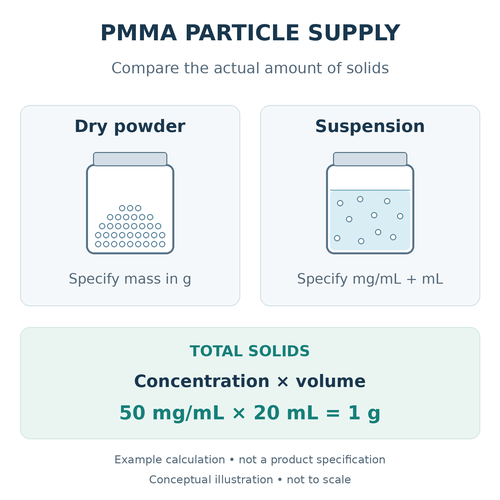
Dry powder and suspension should be compared according to the required mass of particles and the work needed to incorporate them.
Powder is quoted by mass, but its specification should still address composition, moisture or other relevant non-particle content. Suspension requires both a volume and a defined solids concentration.
For a concentration expressed in mg/mL:
Total particle solids = concentration × suspension volume
For example, 20 mL at 50 mg/mL contains 1,000 mg, or 1 g, of solids. This is a calculation example rather than a specification for a particular PMMA product.
A percentage also needs a stated basis. A 5% w/v suspension corresponds to 50 mg/mL. A 5% w/w specification describes a mass fraction and requires the suspension density to calculate solids per mL.
The preferred form depends on the process. Powder may suit direct incorporation into some material formulations. A prepared suspension may support controlled liquid dosing, provided its medium and additives are compatible.
Include losses during dispersion, washing or transfer when estimating the quantity required for a trial.
Compare quotations using the required mass of particles, then include the cost and recovery of any formulation step.
Purchasing Considerations for Russian Customers
Before an extended qualification program, confirm that the selected company or an identified purchasing channel can accept the order and supply the intended destination.
A useful inquiry should include the required polymer, target diameter, distribution, particle structure, supplied form and quantity. Add the application conditions and documentation requirements so the supplier can recommend a specific grade.
Ask for the current specification, safety data sheet and available lot documentation. Where documents use different terminology or units, resolve those differences before agreeing on the purchase specification.
Discuss sample quantities and later production needs together. A product suitable for a small experiment may have different packaging, minimum-order or lead-time arrangements at larger quantities.
Confirm storage and transport instructions for the selected material. Powder and aqueous dispersions can require different handling, and instructions from one product should not be applied automatically to another.
For recurring orders, retain a reference sample and define incoming acceptance checks. Discuss how changes to composition, formulation or manufacturing specifications will be communicated.
An alternative supplier should undergo its own evaluation. Matching the words “PMMA” and “5 μm” is insufficient to establish that two materials will perform identically in the same process.
Frequently Asked Questions
Which PMMA particle manufacturer is best for buyers in Russia?
The best choice depends on the required product and confirmed purchasing availability. Compare exact grades using composition, diameter, distribution, supplied form and application performance. The companies listed here provide candidates for evaluation rather than an independently validated ranking of quality.
Are PMMA microspheres the same as PMMA resin pellets?
No. Microspheres are selected as controlled particles with specified dimensions and morphology. Resin pellets are generally bulk polymer feedstock for processing. A pellet product should not replace a microsphere when particle geometry or distribution is important.
Is every acrylic microsphere made of PMMA?
No. Acrylic particle portfolios can include different methacrylate polymers, acrylic copolymers and modified materials. Request the composition of the specific grade. Product family names and the appearance of a white powder do not establish its polymer identity.
Does crosslinked PMMA always perform better?
No. Crosslinking changes material behavior, but the preferred grade depends on the application. A process requiring discrete particles may favor different characteristics from one requiring dissolution or controlled swelling. Evaluate the selected material under the actual processing conditions.
Does a dry powder automatically have a narrow size distribution?
No. Dry powder describes the supplied form, not the particle distribution. Powders can contain monodisperse, moderately distributed or broadly distributed particles. Ask for distribution data and relevant acceptance limits when size uniformity matters.
Can PMMA particles replace polystyrene particles directly?
Replacement requires evaluation. Polymer composition, density, surface chemistry, optical properties and solvent response can differ. Similar nominal diameters do not guarantee equivalent dispersion or material performance. Test the PMMA grade in the intended process before substitution.
What information should be included in a PMMA sample request?
Include composition, target size, distribution, crosslinking preference, morphology, surface functionality, supplied form and required quantity. For suspensions, specify concentration and medium. Add the intended application, important processing conditions and delivery destination.
Conclusion
PMMA particle selection should begin with a precise material requirement. Polymer composition, crosslinking, diameter, distribution, morphology and supplied form determine which products deserve evaluation.
For customers in Russia, the ten manufacturers and suppliers above offer different technical platforms to investigate. Confirm a specific grade and purchasing route, then evaluate it in the intended formulation or process.
A documented comparison is more useful than choosing by brand name or nominal diameter alone. Keep the accepted material specification consistent between samples, qualification trials and recurring orders.
SANYU GROUP / SHBC offers PMMA microspheres for material development and industrial applications, with discussions around particle size, crosslinking, surface modification and supplied form. Projects requiring reactive surface groups can also explore carboxyl PMMA beads.
To discuss a suitable product or sample evaluation, contact us with your target diameter, preferred powder or suspension format, processing conditions and expected quantity.
Related Blogs
-
 Overview of China’s IVD Magnetic Bead IndustryChina has developed a growing group of magnetic bead manufacturers serving chemiluminescent immunoassay, molecular diagnostics, nucleic acid extraction, protein purification, cell separation and other in-vitro diagnostic applications.IVD magnetic beads a
 -
 How Microspheres PPT Enhances Drug Delivery SystemsMicrospheres have emerged as a pivotal component in the evolution of drug delivery systems, providing distinct advantages through their unique properties. The application of Polymethylmethacrylate (PPT) microspheres in pharmaceutical formulations ha
 - Top Carboxyl Polystyrene Microsphere Suppliers Serving the US MarketCarboxyl polystyrene microspheres are widely used in in-vitro diagnostics, immunoturbidimetric assays, latex agglutination tests, lateral flow immunoassays, biomolecule conjugation, flow cytometry and scientific research.Their surfa

