


Quick Answer
Brazilian laboratories and assay developers can compare fluorescent microspheres from Thermo Fisher Scientific, Merck Estapor, Polysciences, Bangs Laboratories, Spherotech, microParticles GmbH, SANYU GROUP, micromod Partikeltechnologie, Magsphere and Cospheric.
These suppliers cover different requirements: fluorescent assay labels, functionalized polymer beads, instrument controls, imaging particles and industrial tracers. The right choice depends on the application, optical system, particle surface and required supply format.
This 2026 guide presents a purchasing shortlist. Entry numbers show the order of presentation rather than independently measured performance or Brazilian market share. Before ordering, confirm the exact product specification and the available delivery route to Brazil.
What “Serving Brazil” Means
A supplier can be relevant to Brazilian buyers without manufacturing locally. Procurement may involve a Brazilian catalogue, a distributor, a regional sales team or an international quotation.
Thermo Fisher Scientific and Merck have Brazil-specific product pages for fluorescent microspheres. Such listings help buyers identify products and enquiry channels, but they do not establish current stock or delivery time.
For specialist overseas manufacturers, confirm whether the selected product can be supplied to the receiving institution or company. Availability should be checked for the actual catalogue number, quantity and destination.
Use this guide to identify candidates, then compare written quotations and representative samples. A product family that suits one application may not suit another, even when both products are described as fluorescent beads.
Ten Fluorescent Microsphere Manufacturers and Suppliers to Compare
No. | Manufacturer or supplier | Product focus |
|---|---|---|
1 | Thermo Fisher Scientific | FluoSpheres fluorescent polystyrene microspheres |
2 | Merck Estapor | Fluorescent carboxylated particles for lateral flow assays |
3 | Polysciences | Fluoresbrite fluorescent polymer microspheres |
4 | Bangs Laboratories | Functionalized fluorescent beads and custom dyeing |
5 | Spherotech | Rainbow particles and flow cytometry controls |
6 | microParticles GmbH | Fluorescent particles in multiple materials |
7 | SANYU GROUP (SHBC) | Fluorescent polystyrene and carboxyl fluorescent microspheres |
8 | micromod Partikeltechnologie | Fluorescent polymer particles and specialized particle families |
9 | Magsphere | Fluorescent polystyrene with different surface chemistries |
10 | Cospheric | Fluorescent polyethylene particles for tracing applications |
1. Thermo Fisher Scientific
Thermo Fisher Scientific offers Invitrogen FluoSpheres fluorescent polystyrene microspheres. Its catalogue includes products with different diameters, optical properties and surface modifications. Carboxylate-modified products support biomolecule attachment, while other formulations address imaging and tracer applications.
For Brazilian buyers, Brazil-specific FluoSpheres pages provide a starting point for product identification. Check the selected product’s specification rather than applying one formulation’s properties to the whole range.
This supplier is a candidate for laboratories seeking a defined catalogue reagent. Compare excitation and emission information, concentration, surface chemistry and intended use before deciding which FluoSpheres product to test.
2. Merck Estapor
Merck’s Estapor portfolio includes fluorescent carboxylated microspheres positioned for lateral flow immunoassays. Brazil-specific Sigma-Aldrich listings include europium fluorescent particles with defined nominal size, solids concentration and surface functionality.
Estapor is relevant when the purchasing question concerns a fluorescent label for an immunochromatographic platform. Organic-dye and europium-based labels can require different excitation conditions and reader settings, so colour alone is insufficient for selection.
Ask which particle formulation matches the reader and assay architecture. Confirm the coupling approach, evaluation quantity and commercial supply conditions before moving from sample testing to a production order.
3. Polysciences
Polysciences supplies Fluoresbrite fluorescent microspheres, including carboxylated polystyrene particles. Product documentation describes these beads for applications such as phagocytosis research, cellular markers and biomolecule coupling.
The range offers candidates for researchers comparing bead size, fluorescence and surface properties. Individual products have their own concentration and optical specifications; these should be recorded alongside the catalogue number.
When selecting a research particle, distinguish the bead’s optical suitability from its compatibility with the biological experiment. Review the suspension formulation and handling instructions, then evaluate the selected particles under the actual study conditions.
4. Bangs Laboratories
Bangs Laboratories offers fluorescent microspheres based on polystyrene and magnetic particles, with options including carboxylated and streptavidin-coated surfaces. Its fluorescent portfolio also includes bead standards, and the company describes custom dyeing services.
This makes Bangs a candidate for projects needing a specific combination of fluorescence and attachment chemistry. Internally incorporated fluorophores can leave the surface available for conjugation, although the final reagent still requires application testing.
Define whether the project needs an assay label, an affinity bead or an instrument standard. These categories have different acceptance criteria, even when they share the same nominal particle diameter.
5. Spherotech
Spherotech offers fluorescent particles and flow cytometry products, including Rainbow particles used for instrument setup and alignment checks. Its catalogue distinguishes products intended for different control and measurement tasks.
For flow cytometry, selection begins with the purpose of the control: instrument monitoring, fluorescence intensity assessment, counting or compensation. A bead that produces a broad multicolour signal is not automatically suitable for every one of these tasks.
Compare the product instructions with the laboratory’s cytometer configuration and quality-control procedure. Confirm the relevant lasers, detection channels and reference information before introducing a new control into routine use.
6. microParticles GmbH
microParticles GmbH manufactures fluorescent nano- and microspheres using particle materials including polystyrene, PMMA, melamine resin and silica. Its product information describes different fluorochromes, fluorescence intensities and chemical or biochemical surface modifications.
The company is a candidate when material selection is central to the experiment, or when a standard fluorescent polystyrene bead does not meet the required conditions. Its fluorescent offerings span different spectral regions, with project enquiries available for additional dye requirements.
Specify the dispersion medium, optical system and attachment chemistry together. Material, dye and surface functionality must be evaluated as one product specification rather than as independent catalogue choices.
7. SANYU GROUP (SHBC)
SANYU GROUP supplies fluorescent polystyrene microspheres and fluorescent carboxyl polystyrene microspheres for bioassay, diagnostic-development and research applications. Its product categories include several fluorescent colours and surface options.
Carboxyl fluorescent particles are relevant to developers who require a fluorescent label with a surface suitable for biomolecule coupling. Selection should begin with the required particle diameter, excitation and emission properties, solids concentration and suspension formulation.
For Brazilian enquiries, provide the reader specifications, application and evaluation quantity so that the appropriate product or customization request can be reviewed. Available documentation should be confirmed for the selected model and batch.
A useful enquiry identifies both the technical target and the purchasing requirement: sample volume, anticipated repeat demand, packaging and delivery destination. If additional performance data are needed, agree which tests are available and which will be performed during customer evaluation.
8. micromod Partikeltechnologie
micromod offers fluorescent particle families, including micromer-F polystyrene and polymethacrylate particles. The micromer-F portfolio includes red and green fluorescent products, with options such as carboxyl groups, amino groups and streptavidin surfaces.
Its broader fluorescent catalogue is relevant to specialized particle research and biomolecule-attachment projects. The required material and surface chemistry should be selected before comparing nominal particle sizes.
For a custom or less common formulation, define the experiment’s medium, detection method and ligand. Request the corresponding product information and supply conditions rather than assuming that every combination of material, colour and functional group is commercially available.
9. Magsphere
Magsphere’s catalogue includes fluorescent polystyrene particles with plain, aminated and carboxylated surfaces. The company also describes custom synthesis for requirements outside its standard product listings.
This supplier is a candidate for projects that need fluorescent latex with a specified surface chemistry or a nonstandard particle requirement. Its product information distinguishes fluorescent particles from visibly dyed latex and magnetic products.
Include the required excitation and emission properties in the enquiry rather than requesting only a colour name. For larger quantities, confirm the proposed formulation, documentation and commercial terms after the evaluation material has been identified.
10. Cospheric
Cospheric supplies fluorescent polyethylene microspheres in different sizes, colours and densities. Its products include particles intended for flow visualization, particle image velocimetry and other tracer applications.
This is a different purchasing category from aqueous carboxylated latex used for antibody conjugation. For a tracer experiment, density, dispersibility and optical visibility may be more important than biomolecule coupling.
Specify the fluid, flow conditions and particle-size range when selecting a tracer. Confirm the dispersion procedure and density requirement for the actual experiment. An industrial fluorescent powder should be evaluated against tracer requirements rather than substituted directly into a diagnostic assay.
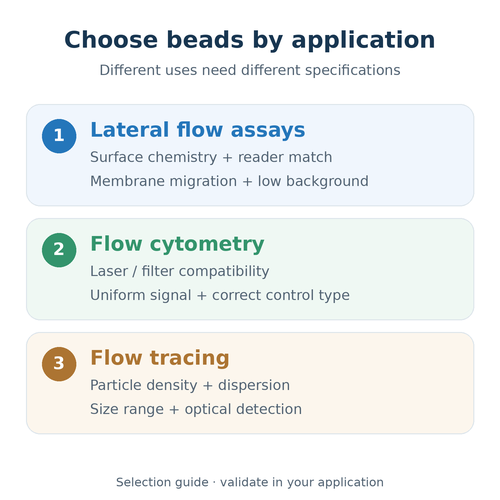
Choosing Beads for Your Application
Lateral Flow and Fluorescent Immunoassays
A fluorescent label must work through the complete assay process. Evaluate reader compatibility, antibody attachment, dispersion stability, release from the conjugate pad and migration through the membrane.
A bright bead suspension can still produce weak assay performance if the conjugate releases poorly or generates excessive background. Compare candidates after conjugation and under the same test-strip conditions.
For quantitative assays, examine both low-concentration samples and the usable measurement range. The preferred particle is the one that supports reproducible assay performance with the selected membrane, antibody and reader.
Flow Cytometry and Instrument Controls
Identify the control task before selecting a bead. Alignment particles, intensity standards, counting beads and compensation controls are designed for different purposes.
Compare particle detectability and fluorescence with the cytometer’s lasers and filters. If quantitative reference values are required, use a product documented for that measurement.
For compensation, choose controls appropriate to the fluorophore used in the sample. Generic fluorescent particles cannot be assumed to reproduce the sample’s emission behaviour merely because they appear to have a similar colour.
Imaging, Cell Studies and Flow Tracing
For microscopy, compare excitation, detection, particle visibility and dispersion in the imaging medium. For cell studies, also review surface chemistry and the suspension components that may affect the experiment.
For flow tracing, select particles that can be detected without materially compromising the intended measurement. Density, size and dispersion all influence suitability.
Keep the application endpoint explicit. A particle selected for membrane migration, cellular uptake or fluid tracking will be qualified differently from a particle selected as an instrument reference.
Seven Specifications to Compare Before Ordering
1. Particle Diameter and Measurement Method
Request the nominal size, the measured result and the method used. Microscopy and dynamic light scattering do not necessarily report the same diameter: DLS measures hydrodynamic behaviour in a liquid, while microscopy can examine particle dimensions directly.
Record whether a distribution is reported by number, volume or scattering intensity. Compare results obtained using compatible methods and conditions.
Do not treat particle-size CV and DLS PDI as interchangeable specifications. Ask the supplier to identify how each reported value was calculated.
2. Excitation and Emission Compatibility
A colour name does not define an optical specification. Request excitation and emission information, then compare it with the instrument’s light source and detection filters.
Two green fluorescent products can respond differently on the same reader. Likewise, an organic-dye bead and a europium fluorescent bead may require different detection arrangements.
Assess brightness using the intended instrument and an agreed particle concentration. Comparisons made with different reader settings, concentrations or acquisition times may not indicate which particle will perform better in the application.
3. Fluorescence Intensity and Uniformity
Particle-size uniformity and fluorescence uniformity describe different properties. A narrow size distribution does not by itself establish a narrow distribution of fluorescent signal.
Where relevant, request intensity-distribution information or a defined reference comparison. For instrument controls, this can be central to interpreting a bead population.
For assay labels, compare the final conjugate’s signal and background. Specify the measurement settings so that repeat batches can be compared meaningfully rather than judged from photographs or visual appearance.
4. Dye Retention and Light Exposure
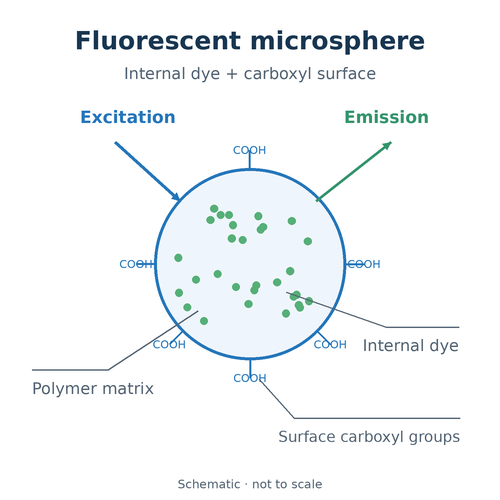
Confirm whether the fluorescent material is incorporated inside the particle or attached to its surface. Internal incorporation can preserve surface sites for conjugation, but fluorescence stability still depends on the product and experimental conditions.
During evaluation, compare the particles before and after the relevant processing steps. If dye release is a concern, examine the separated liquid using a suitable measurement method.
Assess the anticipated buffer, handling and illumination conditions. A stability result obtained in one medium should not automatically be extended to another formulation.
5. Surface Chemistry and Biomolecule Attachment
Choose the surface according to the attachment strategy. Carboxylated particles can support carbodiimide-mediated coupling to molecules with available primary amines; some workflows also use NHS or sulfo-NHS.
The coupling conditions still need optimization for the selected particles and biomolecule. Surface carboxyl content alone does not establish antibody activity, coupling efficiency or assay sensitivity.
For streptavidin-coated beads, confirm the intended biotinylated ligand and available binding information. Evaluate the completed reagent rather than selecting solely from the name of the surface group.
6. Solids Concentration and Usable Quantity
Compare how much particle material is supplied, not only the bottle volume. Ask whether concentration is expressed as mass per volume, percentage by mass or another basis.
For example, 1% w/v equals 10 mg/mL. A 10 mL bottle at that concentration contains 100 mg of particle solids. A percentage expressed as w/w requires a different calculation if the supplied quantity is measured by volume.
Include recovery during washing and conjugation when estimating usable material. Equal bottle volumes do not necessarily support equal numbers of experiments.
7. Suspension Formulation and Storage
Request the dispersion medium and available information about surfactants, preservatives or other additives. These components can affect coupling, biological experiments and assay formulation.
Use the product-specific storage and transport instructions. Many aqueous fluorescent beads require light protection and refrigerated storage, but one condition should not be applied to every fluorescent material.
Record any dilution, buffer exchange or handling performed during evaluation. This helps distinguish a formulation problem from a difference between particle batches.
Purchasing Fluorescent Microspheres for Delivery to Brazil
Obtain a written quotation for the exact product, quantity and receiving destination. Confirm the delivery route, lead time, packaging and transport conditions before arranging payment.
Separate product price from freight and other applicable shipment costs. For aqueous suspensions, compare cost against the supplied particle solids as well as the bottle volume. For custom products, establish the evaluation stage and repeat-order specification before committing to a larger quantity.
Prepare the receiving information and agree which documents will accompany the shipment. These may include a commercial invoice, packing list, product specification, safety data sheet and certificate of analysis where available. Confirm the requirements with the receiving organization and logistics provider for the actual shipment.
For recurring purchases, retain the approved product specification and reference sample results. A clear reorder specification makes it easier to discuss formulation changes, repeat performance and future supply requirements.
A Practical Sample Qualification Workflow
Define acceptance criteria. Identify the optical settings, application endpoint and minimum information needed to compare candidates. Establish the criteria before reviewing sample results.
Check the incoming material. Review the label, formulation and available batch documentation. Record how the suspension is mixed and diluted for testing.
Test the optical response. Measure candidates under the same instrument conditions, using concentrations appropriate to the comparison. Include a background measurement.
Run the application process. For assay labels, perform conjugation and the intended assay. For instrument controls or tracers, use the relevant operating procedure.
Review repeatability. Repeat important measurements and, where needed, compare additional lots. Use the findings to define the purchasing specification.
Keep a simple record linking each result to the catalogue number, batch and preparation method. When troubleshooting, change one relevant factor at a time where practical.
Information to Include in a Fluorescent Microsphere RFQ
A clear request for quotation should include:
Application and intended evaluation.
Preferred particle material.
Required diameter and acceptable distribution.
Excitation source and emission detection range.
Surface group or biological coating.
Required concentration and suspension medium.
Additive restrictions, if relevant.
Sample quantity and expected repeat demand.
Required documents and additional test information.
Delivery city and postal code in Brazil.
If a specification is still being developed, describe the instrument and desired result. This allows the technical discussion to focus on suitable candidate products rather than an unnecessarily broad request for fluorescent beads.
Frequently Asked Questions
Are All These Manufacturers Located in Brazil?
No. This guide includes international manufacturers and suppliers relevant to Brazilian purchasing enquiries. Confirm local distribution, international ordering and delivery conditions for the selected product.
Which Fluorescent Microspheres Should I Choose for Lateral Flow?
Begin with reader-compatible fluorescence and a suitable attachment surface. Then compare conjugation, membrane migration, conjugate-pad release, signal and background in the intended assay. There is no single size or colour that is optimal for every platform.
Can Carboxyl Fluorescent Microspheres Bind Antibodies?
Carboxyl groups can be activated for covalent coupling to available primary amines on antibodies. The resulting antibody activity and reagent stability depend on the coupling and assay conditions, so they require evaluation.
Are Fluorescent Microspheres Also Magnetic?
Fluorescence and magnetism are separate properties. Standard fluorescent polymer beads should not be assumed to respond to a magnet. Select a product specifically identified as fluorescent and magnetic when both properties are required.
Can Generic Fluorescent Beads Replace Flow Cytometry Standards?
Only if the replacement meets the requirements of the intended control or measurement. A visibly fluorescent bead does not automatically provide the reference properties needed for calibration, counting or compensation.
Can SANYU GROUP Review Custom Fluorescent Particle Requests?
Yes. Provide the desired particle size, fluorescence properties, surface chemistry, concentration and packaging. The technical team can review the request and confirm the available specification, evaluation quantity and documentation.
Should I Request a COA Before Buying?
Request available product and batch information before purchasing. A COA may report selected tested parameters, but it does not necessarily include every performance measurement relevant to your experiment. Use sample evaluation to address application-specific requirements.
Conclusion
Selecting fluorescent microsphere suppliers for Brazil begins with matching the particle to the application. The ten companies in this guide cover several purchasing categories, including fluorescent assay labels, functionalized beads, instrument controls and industrial tracers.
Compare the exact diameter specification, optical response, surface chemistry, concentration and formulation. Confirm the supply route and evaluate representative samples under the intended operating conditions before approving a product for repeat use.
For product enquiries, SANYU GROUP offers fluorescent microspheres and fluorescent carboxyl polystyrene microspheres for diagnostic-development and research projects. To discuss particle selection, customization requirements and delivery to Brazil, contact our technical team with your application, instrument specifications and required quantity.
Related Blogs
-
 Overview of China’s IVD Magnetic Bead IndustryChina has developed a growing group of magnetic bead manufacturers serving chemiluminescent immunoassay, molecular diagnostics, nucleic acid extraction, protein purification, cell separation and other in-vitro diagnostic applications.IVD magnetic beads a
 -
 How Microspheres PPT Enhances Drug Delivery SystemsMicrospheres have emerged as a pivotal component in the evolution of drug delivery systems, providing distinct advantages through their unique properties. The application of Polymethylmethacrylate (PPT) microspheres in pharmaceutical formulations ha
 - Top Carboxyl Polystyrene Microsphere Suppliers Serving the US MarketCarboxyl polystyrene microspheres are widely used in in-vitro diagnostics, immunoturbidimetric assays, latex agglutination tests, lateral flow immunoassays, biomolecule conjugation, flow cytometry and scientific research.Their surfa

