


Silica Magnetic Beads in Automated DNA and RNA Extraction
Silica magnetic beads combine a nucleic acid-binding surface with a magnetic component that enables particle collection. Under suitable buffer conditions, DNA or RNA binds to the surface, remains associated during washing, and is released into an elution solution.
Automation controls how samples, particles and reagents move through this process. A useful bead grade must therefore work with both the extraction chemistry and the instrument's handling method.
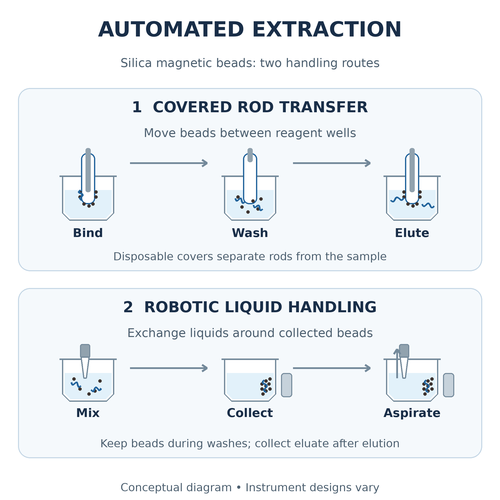
Two common architectures are magnetic particle transfer and robotic liquid handling with a magnet. The first moves beads between reagent locations. The second exchanges liquids while particles are collected in a processing vessel.
Silica coating alone does not establish compatibility with an automated extractor. Evaluate the selected grade with the actual sample, buffers, consumables and instrument settings. This guide explains the handling requirements and a practical approach to developing that combination.
Two Common Automation Architectures
Magnetic Particle Transfer Systems
Common magnetic rod processors use disposable covers or tip combs between the magnetic rods and the sample. Particles collect on the outside of the cover and can then be transferred into another reagent well.
At the required stages, the magnetic rods are withdrawn from the covers so that particles can be released and mixed in the next solution. Collection, transfer and release are repeated through the method.
Evaluate how completely the beads collect, release and redisperse with the intended consumables. Also assess residual liquid carried between stages and any particles left behind.
Following elution, the system can collect and remove the beads from the elution well, leaving purified nucleic acid in the liquid. Subsequent liquid transfer depends on the instrument and workflow. It should not be assumed to occur automatically.
Robotic Liquid Handling with a Magnet
A liquid handler dispenses reagents and removes liquids from tubes or plates. During separation, a magnet retains the bead fraction so that the robot can aspirate supernatant or wash solution.
Mixing may use pipetting, shaking or another available mechanism. The vessel and magnet must be positioned so that particles can disperse when required and collect reliably before aspiration.
Pellet location matters. A magnet can place particles near a wall, around a region of the well or toward its bottom. Aspiration coordinates and liquid-handling settings should account for that collected fraction.
Assess dispensing consistency, resuspension, collection and particle loss during liquid removal. After elution, collect the beads again and transfer the liquid as specified by the method.
Cartridges and prefilled reagent plates describe packaging or consumable formats. They may incorporate different particle- or liquid-handling mechanisms. Identify the actual mechanism before choosing a bead grade or modifying the process.
Comparing the Two Handling Routes
The table describes common arrangements rather than fixed specifications for every instrument. Some platforms combine multiple mechanisms.
Factor | Magnetic Particle Transfer | Robotic Liquid Handling |
|---|---|---|
Main movement | Beads move between reagent locations | Liquids are dispensed and removed |
Common collection interface | Magnetic rods inside disposable covers | External magnet acting on a tube or plate |
Mixing requirement | Release and redistribution in reagent wells | Resuspension by the available mixing mechanism |
Critical collection check | Particle pickup and transfer completeness | Particle retention during aspiration |
Important consumable details | Cover, comb and reagent well geometry | Vessel, tips, reservoir and magnet geometry |
Wash handling | Transfer particles into the specified wash stages | Add, mix and remove wash liquids |
Elution endpoint | Remove collected beads from the eluate where specified | Collect beads and transfer the eluate |
Method transfer | Confirm the instrument-specific particle movement | Confirm dispensing, mixing and aspiration settings |
The schematic compares two common automation routes: moving silica magnetic beads between reagent wells, and exchanging liquids around magnetically collected beads. The upper route shows covered magnetic rods, while the lower route shows robotic pipetting. Both require matched reagents, effective mixing and controlled final bead separation.
The Extraction Chemistry Remains Essential
Both architectures must establish the same chemical goals: release the target from the sample, bind it to the particles, remove contaminants and recover it into a useful eluate.
A general sequence includes:
Prepare and lyse the sample. Perform the sample-specific treatment on or off the instrument as required.
Create binding conditions. Combine the sample, particles and reagents in the specified order, with suitable mixing.
Collect the particles. Establish the magnetic collection needed for bead transfer or liquid removal.
Wash the bead fraction. Exchange solutions or move particles through the required wash stages.
Remove residual wash solution. Follow the method-specific handling before elution.
Elute and separate. Release DNA or RNA, recollect particles, and retain the intended liquid fraction.
A raw bead suspension supplies the solid phase, not the complete extraction formulation. Buffer requirements, sample limits and treatment steps must be established for the chosen method.
RNA purification may include DNA removal and subsequent rebinding. Long DNA or short cell-free fragments can require different preparation and handling. The automated procedure should preserve the target characteristics required downstream.
Bead Properties to Evaluate for Automation
Evaluate properties using relevant conditions and clearly defined measurement methods.
Property | Development Check |
|---|---|
Particle size and distribution | Confirm the reported method and assess collection, dispersion and carryover in the workflow |
Magnetic behavior | Test pickup or retention using the actual magnet, vessel, liquid volume and sample conditions |
Surface and formulation | Confirm the exposed chemistry, suspension medium and compatibility with the binding method |
Stock concentration | Record the reporting basis and particle dose introduced per sample |
Sedimentation | Assess suspension uniformity over the dispensing period |
Redispersion | Check recovery of a usable suspension after magnetic collection and each treatment |
Functional recovery | Measure final target recovery and downstream suitability |
Lot consistency | Compare relevant attributes and workflow performance across additional lots |
Nominal diameter alone does not determine performance. Magnetic material, surface design, aggregation, suspension composition and instrument geometry also contribute.
Likewise, a collection time measured in water does not establish the appropriate setting in a sample lysate. Evaluate the bead in the working formulation and verify the later stages as well as initial capture.
Consistent Bead Dispensing Across a Batch
The bead dose should remain consistent throughout loading. Settling in a stock bottle or reservoir can change the suspension delivered to different samples.
Use the supplier's resuspension method, then establish the mixing needed during dispensing. Evaluate the actual delay between mixing and aspiration, the reservoir geometry and the dispensing sequence.
Compare the beginning, middle and end of a batch. A visually uniform stock at the start does not establish uniform delivery after a prolonged dispensing period.
Document whether dose is defined as stock suspension volume, prepared reagent volume or particle mass. Retain the stock concentration and formulation details.
Changing concentration to reduce fill volume can also change the amount of suspension medium introduced and the ease of mixing. Test such changes as part of the complete extraction method.
These checks are relevant both to laboratory loading and to preparation of prefilled reagent products.
Collection, Release and Redispersion
Magnetic collection and redispersion are separate performance questions. A bead fraction can collect successfully but fail to return to a useful suspension under the next stage's conditions.
For particle-moving instruments, assess pickup onto the cover, transfer into the next well and release after magnetic withdrawal. Examine whether particles remain on the cover or in the previous reagent well.
For liquid handlers, assess retention during aspiration and resuspension after the next reagent is added. Account for the pellet location and the mixing approach available.
Perform these checks in binding solution, wash solution and elution solution. Behavior can change as the liquid composition and particle-associated material change.
Do not select a bead solely because its initial movement toward a magnet is rapid. The complete sequence must preserve target recovery, contaminant removal and final separation.
If dispersion is incomplete, investigate both the bead formulation and the mixing or release settings. Increasing collection time alone does not resolve every handling problem.
Vessel Geometry and Liquid Handling
The vessel and magnetic assembly determine where particles collect relative to the aspiration path. Tip position, aspiration speed and residual volume should be established for that configuration.
Inspect the collected fraction in the actual consumables. A setting that works in one plate may disturb particles or leave excessive liquid in another geometry.
Residual volume matters because it changes how much previous solution enters the next stage. In a particle-transfer workflow, liquid can also accompany the wet particle fraction or cover. Bead movement does not establish zero reagent carryover.
Evaluate the collected eluate volume rather than assuming it equals the amount of elution buffer added. Retained liquid, transfer losses and evaporation can affect the final volume.
When changing plastics, tips, covers or magnets, review the affected settings and compare the resulting recovery and purity. Consumable changes can alter a method even when the bead grade remains the same.
Binding, Washing and Elution on the Instrument
Automation must reproduce the conditions needed by the chemistry, including addition order, mixing, incubation and the required temperature control.
During binding, verify that sample and reagents contact the particles throughout the liquid. During washing, check the resuspension or rinse behavior required by the method. During elution, provide the conditions needed to release the target.
Use the prescribed residual-wash removal procedure. Alcohol carryover and excessive drying can affect the result, but there is no single drying duration appropriate for every system.
Consider how reagent exposure changes during a run. Open reservoirs, heated stages and extended handling can affect volumes or composition. Examine these factors under the intended run conditions.
For a prefilled plate or cartridge, assess the prepared formulation and consumable together over the intended storage and handling period. Performance of a freshly mixed bead suspension does not establish stability of a stored reagent product.
Developing an Automated Extraction Method
Establish a Reference Result
Define the sample, target and downstream requirements. Use a suitable manual or established instrument method as the reference, and record input and collected elution volume.
Set acceptance criteria before comparing candidates. Include recovery, downstream usability, handling consistency and relevant target integrity or fragment range.
Check the Mechanical Stages
Screen dispensing, collection, release and resuspension in relevant solutions. Simple test materials can help locate mechanical issues before processing valuable samples.
Then repeat the assessment with representative sample conditions. A particle-transfer check in a clean buffer cannot establish collection behavior in a viscous lysate.
Evaluate the Complete Chemistry
Process samples through the full workflow using suitable controls. Investigate stage-specific losses where possible, rather than changing several variables together.
Record changes in bead dose, buffer amounts, mixing, collection and elution. Each comparison should have a defined purpose and a consistent reporting basis.
Confirm Batch Performance
Test the sample range and loading patterns relevant to the intended use. Include the expected processing scale, representative well positions and suitable blanks.
Compare additional lots when qualifying a supply choice. Retain the final method settings, instrument configuration, consumable identities and reagent preparation instructions so the result can be reproduced.
Quality Checks Across a Plate or Batch
An average recovery value can conceal position-dependent variation. Examine individual results as well as the batch summary.
Check | What It Helps Assess |
|---|---|
Reference samples at relevant positions | Consistency across the processing layout |
Extraction blanks | Contamination introduced during extraction |
Appropriate positive and neighboring blank patterns | Potential sample-to-sample carryover |
Suitable process or amplification controls | Target loss or downstream inhibition |
Collected volume measurements | Transfer consistency and concentration interpretation |
Particle residue assessment | Final magnetic separation and bead carryover |
Use layouts that reflect the planned workload. Edge positions, dispensing order or changing sample viscosity are possible factors to investigate when a pattern appears; they should not be assumed to be the cause without testing.
For quantitative comparisons, distinguish concentration from recovered amount. Interpret amplification results with appropriate controls, because inhibition and target loss can both affect the signal.
The acceptance criteria should reflect the method's purpose. Avoid treating a single purity ratio or one successful sample as complete evidence of suitability.
Troubleshooting Automated Bead Handling
Observation | Areas to Investigate | Useful Starting Check |
|---|---|---|
Different results across the dispensing sequence | Stock settling, mixing or delivery variation | Compare suspension input and reference sample results from early and late positions |
Particles left on a cover | Release settings, aggregation or reagent compatibility | Inspect release and redistribution in the relevant solution |
Beads lost during aspiration | Incomplete collection or an unsuitable aspiration path | Inspect the pellet and liquid-removal settings |
Low recovery with poor purity | Incomplete dispersion, washing or liquid removal | Check mixing and retained liquid through the wash stages |
Visible bead residue in eluate | Final collection, particle removal or transfer disturbance | Assess the final separation in the selected consumables |
Blank contamination | Loading, transfer, splashing or reagent contamination | Review blank patterns and isolate the affected handling stage |
Confirm a suspected cause before changing the method. A bead substitution, longer collection or stronger mixing may help one problem while changing another part of the process.
Evaluate the final eluate after adjustments. Improved visual particle collection is useful information, but the target and downstream assay remain the functional measures.
Choosing a SANYU Silica Magnetic Bead Grade
SANYU offers silica magnetic bead materials for nucleic acid extraction development. Select a candidate according to the intended chemistry and automated handling requirements.
For a technical discussion, provide:
The instrument model and particle- or liquid-handling mechanism.
Sample matrix, input volume and target DNA or RNA.
Proposed binding, wash and elution conditions.
Plate, tube, cartridge and magnetic consumable details.
Expected processing scale and dispensing sequence.
The evaluation method, reference product and acceptance criteria.
Request the specification and available documentation for the exact grade. Confirm suspension concentration, medium, particle information and recommended starting handling.
A candidate can then be assessed for dispensing, collection, redispersion and functional recovery. Agree any customization or production specification for the selected material after the project requirements are clear.
Compatibility should be established for the tested combination of bead, formulation, consumables and instrument method.
Frequently Asked Questions
Are All Silica Magnetic Beads Compatible with Automated Extractors?
Compatibility depends on the bead grade, formulation, consumables and instrument settings. Silica coating provides relevant surface chemistry, but collection, dispensing, release and recovery must be assessed in the complete workflow.
How Do Magnetic Rod Systems Differ from Liquid Handlers?
Common rod systems use covered magnetic rods to collect and transfer particles between reagents. Liquid handlers exchange liquids around particles held by a magnet. Their collection and transfer settings address different handling requirements.
Does Faster Magnetic Collection Guarantee Better Extraction?
No. Evaluate release, redispersion, washing, elution and downstream performance as well. Rapid initial collection does not establish that the complete method produces acceptable recovery or purity.
How Can Bead Settling Affect an Automated Run?
Settling can change the suspension delivered during loading. Establish stock mixing and dispensing conditions, then check consistency across the actual sequence. The appropriate approach depends on the suspension and hardware.
Can One Automated Method Purify Both DNA and RNA?
Some methods recover both targets, while others use selective conditions or nuclease treatments. Confirm the target, sample and required fragment recovery before applying one script to different extraction purposes.
How Should Bead Carryover into the Eluate Be Reduced?
Review final collection and particle-removal settings. For pipetting systems, also assess aspiration position and transfer behavior. Confirm the result in the actual consumables and check downstream performance after any adjustment.
Can SANYU Beads Replace a Component in an Existing Automated Method?
A selected grade can be evaluated against the existing method. Compare dispensing, collection, release, recovery and purity with suitable controls. Matching a surface label or nominal size alone does not establish equivalent performance.
Conclusion
Silica magnetic beads support automated nucleic acid extraction when their binding chemistry and handling behavior match the method. Particle-transfer systems require reliable pickup, release and redistribution. Liquid-handling systems require consistent dispensing, magnetic retention and controlled aspiration. Both need effective washing, elution and assessment of the final liquid fraction.
Explore our silica magnetic beads and review how to choose silica magnetic beads when planning a SANYU evaluation. Use our magnetic bead nucleic acid extraction protocol to outline the process, then share your instrument, samples, targets, buffers and processing scale when you contact our technical team so that we can discuss suitable candidates and a testing plan.
Related Blogs
-
 Quick Answer: How to Dehydrate Silica BeadsThe safest general method for dehydrating loose silica gel beads is to spread them in a thin, even layer and heat them in a ventilated electric oven at approximately 105–120°C, or 221–248°F. Begin checking the beads after about two hours and continue drying
 -
 Magnetic Bead Extraction Troubleshooting: Quick Diagnostic GuideMost magnetic bead nucleic acid extraction failures can be traced to one of seven stages:Sample preparation;Lysis;Nucleic acid binding;Magnetic collection;Washing;Bead drying;Elution and measurement.Do not change several variables at th
 -
 Silica Magnetic Beads for cfDNA Extraction: Quick AnswerSilica magnetic beads isolate cell-free DNA, or cfDNA, through a reversible bind–wash–elute process.A biological fluid such as plasma is first treated to release short DNA fragments from proteins, vesicles and other sample components. Binding s
 - Silica Magnetic Beads for Viral RNA and DNA Extraction: Quick AnswerSilica magnetic beads are used to isolate viral RNA and DNA through a reversible bind–wash–elute process.First, a lysis buffer disrupts the viral particle and releases its nucleic acid. Binding salts, and often alcohol, then create

