


Overview of Microsphere Manufacturers for Lateral Flow Assays
Microsphere manufacturers supply the colored and fluorescent particles used as reporter labels in many lateral flow assays. Selecting a manufacturer involves matching particle chemistry, optical properties and supply conditions to the complete test system.
For a visual rapid test, the priorities may include strong color contrast, reliable conjugate release and low membrane background. For a quantitative fluorescent assay, excitation wavelength, emission filters, fluorescence lifetime and reader calibration also matter.
This guide reviews ten manufacturers with relevant microsphere portfolios: Merck Estapor, Bangs Laboratories, SANYU GROUP, Thermo Fisher Scientific, Polysciences, Magsphere, VDO Biotech, PolyMicrospheres, Spherotech and ACME Microspheres.
The useful question is which specific particle gives reproducible performance with your antibodies, membrane, sample matrix and manufacturing process. A manufacturer’s broad catalog is a starting point for that evaluation.
How This Manufacturer Shortlist Was Prepared
The comparison uses manufacturer-published product information available in 2026. It considers colored or fluorescent particle availability, surface chemistry, stated lateral flow relevance and opportunities for application-specific development.
The entry numbers help readers navigate the guide. They do not represent measured market share or results from independent comparative testing.
This guide is published by SANYU GROUP and includes our own portfolio alongside other manufacturers. Product descriptions should be assessed together with the current technical data and results from your assay.
Some companies explicitly identify lateral flow products. Others offer broader diagnostic or research microspheres that may be candidates for screening. For those broader portfolios, confirm the intended application and test the selected grade on the strip.
Quick Comparison of the 10 Manufacturers
No. | Manufacturer | Relevant published portfolio | Main evaluation focus |
|---|---|---|---|
1 | Merck Estapor | Colored, fluorescent and europium microspheres | Established LFA grades and application data |
2 | Bangs Laboratories | Dyed latex, carboxyl and streptavidin particles, europium labels | Comparing label and attachment options |
3 | SANYU GROUP / SHBC | Colored carboxyl, fluorescent and time-resolved fluorescent microspheres | Standard and custom specifications for IVD and POCT projects |
4 | Thermo Fisher Scientific | Fluoro-Max europium-chelate particles with carboxylate or streptavidin surfaces | Optical and timing compatibility with the reader |
5 | Polysciences | Dyed and carboxylated polystyrene microspheres | Color, size and surface selection |
6 | Magsphere | Red and blue latex, including carboxylated particles | Visual rapid-test labels and formulation compatibility |
7 | VDO Biotech | Dyed, fluorescent and time-resolved fluorescent microspheres | LFA-focused product selection and scale-up discussion |
8 | PolyMicrospheres | Diagnostic polymer particles, dyed and fluorescent formats, specialized surfaces | Custom surface and conjugation requirements |
9 | Spherotech | Colored, fluorescent, functionalized and coated particles | Selecting a suitable membrane-assay grade |
10 | ACME Microspheres | Dyed, fluorescent, functionalized and coated microspheres | Product-specific LFA screening and supply qualification |
Bangs Laboratories and Polysciences belong to the Ott Scientific family of companies. They offer distinct portfolios, but buyers seeking an independent backup source should consider that shared group relationship.
1. Merck Estapor
Estapor is Merck’s microsphere portfolio for diagnostic and related applications. Relevant options include carboxylated colored particles, fluorescent particles and europium-containing labels.
Red Intense products include nominal 300 nm and 400 nm formats. Merck has published an HBsAg lateral flow model comparing these sizes. In that model, the smaller particles developed a signal faster, while the larger particles produced somewhat stronger visible lines.
Those findings are useful application examples rather than a universal rule for all antibodies or membranes. They demonstrate why signal intensity and development time should be evaluated together.
Evaluation focus: Compare the selected grade’s diameter, functional-group content and optical characteristics with your assay requirements. Use the published conjugation guidance as a development reference and verify performance after drying on your chosen pad.
2. Bangs Laboratories
Bangs Laboratories publishes a dedicated lateral flow microparticle portfolio. It includes visibly dyed polystyrene, dyed carboxyl polystyrene, dyed streptavidin-coated particles and europium-chelate labels.
Its carboxyl europium range includes nominal 100 nm, 200 nm, 300 nm and 400 nm particles. These products support evaluation of long-lifetime fluorescence and covalent ligand attachment.
The range is relevant when an assay team wants to compare passive adsorption, direct carboxyl coupling and attachment through biotinylated ligands. The company’s technical library also provides information on lateral flow formats and particle conjugation.
Evaluation focus: Select the label and surface independently. Confirm biotin-binding capacity for streptavidin grades, coupling behavior for carboxyl grades and reader compatibility for europium particles. Check the exact product’s intended-use and commercial supply terms.
3. SANYU GROUP / SHBC
SANYU GROUP supplies functional microspheres under the SHBC brand for diagnostic development, POCT and research applications. Our relevant range includes colored carboxyl polystyrene microspheres, fluorescent microspheres and rare-earth time-resolved fluorescent microspheres.
Colored carboxyl particles provide visible reporter options, while fluorescent products support reader-based detection. Published green fluorescent options include excitation at 470 nm or 488 nm with emission around 525 nm. The time-resolved fluorescent range lists UV excitation around 360–365 nm and emission around 615 nm.
These spectral examples describe different product types. The exact grade should be matched to the reader’s source, filters and measurement settings.
Standard and custom projects can address particle size, visible or fluorescent color, surface functionality, solids concentration and packaging. Product selection can begin with samples for conjugation and strip screening before moving to a larger supply program.
Evaluation focus: Tell our technical team the target analyte, sample matrix, assay format, reader wavelengths and preferred coupling method. Agree on the available specifications and documentation, then evaluate the conjugated particles under your own drying, storage and test conditions.
4. Thermo Fisher Scientific
Thermo Scientific Fluoro-Max products include europium-chelate fluorescent particles intended for membrane and automated fluorescence applications. Carboxylate-modified grades are listed in nominal diameters of 100 nm, 200 nm and 300 nm, and streptavidin-coated options are also available.
The europium-chelate format has a long fluorescence lifetime and supports time-resolved measurements. It should be distinguished from a conventional short-lifetime fluorescent bead when selecting an instrument.
The published specifications for relevant carboxylate products include excitation around 333 nm and emission around 613 nm. These values illustrate why readers cannot be matched solely by the description “red fluorescent.”
Evaluation focus: Confirm excitation efficiency, emission collection and time-gating capability for the exact particle. Check the current regional product listing, package size and manufacturing-use terms before qualifying a supply route.
5. Polysciences
Polysciences offers dyed and functionalized polymer particles, including Polybead products and dyed carboxylate polystyrene microspheres. Its current dyed carboxylate collection explicitly identifies lateral flow assay development among the applications.
The portfolio allows developers to screen visible colors, particle sizes and carboxylated surfaces. A covalent coupling option can be useful when stable attachment of antibodies or other ligands is required.
The catalog also serves applications outside lateral flow, so the selected particle’s size and formulation should be checked against membrane migration requirements.
Evaluation focus: Compare candidate grades on the actual membrane. Record pad release, background staining and test-line response after conjugation and drying. Evaluate the product itself rather than assuming that every dyed particle in the broader catalog behaves identically on a strip.
6. Magsphere
Magsphere offers colored polystyrene latex particles, including red and blue carboxylated formats. Its product information directly identifies their use in rapid lateral flow tests and notes 300 nm and 400 nm particles as commonly used options.
The company also describes customizable color intensity. This makes its colored latex relevant to projects comparing visual contrast while maintaining a selected particle and surface format.
Its broader portfolio includes surface-modified and surfactant-free products. Availability and formulation should be confirmed for the particular colored grade being considered.
Evaluation focus: Request the suspension composition and relevant functional-group specifications. Compare visible intensity at a consistent delivered particle dose, then check aggregation, release and membrane retention in the working formulation.
7. VDO Biotech
VDO Biotech publishes dyed, fluorescent and time-resolved fluorescent microspheres for diagnostic applications. Its dyed product information specifically includes lateral flow, and its fluorescent range is positioned for lateral flow reagent development and production.
The time-resolved fluorescent portfolio includes carboxyl and streptavidin surface options. Published carboxyl grades include nominal 200 nm, 300 nm and 400 nm particles with excitation around 360 nm and emission around 615 nm.
These options support comparison of visible and reader-based formats within one manufacturer’s particle portfolio.
Evaluation focus: Match the exact product to the intended detection channel and attachment method. Discuss the proposed batch size, release specifications and sample-to-production comparability directly rather than converting general capacity statements into an assumed number of finished tests.
8. PolyMicrospheres
PolyMicrospheres specializes in polymer microspheres for immunodiagnostic applications. Its published portfolio includes plain and carboxyl particles, fluorescent and dyed formats, and specialized surface options.
Near-Soap-Free carboxyl particles and ready-to-couple chloromethyl or epoxy particles are among the technologies described by the company. These formats may be relevant when a team is investigating the effects of surfactants or attachment chemistry.
A specialized surface changes the development problem; it does not by itself establish successful lateral flow performance.
Evaluation focus: Confirm which dyed or fluorescent grade is proposed for the application. Compare ligand activity, nonspecific retention and migration after conjugation. For custom surfaces, agree on the specification that will be measured and controlled from batch to batch.
9. Spherotech
Spherotech manufactures SPHERO colored, fluorescent, functionalized and biomolecule-coated particles. Its technical product information describes intensely colored particles for dipstick and membrane-based assays, as well as latex agglutination.
The broader portfolio includes carboxyl and other surface chemistries together with coated particles. These options can support projects requiring a particular ligand attachment route or an existing coated reagent.
Many Spherotech products also serve flow cytometry, microscopy and instrument applications, which have different performance requirements from mobile strip labels.
Evaluation focus: Specify membrane migration as a requirement when selecting a product. Confirm suitable diameter, suspension formulation, pad release and the intended manufacturing status. A calibration particle’s brightness or uniformity alone does not establish its suitability as an LFA reporter.
10. ACME Microspheres
ACME Microspheres describes a manufacturing and supply portfolio for biomedical and diagnostic applications. Its catalog includes color-dyed, fluorescent, functionalized and coated particles, with custom OEM particle capabilities described in its company information.
The range can provide candidates for projects investigating particular colors, surface groups or coating requirements. Its broader diagnostic positioning should be followed by a discussion of the specific lateral flow use case.
Evaluation focus: Confirm the selected product’s manufacturing source, specifications and available lot size. Request application-relevant information and evaluate the particle on the strip. For a custom program, agree on how the development sample and later production material will be compared.
How Microsphere Labels Work in a Lateral Flow Strip
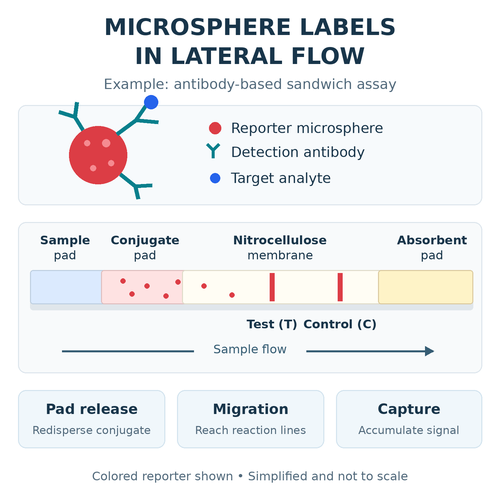
In a typical antibody-based sandwich assay, the reporter microsphere carries a detection antibody. The dried conjugate is released when liquid reaches the conjugate pad, then moves with the sample through the membrane.
If the target analyte is present, a suitable capture reagent at the test line retains analyte-containing complexes. Accumulated reporter particles create a visible or instrument-detected signal. A separate control line verifies the designated control reaction and supports interpretation according to the test’s instructions.
Competitive assays use a different signal relationship. Increasing analyte can reduce the test-line signal in commonly used competitive formats. Particle selection must therefore reflect the assay architecture as well as the detection technology.
The schematic shows a colored reporter and the main strip zones in an example sandwich assay. Test and control line chemistry depends on the design; the drawing illustrates particle release, migration and signal accumulation rather than experimental performance.
Colored Latex, Fluorescent and Time-Resolved Labels
Choose the readout before screening individual manufacturers.
Label type | Readout | Main development priorities |
|---|---|---|
Colored latex | Visual interpretation or a suitable optical reader | Color contrast, membrane background and line development |
Conventional fluorescent particles | Fluorescence reader | Excitation/emission matching, background and calibration |
Long-lifetime fluorescent particles | Compatible fluorescence system, with time gating for TRF | Lifetime, measurement delay, integration settings and optical efficiency |
Time-resolved fluorescence measures a long-lived signal after a delay following excitation. That delay can reduce interference from short-lived background fluorescence when the label and instrument are compatible.
Fluorescent labels can support lower detection limits, but the result depends on binding chemistry, nonspecific signal, reader design and the sample matrix. Compare detection limits and precision in the complete assay.
Streptavidin is a surface-coating option rather than a separate optical label category. A particle may be both streptavidin-coated and visibly dyed or fluorescent.
Particle Size and Distribution: Screen on the Complete Strip
Several published LFA portfolios include particles between 100 nm and 400 nm. These sizes provide useful candidates for screening where they fit the intended platform, but there is no universal optimum diameter.
Larger particles may carry more reporter material per particle while smaller particles may offer different migration and interaction behavior. The useful balance also depends on conjugation, aggregation, membrane structure and sample composition.
Request the measurement method as well as the reported diameter. A light-scattering result, microscopy measurement and other sizing methods may describe different aspects of the same dispersion.
Where a size coefficient of variation is reported, confirm its definition and method. DLS polydispersity index and a diameter CV are different quantities and should not be compared as though they were interchangeable.
Evaluate the conjugated particles after drying and rehydration. A narrow distribution for the starting latex does not exclude aggregation introduced during later processing.
Surface Chemistry and Antibody Conjugation
Carboxylated particles provide sites for coupling to suitable amine-containing biomolecules through a developed carbodiimide workflow, often using EDC with NHS or sulfo-NHS. The particle’s surface functionality is one part of that process.
Compare antibody loading with retained binding activity. More protein attached to a particle does not automatically produce a better assay, and a higher carboxyl content is not a universal performance advantage.
Plain particles may support passive adsorption, while streptavidin-coated particles provide an attachment route for biotinylated ligands. These approaches require different optimization and control strategies.
Record aggregation, free-protein removal, blocking, resuspension and storage behavior alongside the initial coupling result. Evaluate whether the conjugate still releases from the pad and produces acceptable test and control signals.
Reader Compatibility and Batch Consistency
For fluorescent products, request excitation and emission spectra, fluorescence lifetime where relevant, and the conditions used to report intensity.
A peak emission wavelength alone is insufficient. The excitation source, collection filters, detector response and time settings determine how much usable signal the system measures.
Compare batches at a defined particle concentration and reader setting. Otherwise, different solids levels or dilution procedures can be mistaken for a change in intrinsic brightness.
Build a small incoming-material qualification panel around the assay’s sensitive variables. It may include a negative matrix, a sample near the decision threshold and a higher-level sample, together with controls for release and background.
Acceptance criteria should describe the finished workflow’s requirements and be agreed before a replacement batch is evaluated.
Documentation and Commercial Supply Questions
Ask for the documents and supply terms needed for the exact grade.
Information | Why it matters |
|---|---|
Technical data and batch COA | Distinguish typical properties from agreed release limits |
SDS and suspension composition | Identify handling needs and formulation ingredients |
Intended-use and further-manufacturing terms | Confirm the permitted role of the raw material |
Lot size and reservation options | Support development and qualification planning |
Change-notification arrangements | Manage changes in material or production process |
Shelf life and storage conditions | Plan transport, inventory and retesting |
Custom specification and scale-up plan | Define what must remain comparable in larger supply |
A raw-material description does not establish the regulatory status of the finished diagnostic test. Determine those requirements separately for the intended product and market.
For backup sourcing, evaluate the complete supply route and product comparability. Different sales channels do not necessarily provide independent manufacturing capacity.
Compare Cost on a Consistent Solids Basis
Bottle volume alone is an incomplete purchasing comparison. Convert suspension quantity to dry particle mass before comparing offers.
For a concentration stated as weight per volume:
1% w/v = 10 mg/mL
5% w/v = 50 mg/mL
A 10 mL bottle at 1% w/v contains 100 mg of dry solids, while a 10 mL bottle at 5% w/v contains 500 mg. These are illustrative calculations, not specifications or quotations for a listed manufacturer.
Check whether reported solids include other nonvolatile formulation components. Do not use the same conversion for a concentration defined on a weight-per-weight basis without accounting for the necessary density information.
The practical cost per acceptable test also depends on conjugation recovery, particle dose, manufacturing losses and assay performance. A lower price per bottle may not give a lower cost per usable strip.
Frequently Asked Questions
Which microsphere manufacturer is best for lateral flow assays?
The best fit is the manufacturer whose selected grade meets your assay and supply requirements. Compare candidate products using the same antibodies, sample matrix, membrane and readout conditions.
Are all dyed microspheres suitable for lateral flow?
Suitability depends on the selected grade and formulation. Confirm appropriate diameter, surface chemistry, conjugate release, migration and background on the intended strip.
Are fluorescent microspheres always more sensitive than colored latex?
Fluorescence can improve detection performance with a suitable reader and assay design. Verify the detection limit, precision and matrix interference of the complete system rather than assuming a fixed improvement.
What is different about europium microspheres?
Relevant europium-chelate products have long-lived fluorescence that can support time-resolved measurements. Match their spectrum and lifetime to the instrument’s excitation and detection settings.
Is a smaller particle always better for membrane migration?
Nominal diameter is only one variable. Aggregation, surface interactions, membrane properties and the working buffer can change migration and signal development.
Can a manufacturer guarantee assay performance from a COA?
A COA reports the batch properties covered by its tests and specifications. Confirm assay performance through conjugation, strip testing and stability evaluation under the intended conditions.
What should I provide when requesting microsphere samples?
Provide the target analyte, sample type, sandwich or competitive format, readout method, reader wavelengths if applicable, preferred coupling route and approximate particle size. Include the performance issue you are trying to solve.
Conclusion
The manufacturers in this guide offer different routes to colored and fluorescent lateral flow labels. A useful selection process begins with the assay format and readout, narrows the candidate particles, then compares conjugation, pad release, migration, background and batch reproducibility. Commercial supply terms should be qualified alongside laboratory performance.
For a new assay or an alternative particle source, explore colored carboxyl polystyrene microspheres and fluorescent microspheres from SANYU GROUP. To discuss a sample or custom specification, contact our technical team with your target analyte, sample matrix, preferred surface chemistry, particle size and reader requirements.
Related Blogs
-
 How to Choose Silica Magnetic Beads: Quick AnswerChoose silica magnetic beads according to the complete extraction workflow—not according to particle diameter or catalog price alone.The correct bead must match:The target nucleic acid;The sample matrix;The expected nucleic acid concentration;The requ
 -
 How Silica Magnetic Beads Work: Quick AnswerSilica magnetic beads extract DNA and RNA through a reversible bind–wash–elute process.First, a lysis buffer breaks open cells, viruses or other biological materials and releases nucleic acids into solution. A binding buffer containing salts—and often alco
 -
 Overview of China’s Fluorescent Microsphere IndustryChina has developed a growing group of fluorescent microsphere manufacturers serving in-vitro diagnostics, point-of-care testing, lateral flow assays, flow cytometry, bioimaging, cell tracking, instrument calibration and life science research.Fluor
 - Overview of the Latex Microsphere Market in the USALatex microspheres are uniform polymer particles dispersed in an aqueous medium. In diagnostic and life science applications, the term normally refers to polystyrene or related synthetic polymer beads rather than natural rubber latex.These particles

