


Silica vs Carboxyl Magnetic Beads: The Main Difference
Silica and carboxyl magnetic beads differ in the surface presented to the sample and the chemistry used to bind the target. The magnetic component enables separation, while the surface and reagent formulation determine the bead's role in the workflow.
Silica-based nucleic acid purification uses reversible adsorption to a silica or silica-like surface under suitable binding conditions. Carboxyl magnetic beads have two important uses: reversible nucleic acid purification in formulated SPRI systems, and covalent attachment of biomolecules after chemical activation.
This distinction matters when buying beads. A carboxyl bead suspension intended for antibody coupling is not automatically a ready-to-use DNA cleanup reagent. Equally, a silica purification product may support extraction, PCR cleanup or another defined application, depending on its method.
Choose the product according to the target, sample, buffers and intended result. Surface terminology is the starting point for selection, not a complete performance specification.
Comparison at a Glance
The following comparison describes common workflows. Individual products may use specialized formulations or modified surfaces, so check the selected grade and protocol.
Factor | Silica-Based Purification | Carboxyl-Based SPRI Purification | Reactive Carboxyl Bead Coupling |
|---|---|---|---|
Relevant surface | Silica or a specified silica-like surface | Carboxyl-functional magnetic solid phase | Accessible carboxyl groups |
Typical target | DNA or RNA | DNA; RNA in suitable formulations | Antibodies, proteins or suitably modified probes |
Common reagent environment | Binding salts, often chaotropes and alcohol | PEG and salt formulation | EDC, with or without NHS or sulfo-NHS |
Type of attachment | Reversible adsorption | Reversible immobilization | Covalent ligand attachment |
Common purpose | Nucleic acid extraction or purification | Cleanup and fragment-size selection | Affinity bead preparation and bioconjugation |
Starting material | Lysates or processed nucleic acid samples | Reaction mixtures, libraries or samples covered by the method | Beads and a selected ligand |
Expected final material | Purified nucleic acid in solution | Purified or size-selected nucleic acid in solution | Beads carrying an immobilized ligand |
Main evaluation | Recovery, purity and downstream suitability | Recovery, fragment profile and contaminant removal | Ligand loading, activity and background binding |
Automation | Depends on the complete method and hardware | Depends on the complete method and hardware | Depends on the conjugation process and hardware |
Three Workflows to Compare
The main purchasing decision is whether the target should be recovered into solution or attached to the bead as a ligand. For nucleic acid purification, select a validated bead-and-buffer combination. For conjugation, select a reactive surface and a suitable coupling method.
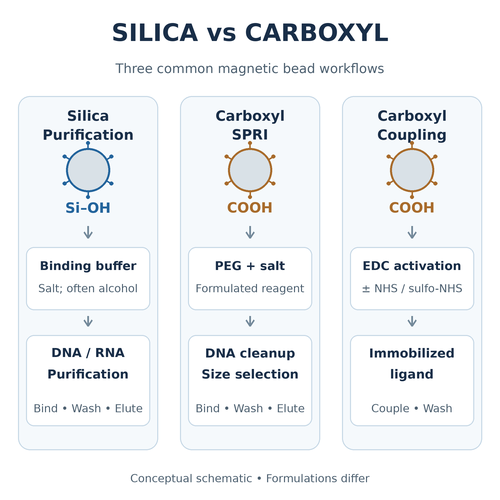
The schematic compares three practical routes: silica-based nucleic acid purification, carboxyl-based SPRI purification, and carboxyl-based biomolecule coupling. The bead drawings indicate surface chemistry only; they do not specify particle size or internal construction. Each route requires its own reagents and validated procedure.
Silica Magnetic Beads: Reversible DNA and RNA Purification
A silica surface presents silanol groups, commonly written as Si–OH. Under suitable binding conditions, DNA or RNA associates with the surface and can subsequently be recovered by changing the solution conditions.
Many silica extraction methods use chaotropic salts and alcohol. These reagents help establish the binding environment, while sample preparation and washing address contaminants. The exact formulation depends on the sample and target.
A common workflow involves sample preparation, nucleic acid binding, magnetic collection, washing and elution. The magnet retains particles while liquids are exchanged. During elution, the nucleic acid returns to solution; a final magnetic separation allows collection of the eluate.
Silica-based methods are widely used for nucleic acid isolation, but the surface does not inherently recognize a particular DNA sequence. Selectivity may come from sample preparation, enzymatic treatment or a specialized procedure. Recovery of short fragments, long DNA or RNA must be established for the selected method.
Carboxyl SPRI Beads: Reversible Nucleic Acid Purification
SPRI stands for solid-phase reversible immobilization. In common SPRI formulations, carboxyl-functional magnetic particles provide the solid phase, while polyethylene glycol, or PEG, and salt create conditions for nucleic acid immobilization.
This process does not require EDC activation of the carboxyl groups. DNA is recovered into solution during elution, which distinguishes purification from covalent probe or protein attachment.
The complete formulation matters. PEG concentration, salt conditions, bead content and the volume of reagent added to the sample influence recovery. A raw carboxyl bead suspension does not contain all the information or reagents needed to reproduce a commercial cleanup method.
SPRI systems are frequently used for PCR cleanup, library purification and DNA size selection. RNA purification also requires an appropriate formulation and protocol. Use the supplier's application data to establish which targets and reaction mixtures the product is designed to process.
Reactive Carboxyl Beads: Covalent Biomolecule Coupling
Reactive carboxyl magnetic beads provide groups that can be chemically activated for ligand attachment. A common approach uses EDC alone or EDC with NHS or sulfo-NHS, followed by reaction with an amine-containing ligand to form an amide linkage.
The ligand may be an antibody, protein, peptide or an oligonucleotide with a suitable amino modification. Activation and coupling conditions should follow a method developed for the bead and ligand.
Buffer selection matters because competing reactive groups can consume the activated sites. For example, primary amine buffers can interfere with an NHS-mediated coupling step. A buffer suitable for DNA elution is therefore not automatically appropriate for conjugation.
The desired product is an affinity particle carrying a functional ligand. Measure both attachment and biological activity. An antibody can be attached successfully while showing insufficient target recognition or excessive nonspecific binding.
Distinguish the immobilized ligand from the target it later captures. A covalently attached antibody normally remains on the bead, while a captured antigen or protein may be released using an appropriate affinity elution method.
Can Silica Magnetic Beads Also Have Carboxyl Groups?
Yes. Silica describes a material or coating, while carboxyl describes a functional group that can be introduced onto a surface. A silica-coated magnetic particle can therefore also be carboxyl-functionalized.
For example, SANYU lists carboxyl magnetic silica beads as silica-coated particles bearing surface carboxyl groups. This naming describes both the bead construction and the functionalized surface.
Such a product should be assessed according to its exposed chemistry and intended application. Its silica-containing structure does not establish that it behaves like an unmodified silica extraction bead. Likewise, the presence of carboxyl groups does not establish SPRI cleanup performance.
Ask for the exact grade, surface description, suspension formulation and application data. These details are more useful than trying to classify every product into two mutually exclusive categories.
When to Use Each Bead Type
DNA or RNA Extraction from Biological Samples
For blood, tissue, cells, swabs or other biological samples, start with a method designed for the sample matrix and target. Silica magnetic bead systems are common candidates because they combine nucleic acid binding with contaminant-removal procedures.
Carboxyl-based SPRI technology also supports complete extraction systems. Beckman Coulter's GenFind V3, for example, uses SPRI technology for genomic DNA isolation from blood and related samples.
The relevant comparison is therefore between complete extraction methods. Evaluate lysis, recovery, inhibitor removal and downstream suitability rather than selecting solely by the surface name.
PCR Cleanup and Library Purification
Validated SPRI reagents are common choices for PCR cleanup and NGS library preparation. They allow recovery to be controlled through the formulated reagent and the specified addition ratio.
Silica-coated magnetic beads can also support PCR cleanup. New England Biolabs' Monarch Mag PCR & DNA Cleanup Kit is one documented example.
For cleanup, check removal of primers, enzymes and other reaction components while preserving the desired product. For size selection, use a method with validated fragment-recovery behavior. A cleanup product and a size-selection product may have different specifications and recommended procedures.
Antibody, Protein or Probe Immobilization
Choose a reactive carboxyl grade when the aim is covalent ligand attachment through a compatible coupling chemistry. Provide the ligand identity, formulation, available quantity and intended assay when requesting technical guidance.
Confirm whether the ligand has a suitable attachment group. For oligonucleotides, a designed amino modification can provide a controlled coupling site.
Evaluate conjugated beads using the intended assay. Useful measurements include ligand loading, target recognition, nonspecific binding, bead dispersion and stability during storage.
Bead-to-Sample Ratios and DNA Size Selection
In SPRI protocols, the stated ratio usually refers to the volume of formulated bead reagent relative to the specified sample volume. It is not simply a ratio of solid particles to DNA mass.
For example, adding 40 µL of reagent to a 50 µL sample gives a reagent-to-sample volume ratio of 0.8×. This arithmetic does not define a universal DNA size cutoff. The fragment profile depends on the product, sample composition and method.
Within a given validated system, changing the reagent ratio changes the effective binding environment. Different conditions can retain or exclude different fragment populations. Use the product's instructions and verify the result with the intended sample.
Double-sided size selection involves more than performing one cleanup twice. A first binding step removes a larger-fragment fraction, with the desired intermediate fragments retained in the supernatant. A second step captures the desired fraction while smaller material remains in solution.
Follow the specified transfers carefully. The fraction containing the target can change between steps, so discarding every supernatant would lose the desired material.
Binding Capacity, Recovery and Ligand Loading
Capacity claims should be compared only when their measurement basis and conditions are clear. DNA adsorption capacity, final extraction recovery and protein coupling capacity describe different outcomes.
For nucleic acid purification, useful data identify the target, fragment range, bead dose, buffer conditions and final elution procedure. A high initial adsorption value does not establish that the same amount will survive washing and be recovered in the eluate.
For conjugation, surface carboxyl content and measured ligand attachment provide information about functionalization. They do not, by themselves, establish antibody activity or assay sensitivity.
Suspension concentration also matters when calculating dose. Equal liquid volumes of two bead stocks may contain different particle masses. Record both the amount of suspension and its stated solids content, while following the formulation-specific procedure.
Select the material that meets the application requirements. There is no reliable universal capacity ranking based only on the labels “silica” and “carboxyl.”
Washing and Elution: What Should Be Recovered?
In silica and SPRI purification, the usual goal is to collect nucleic acid in the final liquid fraction. Washing removes unwanted components while the target is retained under the prescribed conditions.
Follow the product's instructions for wash composition, residual alcohol removal and elution. Excessive residual wash solution can affect downstream reactions, while inappropriate drying or incomplete resuspension can reduce recovery. The required handling varies between formulations.
In carboxyl coupling, washing removes unreacted reagents and unattached ligand. The conjugated bead itself is normally the prepared product.
When those beads are later used for affinity capture, target release is a separate operation. The conditions needed to release an antigen, protein or hybridized nucleic acid depend on the recognition interaction and the downstream application.
Decide which fraction should contain the target at each stage. This is particularly important when moving between purification, size selection and affinity capture workflows.
Magnetic Handling and Automated Workflows
Surface chemistry controls interactions with the sample, while particle construction and the separation setup influence magnetic handling. Two beads with similar functional groups may settle, collect or redisperse differently.
Magnetic clearance depends on the particle, magnet geometry, vessel, liquid volume and sample properties. A capture time measured in a small tube should not be assumed to apply to a deep-well plate or viscous lysate.
For automation, assess suspension mixing, dispensing consistency, magnetic collection, aspiration position and carryover. Test the actual instrument configuration and consumables.
Avoid treating a broad compatibility statement as a finished method. Changes in bead dose or buffer volume can affect mixing, binding and liquid removal. Record the settings needed to produce acceptable results.
For conjugated beads, also examine dispersion after coupling and blocking. The chemistry can produce particles that behave differently from the original stock, so handling should be verified on the final prepared material.
Can Silica and Carboxyl Magnetic Beads Be Substituted?
Substitution should be treated as a method-development question. Matching particle size or having a magnetic response does not establish chemical equivalence.
When replacing a silica purification bead, test the selected surface with the intended binding, washing and elution conditions. When replacing a formulated SPRI reagent, account for both the particles and the reagent composition. Replacing only the bead stock may change the formulation substantially.
For a coupling product, confirm accessible surface groups, activation behavior and ligand performance. Changes in the bead material can affect nonspecific binding and dispersion even if nominal carboxyl content is similar.
Establish acceptance criteria before the comparison. Test representative samples, suitable controls and the intended downstream assay. Repeat promising conditions and examine additional lots when qualifying a supply choice.
A successful result in one workflow supports that tested combination. It should not be extended automatically to different matrices, fragment ranges or ligands.
How to Choose a SANYU Bead Grade
SANYU offers silica magnetic beads and carboxyl magnetic bead products for different development needs. Define the intended chemistry before selecting a grade or requesting customization.
For a technical inquiry, provide:
The purpose: extraction, cleanup, size selection or ligand coupling.
The target: DNA, RNA, an antibody, a protein or a modified probe.
The starting sample or ligand formulation.
The input volume and expected processing scale.
The proposed buffers, magnet or automated instrument.
The required product information and available evaluation method.
For nucleic acid work, request relevant recovery and handling data for the proposed conditions. For coupling, request the surface specification and a suitable starting procedure.
Confirm whether the supplied material is a raw bead suspension, an activated surface or a formulated reagent. Plan sample testing around that supply format. Product specifications support selection, while application testing establishes performance in the intended workflow.
Frequently Asked Questions
What Is the Main Difference Between Silica and Carboxyl Magnetic Beads?
The main difference is the exposed surface chemistry and how it is used. Silica supports reversible nucleic acid adsorption in appropriate buffers. Carboxyl surfaces support reversible purification in SPRI formulations or covalent ligand attachment after activation.
Can General Carboxyl Magnetic Beads Replace a Ready-to-Use SPRI Reagent?
A general bead suspension requires formulation and testing before it can be used as a cleanup reagent. Surface carboxyl groups alone do not establish the required PEG, salt, bead concentration or fragment-recovery behavior.
Can Silica Magnetic Beads Be Used for PCR Cleanup?
Yes, when the bead and buffer system is designed for that application. Silica-coated magnetic bead cleanup kits are available. Follow the selected product's method and assess contaminant removal together with recovery of the desired DNA.
Is DNA Covalently Attached During SPRI Cleanup?
SPRI cleanup uses reversible immobilization. It does not normally activate bead carboxyl groups with EDC. Covalent probe attachment is a separate conjugation procedure using a suitable ligand modification and coupling chemistry.
Does a Particular Bead Ratio Always Give the Same DNA Size Cutoff?
No. A reagent ratio has meaning within a specified product and method. Sample composition and formulation affect the recovered fragment profile. Confirm the result experimentally rather than transferring a cutoff between unrelated products.
Can Both Bead Types Be Used for RNA Purification?
Suitable silica and carboxyl-based systems can purify RNA, but the specific formulation must support the target and sample. Check RNase control, RNA integrity, genomic DNA contamination and recovery of the required RNA size range.
Which Bead Type Has Higher Binding Capacity?
There is no universal answer. Compare capacity under defined conditions and distinguish it from final recovery or functional ligand loading. The appropriate choice is the product that meets the requirements of the intended method.
Conclusion
Silica and carboxyl magnetic beads are useful tools when their surface chemistry is matched to the workflow. Silica-based systems commonly support reversible nucleic acid purification. Carboxyl-based SPRI formulations support reversible cleanup and size selection, while activated carboxyl surfaces enable covalent ligand attachment. Modified silica particles can also carry carboxyl groups, making the exact product description important.
Explore our silica magnetic beads and carboxyl magnetic beads to discuss suitable SANYU candidates. For extraction development, review our guide on how silica magnetic beads work. Share your sample, target, buffer conditions and equipment when you contact our technical team, so that we can discuss a bead grade and an evaluation plan suited to your application.
Related Blogs
-
 Overview of the Fluorescent Microsphere Market Serving RussiaFluorescent microspheres are nano- or microscale spherical particles that contain one or more fluorescent dyes and emit light after excitation at a suitable wavelength.They are used in applications including:Lateral flow immunoassays;Flow
 -
 Overview of the PMMA Microsphere MarketPoly(methyl methacrylate) microspheres, commonly called PMMA microspheres or acrylic microspheres, are spherical polymer particles manufactured from methyl methacrylate-based materials.They are available in forms including:Monodisperse particles;Broad-distribut
 -
 Quick Answer: How to Dehydrate Silica BeadsThe safest general method for dehydrating loose silica gel beads is to spread them in a thin, even layer and heat them in a ventilated electric oven at approximately 105–120°C, or 221–248°F. Begin checking the beads after about two hours and continue drying
 - Magnetic Bead Extraction Troubleshooting: Quick Diagnostic GuideMost magnetic bead nucleic acid extraction failures can be traced to one of seven stages:Sample preparation;Lysis;Nucleic acid binding;Magnetic collection;Washing;Bead drying;Elution and measurement.Do not change several variables at th

